
Key Takeaways
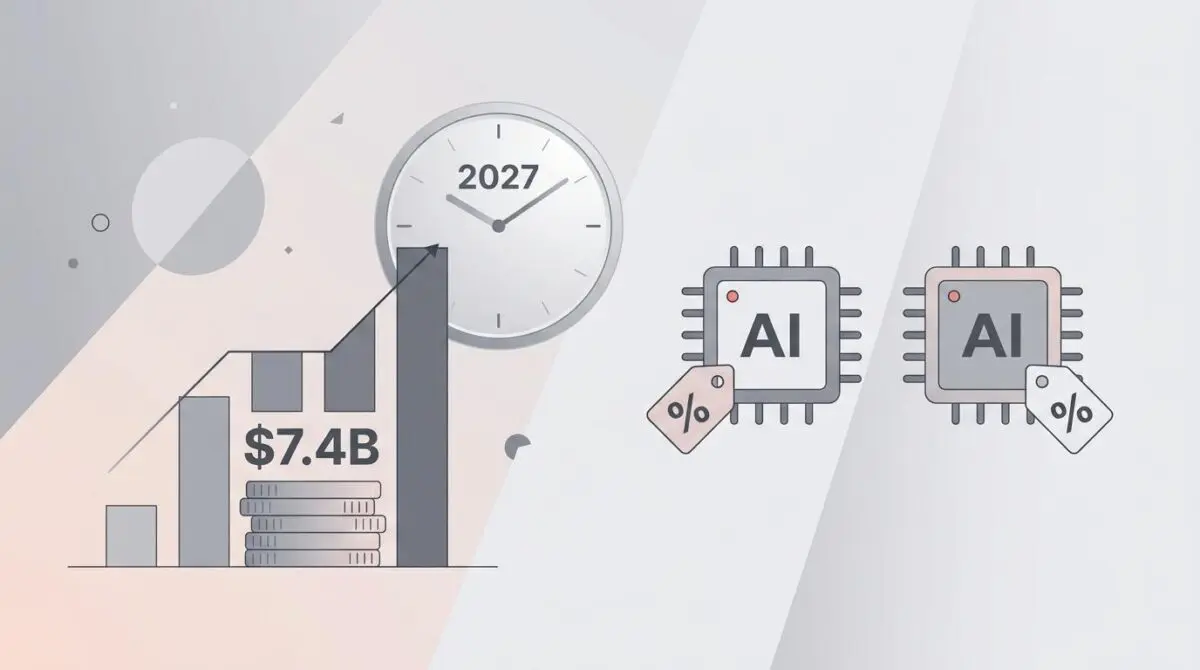
- DeepSeek raised $7.4 billion in the largest private AI financing in Chinese history, valuing the company at over $50 billion.
- The startup plans an IPO in 2027, leveraging its low-cost AI models to challenge US giants like OpenAI and Anthropic.
- Enterprise adoption is surging: Lindy AI and TinyFish report 90-95% cost savings after switching to Chinese open-source models.
DeepSeek’s $7.4B Bombshell: Record Funding and 2027 IPO Shake AI Sector
Chinese AI startup DeepSeek has raised a staggering $7.4 billion in the largest private AI financing in Chinese history, catapulting its valuation above $50 billion. Founder Liang Wenfeng is now setting sights on an initial public offering in 2027, a move that could inject billions more into the company’s aggressive global expansion.
The funding round, disclosed earlier this month, underscores a seismic shift in the AI landscape as DeepSeek’s ultra-low-cost models gain traction with enterprise customers worldwide. With inference costs as low as $0.02 per standardized task compared to $2.75 for Anthropic’s Claude Fable 5, the startup is igniting a price war that threatens to upend the economics of artificial intelligence.
Table of Contents
The V4 Flash Factor: How DeepSeek Is Redefining AI Economics
DeepSeek’s flagship model, V4 Flash, is the weapon of choice in this cost war. Artificial Analysis estimates that completing a standardized intelligence task with V4 Flash costs about $0.02, a fraction of the $2.75 required by Anthropic’s top-tier Claude Fable 5. This 99% cost reduction is not just a headline number; it’s a practical reality for enterprises.
Companies like Lindy AI, based in San Francisco, have already made the switch. After a six-week evaluation, Lindy moved from Anthropic’s Claude Sonnet to DeepSeek and now pays roughly 10% of its previous inference costs, saving millions of dollars annually. Similarly, Palo Alto startup TinyFish reduced its inference expenses by 90% after adopting Chinese open-weight models.
DeepSeek’s open-source strategy is crucial. By releasing models publicly, it has sparked a wave of adoption on platforms like OpenRouter, where Chinese open-source providers now account for over 30% of activity, up from less than 2% in 2024. Major Western firms including Airbnb, Pinterest, and even Microsoft — a key OpenAI partner — are evaluating or actively using DeepSeek models for their cost benefits.
The investor lineup ties DeepSeek into China’s broader tech ecosystem. Tencent, JD.com, China’s National AI Industry Investment Fund, battery giant CATL, and chipmaker Huawei all participated, linking DeepSeek to energy, semiconductor, and cloud infrastructure. China added 543 gigawatts of generating capacity in 2025, ensuring ample power for the data centers that will run these AI models.
Strategic Analysis: The AI Pricing Collapse Is Here
The data from real-time research confirms that DeepSeek’s pricing is not an outlier but a harbinger of a broader industry trend. According to a CNBC report from July 2026, recent model releases from Chinese companies including DeepSeek and Z.ai are seen as highly competitive compared to leading U.S. frontier systems. A comprehensive analysis on Milkroad notes that in 2026, the question is who can deliver useful tokens cheaply, at scale, and on infrastructure they actually control. ‘Intelligence just got cheap,’ the report states, and DeepSeek’s V4 model is leading the charge.
A pricing comparison from Tech-Insider in June 2026 shows DeepSeek undercuts OpenAI’s input tiers by over 91%, with API rates of $0.43 per million tokens versus ChatGPT’s $2 and Gemini’s $5. This asymmetry is forcing established players to rethink their strategies. OpenAI and Anthropic, long reliant on proprietary high-margin models, now face a commoditization of intelligence that could erode their valuation and market share.
The implications for the business sector are profound. As enterprise cost pressures mount, the appeal of cheap, open-source models becomes irresistible. The shift is not just about price; it’s about control. Companies can run Chinese models on their own infrastructure, reducing dependency on expensive cloud AI APIs. This trend may accelerate global adoption of Chinese AI, as noted by the CNBC source, and increase competitive pressure on Western providers.
For investors, the signals are clear. The Reddit discussions questioning Anthropic’s valuation moat are grounded in reality. With DeepSeek planning a 2027 IPO and raising $7.4B, the startup has the resources to sustain a prolonged price war. The Chinese government’s support through the National AI Industry Investment Fund further solidifies its staying power.
Conclusion: The New AI Order Is Cost-Driven
The era of expensive proprietary AI is waning. DeepSeek’s $7.4 billion haul is not just a funding round; it is a declaration that cost leadership will dictate the next phase of the AI revolution. As the 2027 IPO approaches, the company is positioned to challenge the incumbents on pricing and scale.
For businesses, the message is clear: adopting cheap, open-source AI models is no longer a risk but a strategic imperative. The market dynamics have shifted, and those who fail to adapt will be left paying a premium for intelligence that is increasingly commoditized.
Staying ahead in the rapidly shifting landscape of Business requires precision. To future-proof your digital strategy and scale effortlessly, you need a foundation built on precision. Optimize your site with advanced speed engineering, secure your infrastructure in high-performance hosting environments, and streamline your entire workflow through autonomous AI pipelines. If you are ready to elevate your systems, Connect with Andres at Andres SEO Expert to build your ultimate architecture.
Frequently Asked Questions
What makes DeepSeek’s $7.4 billion funding round so significant?
The funding is the largest private AI financing in Chinese history, catapulting DeepSeek’s valuation above $50 billion. It signals a major shift in AI investment toward cost-efficient models and supports the company’s aggressive global expansion and planned 2027 IPO.
How does DeepSeek achieve such low inference costs compared to competitors like Anthropic?
DeepSeek’s flagship model V4 Flash costs about $0.02 per standardized task versus $2.75 for Anthropic’s Claude Fable 5—a 99% reduction. This is due to optimized architecture, open-source distribution, and efficient infrastructure backed by China’s massive energy grid (543 GW added in 2025).
Which companies are already using DeepSeek models?
Enterprise adopters include Lindy AI (saved 90% of inference costs), TinyFish (reduced expenses by 90%), and major Western firms like Airbnb, Pinterest, and even Microsoft, which is also an OpenAI partner. Chinese open-source providers now account for over 30% of activity on OpenRouter.
How does DeepSeek’s API pricing compare to OpenAI and Google Gemini?
DeepSeek undercuts OpenAI’s input tiers by over 91%, with API rates of $0.43 per million tokens versus ChatGPT’s $2 and Gemini’s $5. This drastic price difference is forcing established players to reconsider their pricing models.
What is DeepSeek’s open-source strategy and why does it matter?
DeepSeek releases its models publicly, allowing enterprises to run them on their own infrastructure. This reduces dependency on expensive cloud APIs and has spurred rapid adoption, with Chinese open-source models growing from under 2% to over 30% of OpenRouter activity in 2025.
Who are the key investors in DeepSeek, and what does that imply?
Investors include Tencent, JD.com, China’s National AI Industry Investment Fund, battery giant CATL, and chipmaker Huawei. This ties DeepSeek to China’s broader tech and energy infrastructure, ensuring access to capital, semiconductors, and power for scaling.
What does DeepSeek’s planned 2027 IPO mean for the AI industry?
The IPO could inject billions more into the company, enabling it to sustain a prolonged price war against Western incumbents. It signals that cost leadership, not proprietary models, will define the next phase of AI competition, forcing rivals to adapt or lose market share.