




Key Takeaways
- 81% of marketers still use ‘SEO’ internally for AI search visibility; only 19% have adopted ‘GEO’.
- 71% of decision-makers rank case studies, methodology, or team track record as top credibility signals; buzzwords are the #1 red flag at 36%.
- Marketers now allocate an average of 24% of search/content budgets to AI visibility, and 66% use AI tools to research vendors.
Marketers Stick With ‘SEO’ as GEO Fails to Catch On, Fractl Data Shows
A new survey from growth marketing agency Fractl reveals a stark disconnect between the language agencies use to sell generative search services and the terminology marketers actually type. Based on responses from 343 US marketing decision-makers responsible for AI visibility, the study finds that 81% still say ‘SEO’ internally when discussing AI search strategy, while just 19% have adopted ‘GEO.’ The research warns that heavy buzzword use ranks as the single biggest reason buyers dismiss a vendor — cited by 36% of respondents — and that case studies with measurable results are valued nearly four times more than acronym fluency as a credibility signal.
Table of Contents
The Vocabulary Disconnect: ‘SEO’ Still Dominates Internal Language
Fractl’s survey measured how marketers refer to AI search visibility in daily work. The headline finding: 81% use ‘SEO’ when discussing strategy with their teams. Only 19% have adopted ‘GEO,’ 15% use ‘LLM optimization,’ and 10% use ‘AEO.’ A middle-ground term, ‘AI search optimization,’ is used by 48% internally and is the phrase most searched when looking for an agency or tool.
The adoption gap is not uniform. C-suite marketers use ‘GEO’ (28%) and ‘AEO’ (17%) at roughly three times the rate of individual contributors (9% and 3%). SEO specialists lead in ‘GEO’ adoption at 29%, while B2C and e-commerce marketers default to plain ‘SEO’ when searching at 33%.
Half of all marketers have looked up an unfamiliar term after seeing it in a colleague’s or competitor’s content, indicating widespread confusion. Only 27% of teams have officially adopted new terminology beyond ‘SEO’ for AI-related work, while 42% have explicitly declined and 31% are still debating.
What Buyers Reward vs. What Vendors Pitch
Fractl’s survey reveals a clear hierarchy of credibility signals. When evaluating an AI search agency or tool, 34% of decision-makers rank case studies with measurable results as the most important factor, followed by clear methodology (22%) and team expertise (15%). Terminology fluency is the top signal for only 9% of respondents.
Conversely, the biggest red flag is heavy buzzword use without clear explanation, cited by 36% of buyers. This jumps to 33% among C-suite leaders, who are also most wary of ‘repackaged SEO with AI branding’ — a concern that more than doubles the rate among junior staff.
The message is clear: senior buyers prioritize proven outcomes over vocabulary. An agency leading with acronyms is pitching to the 3% of C-suite decision-makers who care about terminology fluency.
Budget Shifts Toward AI Visibility
Despite the language lag, budgets are moving. Marketers now route an average of 24% of search or content budgets to AI visibility. A large majority (82%) have allocated at least some budget, with 43% spending more than 20%. Financial services leads in commitment at 39% of spend, nearly double that of B2C and e-commerce (19%).
The traffic impact is mixed. 29% of marketers report moderate or significant traffic gains from AI search features over the past year, while 19% report declines — a ratio of roughly 3:2 favoring gains. Large organizations (5,000+ employees) report the highest decline rate at 26%.
The single biggest operational challenge is keeping pace with landscape evolution (28%), well ahead of measurement (17%) and platform prioritization (15%).
Which Platforms Marketers Chase
When asked which AI platform they prioritize for visibility, ChatGPT Search leads at 34%, followed by Google AI Overviews (23%) and Gemini (16%). Perplexity, despite industry buzz, garners only 1% priority.
However, platform share is volatile. Similarweb data cited by PPC Land shows ChatGPT’s share of generative AI traffic fell from 76.4% to 52.7% over the past year as Gemini and Claude gained. Citation sets change roughly 50% monthly with only 11% overlap between platforms, adding complexity to optimization efforts.
Deeper Implications for the GEO Market
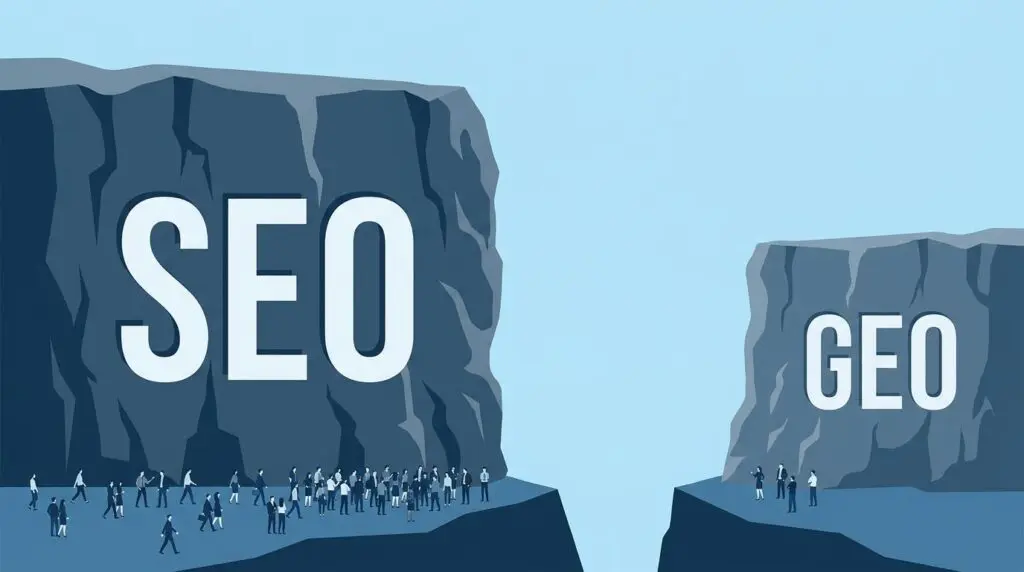
Fractl’s findings align with and are amplified by recent independent research. A survey by Goodfirms of over 100 SEO and marketing professionals found that 43% are actively implementing GEO strategies in 2026, up from near zero in 2025, yet only 14% track AI/LLM citation visibility. This gap between action and measurement echoes Fractl’s vocabulary divide.
According to a SparkToro analysis of Similarweb data, 68% of US Google searches in early 2026 ended without a click to the open web, up from 60% in 2024. Meanwhile, Pew Research found that when an AI summary appears, users click a traditional result on just 8% of searches, versus 15% without a summary. Seer Interactive tracked a 61% drop in organic click-through rates when AI Overviews are present — from 1.76% to 0.61%. These numbers underscore why marketers are prioritizing AI visibility even as they struggle with terminology.
The evidence base beneath newer terms like GEO remains contested. A critical survey of 45 studies found that body-only content rewrites can lower a page’s presence in the top ten by 16%, a finding that undercuts vendor promises of citation gains. The study’s authors warn that commercial promises have outrun the data. Yet budgets keep flowing: Gartner predicts 25% of organic search traffic will shift to AI-driven experiences by 2026, a forecast already in motion.
Adobe’s research covering more than 500 marketers found that 98% lack a confident, documented AI search roadmap. Into that uncertainty, agencies are selling acronyms — and Fractl’s data shows this is a misaligned strategy. The agencies best positioned to win are those that explain work clearly, prove results, and skip the rebrand while competitors argue over labels.
Conclusion and Strategic Outlook
Fractl’s survey delivers a reality check for an industry racing to rebrand itself for the AI era. The data shows that while budgets are indeed shifting toward generative search visibility, the loudest voices on LinkedIn are not the ones winning RFPs. Buyers are voting for clarity and proof over jargon. For agencies and marketers alike, the path forward lies not in adopting the latest acronym but in demonstrating measurable impact through case studies and transparent methodology. The fundamentals of search — clear writing, authoritative content, and technical rigor — remain the foundation, regardless of what the industry calls it.
As the search landscape evolves at breakneck speed, aligning your strategy with proven methods is more critical than ever. Whether you need to optimize your site’s technical foundation or build programmatic workflows for AI visibility, the right expertise can make the difference. Explore how Andres SEO Expert’s AI automation and programmatic SEO services can help you navigate these changes. Connect with Andres today to discuss your specific needs, and learn more about Andres SEO Expert‘s approach to future-proof digital strategies.
Frequently Asked Questions
What is the difference between SEO and GEO?
SEO (Search Engine Optimization) traditionally focuses on optimizing content for search engines like Google to improve organic rankings. GEO (Generative Engine Optimization) is a newer term referring to optimizing content specifically for AI-driven search experiences like ChatGPT Search and Google AI Overviews. However, the Fractl survey found that 81% of marketers still use ‘SEO’ internally when discussing AI search strategy, while only 19% use ‘GEO’. Despite the terminology shift, most professionals continue to default to the familiar term.
Why are marketers still using ‘SEO’ instead of ‘GEO’ for AI search?
The Fractl survey shows that the industry hasn’t widely adopted new acronyms like GEO. Only 27% of teams have officially adopted newer terminology, while 42% have explicitly declined. Heavy buzzword use is the top reason buyers dismiss a vendor (36%), indicating that marketers prioritize clear communication over trendy labels. Additionally, the fundamentals of search—authoritative content, technical rigor, and measurable results—remain consistent regardless of terminology.
What credibility signals matter most when evaluating an AI search agency?
According to the Fractl survey, the most important credibility signal is case studies with measurable results (34%), followed by clear methodology (22%) and team expertise (15%). Terminology fluency is the top signal for only 9% of respondents. The biggest red flag is heavy buzzword use without clear explanation (36%). Buyers overwhelmingly value proven outcomes and transparent methodologies over jargon.
How much budget are marketers allocating to AI visibility?
The survey found that marketers now allocate an average of 24% of their search or content budgets to AI visibility. 82% have allocated at least some budget, with 43% spending more than 20%. Financial services leads with 39% of spend allocated to AI visibility, nearly double that of B2C and e-commerce (19%). Despite terminology debates, budgets are shifting toward generative search.
Which AI platforms are marketers prioritizing for visibility?
ChatGPT Search is the top priority at 34%, followed by Google AI Overviews (23%) and Gemini (16%). Perplexity, despite industry buzz, garners only 1% priority. However, platform share is volatile; ChatGPT’s share of generative AI traffic fell from 76.4% to 52.7% over the past year as Gemini and Claude gained. Citation sets change roughly 50% monthly, adding complexity to optimization efforts.
What are the main challenges in optimizing for AI search?
The single biggest operational challenge is keeping pace with landscape evolution (28%), well ahead of measurement (17%) and platform prioritization (15%). Additionally, only 14% of marketers track AI/LLM citation visibility, despite 43% actively implementing GEO strategies in 2026. The evidence base is still contested, with some studies showing that content rewrites can lower presence in top results by 16%. Marketers struggle with rapid changes and lack of standardized metrics.
How is the search landscape changing with AI summaries?
Data from SparkToro and Similarweb shows that 68% of US Google searches in early 2026 ended without a click to the open web, up from 60% in 2024. When an AI summary appears, users click a traditional result on just 8% of searches, versus 15% without a summary. Seer Interactive tracked a 61% drop in organic click-through rates when AI Overviews are present. Gartner predicts that 25% of organic search traffic will shift to AI-driven experiences by 2026.