


Key Takeaways
- Cloudflare’s Agent Readiness scans your site like an agent, flagging robots.txt, sitemaps, markdown, and APIs.
- New AEO metrics — citation rate, prominence, mention rate, and share of voice — replace rankings for AI visibility.
- Winning sites are machine-readable, fresh, and cited by third parties — built for bots, not just browsers.
Table of Contents
Your Next Customer Already Talks to an Agent, Not a Search Bar
Cloudflare has launched Agent Readiness and Answer Engine Optimization tools, giving site owners their first operational dashboard for the agentic web.
The move crystallizes a shift that has been building for months: fewer than half of all HTML page requests now originate from a human, and AI agents — shopping assistants, research bots, answer engines — are deciding which businesses get found.
Where discoverability once meant climbing a search results page, it now means being the source a model confidently cites before a person ever sees a homepage.
Two questions dominate the logs of AI-crawled sites: can agents actually use my site, and am I getting recommended?
Cloudflare’s integrated tools answer both, treating machines as a core audience and replacing guesswork with measurable signals.
Cloudflare’s Dual Tool: Diagnostics for Agent Readiness and AEO for AI Visibility
Agent Readiness is a structured technical checkup that scans a site exactly the way an agent would.
It validates whether crawlers are allowed in, whether content can be discovered, whether a clean machine-readable copy is served, and whether programmable interfaces like APIs and agent cards are exposed.
Instead of inferring health from human-behavior metrics, the tool reads robots.txt, sitemaps, response headers, markdown versions, and authentication metadata — the signals that matter to a non-human visitor.
Results roll into a single readiness view, from ‘Not Ready’ to fully agent-native, with every check tagged as pass, fail, or neutral.
Cloudflare groups the checks by effort, starting with quick wins most sites are missing: a crawler-readable robots.txt, an XML sitemap, AI-crawler rules, and markdown serving.
Technical groundwork layers in content-signal headers, an API catalog, link headers, and agent login instructions.
Advanced integration then scores OAuth discovery, MCP and A2A agent cards, a skills index, Web Bot Auth, and WebMCP.
An informational commerce panel tracks emerging agent-payment standards such as x402, ACP, UCP, and AP2.
Each improvement ships with a direct ‘Set up in Cloudflare’ link or a copyable agent prompt builders can hand to a coding assistant.
The second half of the dashboard — Answer Engine Optimization, or AEO — tackles the question that keeps site owners awake after hours: when a customer asks an AI assistant a question in your category, are you the name that comes back?
Because AI models rarely answer the same question the same way twice, Cloudflare built a benchmark panel per industry and category, probing Anthropic’s Claude and OpenAI’s GPT with realistic prompt patterns at scale.
It captures citations, prominence, brand mention rate, and share of voice against competitors, then exposes four new metrics directly inside the dashboard.
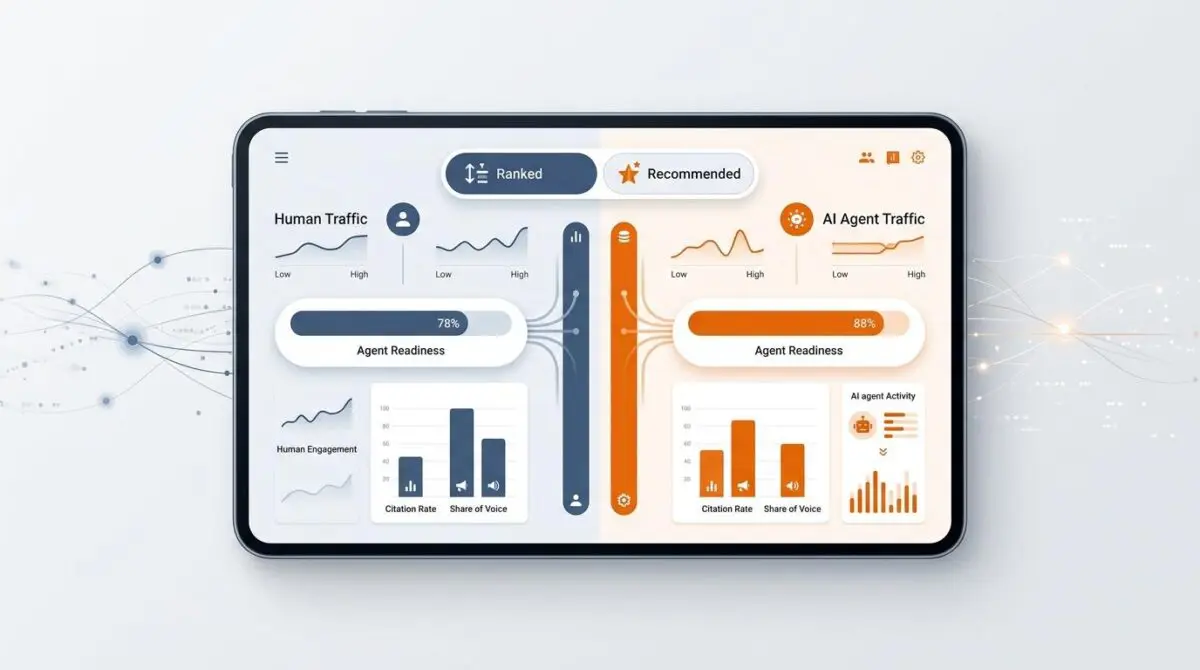
Citation Rate shows the share of answers in your category that cite your domain as a source.
Prominence reveals how early your content appears and how much of the final answer’s substance traces back to you.
Mention Rate decouples brand awareness from attribution — a gap where assistants name you far more than they cite you.
Share of Voice maps your slice of citations against competitors, making it blindingly obvious who is winning the prompts you are losing.
‘The sites built for agents will be rewarded now. The ones that are easy to find, read, and trust are the ones agents will recommend.’
An AI Operator Activity panel overlays crawl and referral traffic per operator, exposing bots that consume thousands of pages without sending a single visitor back.
The tool does not re-query models per scan; it uses a pre-computed category baseline for zero latency, then runs Workers AI on Cloudflare’s own infrastructure to score replies with exact text analysis rather than model-graded output.
From Ranking to Recommendation: The Metric Overhaul That Changes Everything
Cloudflare’s AEO tool lands at a moment when the entire GEO industry is being forced to rewrite its measurement playbook.
Content Science Review defines Answer Engine Optimization as structuring content so AI-driven systems can extract, summarize, and deliver it directly in response to user questions — a discipline that prizes citation over click-through.
Traditional SEO tracks rankings, traffic, and backlinks; AEO and its broader cousin Generative Engine Optimization measure citation rate, feature snippet visibility, voice search inclusion, and zero-click presence.
‘The practice of structuring and optimizing content so that AI-driven systems can extract, summarize, and deliver it directly in response to user questions.’
That distinction is no longer theoretical.
Gartner’s prediction that traditional search engine volume would drop 25% by 2026 has materialized.
Seer Interactive’s study found organic CTR for AI Overview queries fell 61% — from 1.76% to 0.61% — and Ahrefs data showed top-ranking pages on AI Overview keywords saw a 58% CTR collapse.
When an answer box delivers a recommendation without a click, the old metric of ‘ranking’ becomes a vanity number.
Inside this vacuum, third-party authority is swallowing brand-owned presence.
Research indicates that roughly 85% of brand appearances in AI search originate from third-party pages, not brand-owned sites.
Earned media, analyst reports, community forums, and platform-native content like YouTube and Reddit are shaping model belief long before a company’s own domain gets cited.
That dynamic surfaces a hard truth: being machine-readable is necessary but not sufficient.
Content Science Review notes that strong topical authority, updated and credible information, and citations from trusted third-party sources are among the factors that appear to influence answer visibility — even though the exact criteria answer engines use remain undisclosed.
Formatting decisions now carry outsized weight in a model’s selection logic.
A Princeton study found that adding statistics to content boosts AI visibility by up to 40%, while citations and quotations lift it by up to 41%.
FAQ sections have an 81% citation probability; lists, tables, and step-by-step guides see 2.5× higher citation odds than paragraph-only content.
Kevin Indig’s 2026 State of AI Search report shows pages not updated quarterly are 3× more likely to lose AI citations entirely, while content refreshed within 30 days receives 3.2× more citations.
Freshness is composable: Perplexity’s recency bias means content older than 90 days enters a decay window for fast-moving queries.
Not all technical maneuvers pay off the way they used to.
As of May 2026, Google explicitly states structured data is not required for AI Overviews or AI Mode, and FAQ rich results were deprecated.
A separate study found adding JSON-LD schema did not measurably increase AI citations.
Cloudflare’s tool doesn’t hang its hat on legacy schema markup; instead, it targets the surface area that agents actually consume — markdown delivery, API discoverability, agent authentication cards, and commerce protocols — a stack that maps more cleanly to an agent-native web than to traditional SEO instrumentation.
The fracturing of the recommendation surface means no single score covers all channels.
Only 11% of domains are cited by both ChatGPT and Perplexity.
Even inside Google’s own ecosystem, AI Overviews and AI Mode share just 13.7% of cited URLs.
A practical measurement framework must therefore track share of model across multiple engines, not chase one universal rank.
Cloudflare’s category-panel approach essentially productizes this fragmentation into a dashboard that normalizes variance without requiring every publisher to build their own multi‑model evaluation stack.
The Sites That Win Are Built for Bots, Not Just Browsers
As detailed in Cloudflare’s recent announcement, this is not just a product release; it’s a signal that the agentic audience has moved from experimentation to infrastructure.
Site owners who once guessed at robot behavior by grepping logs or eyeballing chatbot mentions now have a measurement loop: scan readiness, close gaps, re-scan, and watch AEO metrics move.
The tools fuse diagnostics with visibility scoring on the same dashboard, collapsing what used to require a patchwork of log analyzers, SEO crawlers, and manual model prompts into a single pane.
As agent traffic becomes the dominant consumer of web content, the businesses that engineer for machine comprehension — fast, structured, trustworthy, and fresh — will inherit the recommendation pipeline that used to belong to the ten blue links.
For teams ready to translate agent-readiness into real recommendation growth, building the technical scaffolding is only the starting point. Andres SEO Expert’s programmatic SEO and AI automation services help organizations architect content pipelines that models trust, cite, and surface — before a competitor’s brand becomes the default answer. Reach out to Andres to discuss a custom roadmap, or explore the vision behind Andres SEO Expert and the technical foundation that powers AI-driven content engineering. Connect with Andres here.
Frequently Asked Questions
What are Cloudflare’s Agent Readiness and Answer Engine Optimization tools?
Cloudflare’s Agent Readiness is a diagnostic tool that scans a website the way an AI agent would, checking robots.txt, sitemaps, markdown delivery, APIs, and agent authentication metadata. Answer Engine Optimization (AEO) is a benchmark panel that measures how often your brand is cited or mentioned in AI answers from models like Claude and GPT, across categories and competitors.
How does Cloudflare measure AI visibility with AEO metrics like Citation Rate and Share of Voice?
Cloudflare’s AEO tool tracks four key metrics: Citation Rate (share of AI answers citing your domain), Prominence (how early and substantively your content appears in an answer), Mention Rate (brand mentions even without citations), and Share of Voice (your citation share against competitors). It uses pre-computed category baselines and Workers AI for exact text analysis rather than model-graded output.
Why is third-party authority so important for AI search recommendations?
Research indicates that roughly 85% of brand appearances in AI search originate from third-party pages, not brand-owned sites. Earned media, analyst reports, community forums, and platform-native content shape model belief before a company’s own domain gets cited, making third-party authority a critical factor in answer visibility.
What content formats increase the likelihood of being cited by AI answers?
Studies show that FAQ sections have an 81% citation probability, while lists, tables, and step-by-step guides see 2.5× higher citation odds than paragraph-only content. Adding statistics boosts AI visibility by up to 40%, and citations/quotes lift it by up to 41%. Freshness also matters: content updated within 30 days receives 3.2× more citations.
Does structured data or schema markup help with AI citations?
No. As of May 2026, Google states that structured data is not required for AI Overviews or AI Mode, and FAQ rich results were deprecated. A separate study found that adding JSON-LD schema did not measurably increase AI citations. Cloudflare’s tool instead targets agent-consumed surfaces like markdown delivery, API discoverability, and agent authentication cards.
How can site owners improve their Agent Readiness according to Cloudflare?
Cloudflare groups readiness checks by effort: quick wins include a crawler-readable robots.txt, XML sitemap, AI-crawler rules, and markdown serving. Technical groundwork adds content-signal headers, API catalogs, and link headers. Advanced integration involves OAuth discovery, MCP/A2A agent cards, skills index, Web Bot Auth, and WebMCP. Each improvement includes a ‘Set up in Cloudflare’ link or a copyable agent prompt.
How much do AI Overviews reduce organic click-through rates?
Seer Interactive’s study found organic CTR for AI Overview queries fell 61% — from 1.76% to 0.61% — and Ahrefs data showed top-ranking pages on AI Overview keywords saw a 58% CTR collapse. This shift underscores why traditional ranking metrics are becoming less meaningful.