Key Takeaways
- Cloudflare collapses Workers AI and AI Gateway into one AI control plane, removing the need to choose between inference access and traffic observability.
- Default gateway auto-creates logging, token tracking, and cost attribution on the first request — no dashboard setup required.
- AI Gateway credits now apply to Workers AI usage, with elevated rate limits and model-first routing on the horizon.
Table of Contents
Two Products, One Binding, Zero Friction
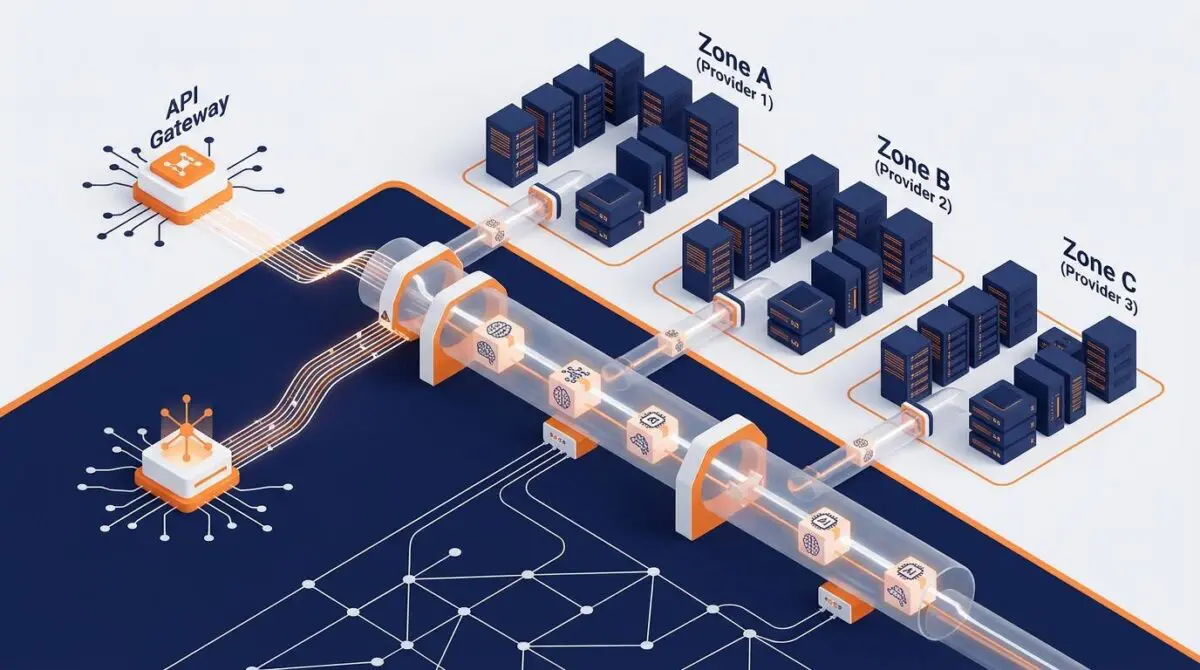
Cloudflare is collapsing Workers AI and AI Gateway into a single unified AI control plane — a move that eliminates the architectural choice developers have been forced to make between inference access and traffic observability.
The announcement, published on the Cloudflare blog on August 7, 2026, outlines a convergence roadmap where every model call, whether routed to Workers AI’s managed GPU infrastructure or to an external provider like OpenAI or Anthropic, flows through one binding, one REST API, and one billing system.
The practical implication is immediate: developers no longer face a fork in the road before writing their first inference call.
Observability Arrives by Default, Not by Configuration
As announced on the Cloudflare blog, the most operationally significant detail in this unification is automatic observability delivered through a concept Cloudflare calls the ‘default’ gateway.
Pass gateway: { id: 'default' } as a third argument to the existing AI binding, and on the very first authenticated request, the system auto-creates a gateway instance with full logging, token tracking, and cost attribution — no dashboard setup required.
Every request payload, every response, every latency breakdown, and every token count becomes visible without manual instrumentation.
For teams that have been debugging model behavior blind or retrofitting logging after the fact, this changes the operational baseline entirely.
If a project later outgrows the default gateway — requiring custom caching rules or per-application traffic segmentation — a named gateway replaces it with a single parameter swap.
The REST API mirrors this pattern through the /ai/ endpoint, where a cf-aig-gateway-id header toggles routing identically.
Unified Credits and Elevated Rate Limits
Another structural shift arrives through billing: AI Gateway credits now apply to Workers AI consumption.
Previously, credits loaded into the AI Gateway wallet could only cover external model providers.
Workers AI usage sat in a separate billing silo, forcing teams to manage two spending tracks for what was functionally a single inference workflow.
Now a single pre-paid wallet spans OpenAI, Anthropic, Workers AI, and every other supported provider.
Cloudflare is incentivizing adoption of this unified path with elevated rate limits on Workers AI models for teams that bill through the consolidated system — a detail worth checking against the developer docs for current thresholds.
Model-First Routing Redraws the Inference Map
The most ambitious piece of the announcement is still in the pipeline: model-first routing that inverts how applications select inference providers.
Model-first routing flips that. You think about what you need — a capable reasoning model, a fast summarizer, a cheap embedding model — and the control plane handles provider selection, failover, and load balancing.
Today, a developer calling Kimi K2.7 Code must know which provider hosts it and handle failures at the application layer if that provider is down or rate-limiting.
Under model-first routing, the request specifies only the model — the gateway resolves which provider serves it, transparently failing over to an alternative host running the same weights if the primary is unavailable.
Cloudflare’s architecture treats model availability as a routing problem, not an application-level retry problem.
Vetted providers and Zero Data Retention requirements remain part of the quality envelope, so failover does not mean degraded trust boundaries.
This pilot is expected to roll out across AI Gateway and Workers AI users in the coming months.
Smart Routing and the Zero-Config Future
Beyond deterministic model-first routing lies what Cloudflare calls smart routing — a layer where the gateway itself reads the prompt, classifies the task type and complexity, and selects the optimal model from a curated pool without the developer specifying anything.
A classifier running on Workers AI predicts whether the request involves coding, research, summarization, or general Q&A.
A heuristic scorer then maps that prediction to the best model for the economics and performance profile required.
Internally piloted and entering active testing in the coming weeks, this zero-configuration path represents a genuine departure from the provider-management overhead that has defined enterprise AI integration for the past three years.
For teams that want control, explicit model selection remains available — but the default trajectory is clear: infrastructure fades into the background, and the model becomes the only variable that matters.
For engineering teams building inference pipelines that need to scale across multiple providers without embedding provider logic into application code, Andres SEO Expert’s approach to programmatic SEO and AI automation tackles the same class of routing and optimization challenges — reach out here to explore how.
Frequently Asked Questions
What is the Cloudflare Workers AI and AI Gateway unification?
Cloudflare is unifying Workers AI and AI Gateway into a single AI control plane. Developers can access inference and observability through one binding, one REST API, and one billing system, eliminating the need to choose between managed GPU inference and traffic observability.
How does the default gateway provide observability in Cloudflare AI?
Passing gateway: { id: 'default' } as a third argument to the AI binding auto-creates a gateway instance on the first authenticated request. It enables full logging, token tracking, and cost attribution without manual setup. You can later swap to a named gateway for custom caching or segmentation.
What are unified credits in Cloudflare’s AI Gateway and Workers AI?
Unified credits allow a single pre-paid wallet to cover both Workers AI and external providers like OpenAI and Anthropic, instead of maintaining separate billing silos. Teams using this consolidated system also receive elevated rate limits on Workers AI models.
What is model-first routing in Cloudflare AI Gateway?
Model-first routing lets developers specify only the model name while the gateway resolves which provider serves it, handles failover, and performs load balancing. If a provider is unavailable, the system transparently falls back to another host running the same weights, maintaining vetted providers and Zero Data Retention requirements.
How does Cloudflare smart routing work?
Smart routing uses a classifier running on Workers AI to predict task type (coding, research, summarization, Q&A) and a heuristic scorer to select the optimal model from a curated pool. It requires zero configuration, though explicit model selection remains available.
Do I need to set up logging manually with Cloudflare AI Gateway?
No. With the default gateway, observability arrives automatically on your first authenticated request. Full logging, token counts, latency breakdowns, and cost attribution are captured without manual instrumentation.