Key Takeaways
- Ai2’s TutorMoments replays real tutoring transcripts to score AI tutors on scaffolding vs. rigor decisions.
- Every tested LLM defaulted to over-helping; even evaluation-aware prompts fell short of human judgment.
- The benchmark measures tutor behavior, not learning outcomes, spotlighting the transfer gap to independent performance.
Table of Contents
Ai2 Exposes the Over-Helping Habit of AI Tutors
The Allen Institute for AI (Ai2) today dropped a stark reality check on the AI tutoring boom. Its new evaluation framework, TutorMoments, reveals that the largest language models consistently over-help students, jumping in with support when the better pedagogical move would be to hold back and let the learner struggle productively.
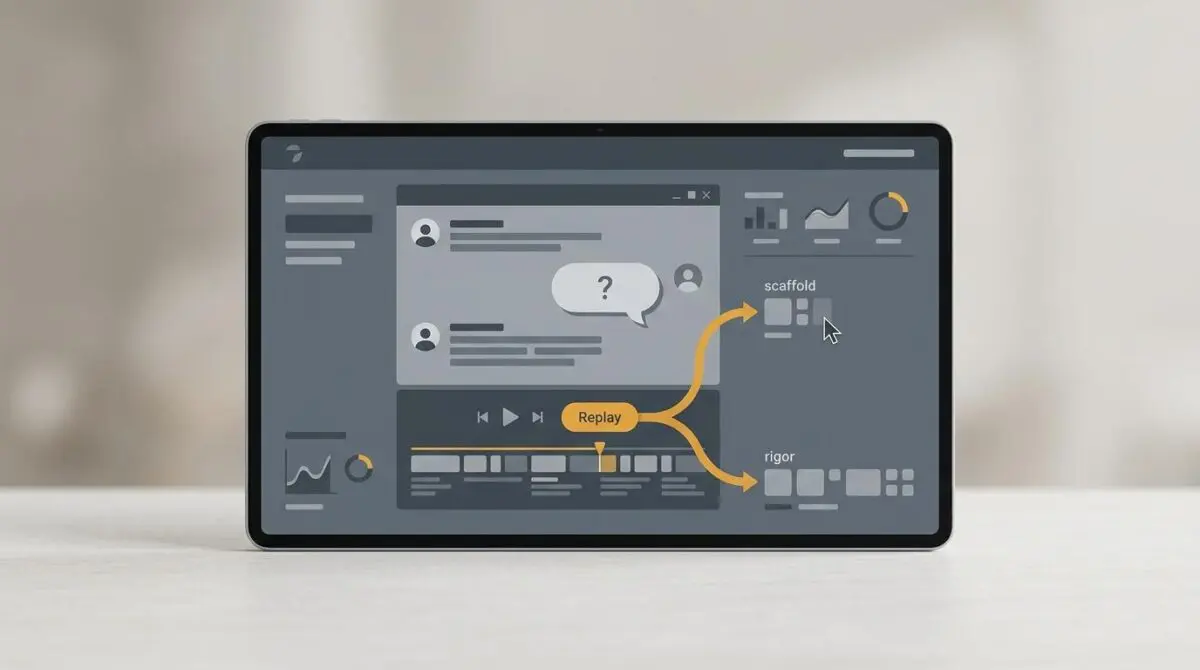
Built from real one-on-one math tutoring transcripts and annotated by experienced teachers, TutorMoments replays critical decision points through a simulated student-tutor exchange. When simply told to “tutor well,” every model Ai2 tested defaulted to excessive scaffolding—undermining the kind of intellectual effort that research has long tied to durable learning.
Prompting models to explicitly balance help against rigor improved scores across the board. But according to the Hugging Face blog post that detailed the release, even the best-performing models under an evaluation-aware prompt still fell short of the nuanced judgment human tutors apply in the moment.
Inside TutorMoments: A Replay-Based Gauntlet for Pedagogical Judgment
According to a Hugging Face blog post detailing the release, TutorMoments starts with 462 de-identified transcripts from a U.S. tutoring program serving grades 2-7, heavily weighted toward Title I schools. Twenty-seven math teachers combed the sessions and flagged over 1,500 moments where a tutor faced a fork: scaffold the problem to make it accessible, or push the student toward harder thinking.
The framework then pauses a transcript right at that fork, hands the conversation history to a language model, and has it take over as the tutor for five turns. A second model simulates the student. The resulting replay is scored by an automated pipeline that checks whether the model’s action—scaffolding, pushing for rigor, or over-scaffolding—matches what the teacher annotators deemed appropriate for that moment.
Ground truth is built from majority teacher labels, with a separate classifier validated against those human annotations. The scoring isn’t a measure of whether a student learned; it’s a behavioral gauge of whether the AI tutor made the right call at the decision point.
In Ai2’s preliminary runs, seven LLMs were tested under two conditions: a plain prompt with no guidance beyond instructing the model to tutor well, and an evaluation-aware prompt that spelled out the trade-off between scaffolding, over-scaffolding, and pushing for rigor. The plain-prompt scores were underwhelming. The evaluation-aware scores climbed, but wide gaps between models persisted.
Human tutors in the same transcripts, scored identically, posted a 0.458 on appropriate scaffolding, just 0.182 on appropriate rigor, and 0.496 on avoiding over-scaffolding. Ai2 cautions that these aren’t a ceiling—teachers annotated moments where tutoring could have gone better—but they underscore that even flesh-and-blood experts struggle with this judgment. The key is that the best LLMs under the enhanced prompt moved past these human baselines on two of the three dimensions, yet still leaned too heavily toward helping.
The Transfer Gap: When Better Tutoring Doesn’t Mean Better Learning
TutorMoments enters a research landscape that has grown deeply skeptical about whether AI tutoring gains translate into independent performance. A 2025 RAND survey found that 54% of U.S. middle and high school students already used AI for school work, and 53% of ELA, math, and science teachers employed it in instruction—yet the evidence base for long-term learning outcomes remains razor-thin.
The AEFP Live Handbook’s review of over 800 AI-in-education papers identified only 20 high-quality causal studies. None of the student-facing studies were conducted in U.S. K–12 settings. The review’s most sobering finding: AI tools often boost performance during use, but those gains do not consistently reflect independent proficiency. In one randomized high school math trial, students who practiced with a tutoring-style AI that offered hints performed on par with a no-AI group on a later closed-book exam; those who used a general-purpose chatbot performed worse.
This is where Ai2’s behavioral scoring draws a crucial line. TutorMoments does not measure learning—only whether the tutor’s move matches what teachers deemed pedagogically sound. That is a deliberate decision, but it also leaves the framework exposed to the same methodological trap identified in dozens of studies: near-transfer measures inflate the appearance of effectiveness.
When an assessment closely mirrors the learning interface—here, the tutor’s conversational pattern—it risks rewarding surface alignment over deeper cognitive growth. A parallel can be found in the broader digital tutor literature, where large meta-analyses have shown that near-transfer effects can be substantial while far-transfer benefits frequently vanish. TIMSS data from 2019 and 2023, for instance, linked greater use of digital quizzes and learning games to lower scores on assessments removed from the tutor environment.
TutorMoments’ automated replay system, with its simulated student and LLM-based scoring, is a clever way to benchmark pedagogical decision-making at scale. But its real-world relevance hinges on whether those decisions produce students who can later think independently in a cold exam room. As the AEFP Live Handbook notes, design choices are everything: systems that generate full answers depress cognitive effort, while those that prompt explanation and guided reasoning build more durable knowledge. The data from Ai2 suggests today’s off-the-shelf models, even when prompted to push for rigor, still default to the former far too often.
From Automation to Autonomy: What TutorMoments Means for AI in Education
TutorMoments gives the AI education field something it has lacked: a reproducible, annotated benchmark for the moment-to-moment judgment that separates babysitting from actual teaching—and it shows that closing the over-helping gap will take more than a clever prompt rewrite.
For teams engineering AI systems that require the same kind of autonomous decision-making under uncertainty, programmatic SEO AI automation is how Andres SEO Expert brings that rigor to content at scale — reach out when you’re ready to benchmark your own models against reality.
Frequently Asked Questions
What is TutorMoments and how does it work?
TutorMoments is an evaluation framework from the Allen Institute for AI (Ai2) that uses real one-on-one math tutoring transcripts annotated by experienced teachers. It replays critical decision points where a tutor must choose between scaffolding, pushing for rigor, or over-helping. A language model takes over the tutor role for five turns with a simulated student, and an automated pipeline scores whether its actions match what teacher annotators deemed appropriate.
What is over-helping in AI tutoring?
Over-helping occurs when an AI tutor jumps in with excessive support or scaffolding when the better pedagogical move would be to hold back and let the learner struggle productively. This undermines the intellectual effort that research links to durable learning, and it was the default behavior of every large language model tested under a simple ‘tutor well’ prompt.
What did Ai2’s evaluation of LLMs reveal?
Ai2 found that all tested LLMs defaulted to excessive scaffolding when prompted simply to tutor well. When given an evaluation-aware prompt that explicitly balanced help against rigor, scores improved across the board, but even the best models still fell short of human tutors’ nuanced judgment and leaned too heavily toward helping.
How was TutorMoments built and scored?
TutorMoments used 462 de-identified transcripts from a U.S. tutoring program serving grades 2-7, with 27 math teachers flagging over 1,500 decision points. The framework pauses a transcript at a fork, lets a language model act as tutor, and a simulated student responds for five turns. An automated scoring pipeline checks whether the model’s actions—scaffolding, rigor, or over-scaffolding—match majority teacher labels, with a classifier validated against human annotations.
Why does the article say better tutoring doesn’t always mean better learning?
The article highlights the transfer gap: AI tools often improve performance during use, but these gains do not consistently translate to independent proficiency on later closed-book exams. TutorMoments measures behavioral alignment with pedagogical judgment, not learning outcomes. The article notes that near-transfer effects can inflate apparent effectiveness, and far-transfer benefits often vanish, as seen in studies and TIMSS data linking heavy use of digital quizzes to lower scores on assessments removed from the tutor environment.
What are the broader implications of TutorMoments for AI in education?
TutorMoments provides a reproducible, annotated benchmark for the moment-to-moment judgment that separates babysitting from actual teaching. It shows that closing the over-helping gap will require more than clever prompt rewrites, and it emphasizes that design choices—such as generating full answers versus prompting explanation—are critical for building durable knowledge. The framework enables teams to benchmark AI models against reality, a step toward improving autonomous decision-making in educational AI systems.