Key Takeaways
- Meta’s 30B Muse Glimmer runs locally on consumer GPUs via ExecuTorch, hitting 233 tok/s on an RTX 5090.
- ExecuTorch decouples model logic from backends, allowing PyTorch-native development with automatic CUDA and Metal lowering.
- Open-weight and Apache 2.0, Glimmer leads agentic benchmarks like MCP Atlas and enables fully offline AI workflows.
Table of Contents
A 30B Reasoning Engine Lands on Consumer GPUs — No Cloud Required
On August 10, 2026, Meta shipped Muse Glimmer: a 30-billion-parameter, open-weight model distilled from Muse Spark and built end-to-end for autonomous agentic workflows on consumer hardware.
The PyTorch blog published the complete technical breakdown the same day, confirming that the ExecuTorch team has delivered full runtime support for NVIDIA GPUs and Apple Silicon Macs — no server farm necessary.
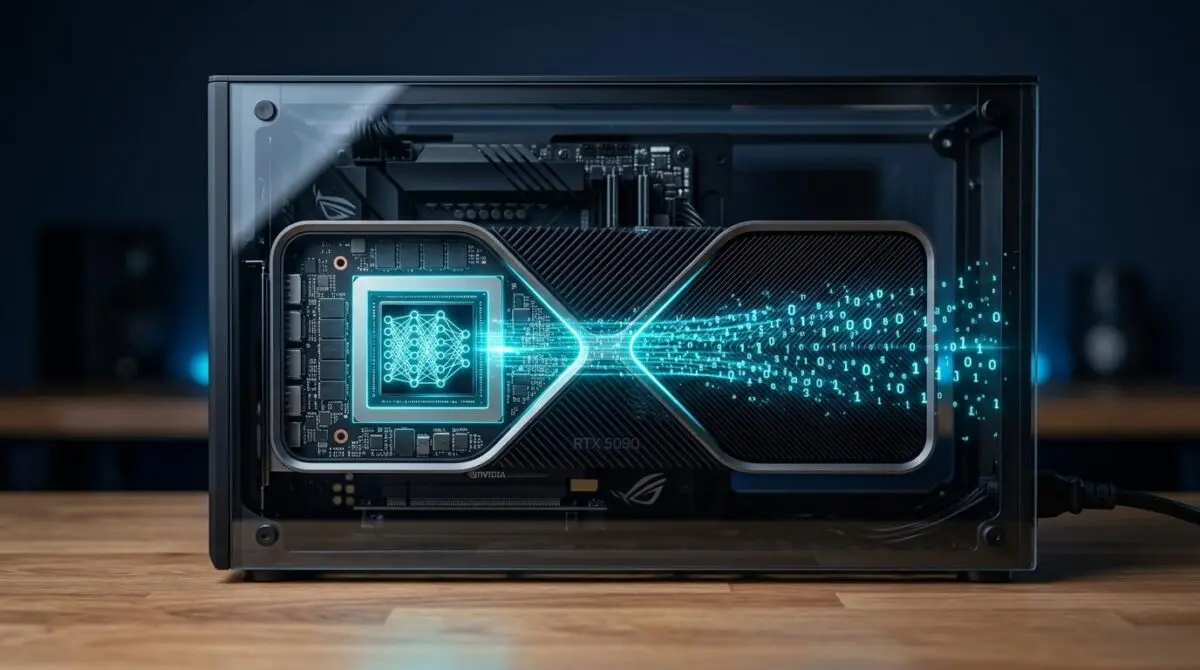
A single RTX 5090 can now push 233 tokens per second through this model using DFlash speculative decoding, a 3.1× leap over the 75 tok/s baseline.
On Apple’s M5 Max, the same technique propels output from roughly 27 tok/s to over 50 tok/s.
Those are production-grade speeds on hardware that fits under a desk.
How ExecuTorch Eliminates the Rewrite Bottleneck for Complex Models
Most local AI frameworks demand that models be rewritten in non-Python languages before deployment — a workflow that collapses the moment architectures grow beyond standard text transformers.
Multimodal inputs, custom decoding algorithms, and agentic tool-call parsing each introduce surface area that hand-ported backends struggle to cover.
ExecuTorch inverts this pattern entirely.
As documented by the PyTorch blog, engineers implement the model and its decoding strategy directly in PyTorch, then export the full graph ahead of time.
The framework handles backend-specific lowering automatically: Triton kernels on CUDA, MLX-native and custom Metal operations on Apple Silicon.
No per-backend rewrite. No hand-tuned op libraries maintained in parallel.
This architecture is what makes Muse Glimmer’s feature set deployable at all on local hardware.
The model ships with native GGUF export, K-quant execution across Q4_K, Q5_K, and Q6_K precision levels, and a 128,000-plus token context window — 13 of its 52 layers operate globally while the remaining 39 use sliding-window attention, keeping the KV-cache footprint practical on edge devices.
DFlash, the parallel diffusion-based speculative decoding system, is baked into a single PTE artifact alongside the base model through weight sharing between the target and draft networks.
The block dimension exports dynamically, letting a single artifact support runtime-selectable draft lengths.
An agentic serving harness wraps the entire stack: one model load sustains multiple isolated conversations through per-session mutable-state rebinding, with Harmony chat templating and a parser for the model’s XML tool-call format — including multiple tool invocations in a single turn.
Benchmarks, Strategy, and the Open-Weight Advantage Over Closed Rivals
Meta published head-to-head benchmarks pitting Muse Glimmer against Gemma4-31B and Qwen3.6-27B, and the margins are decisive in the categories that matter for agentic work.
On MCP Atlas — a benchmark measuring multi-step tool orchestration — Glimmer scores 75.5 against 54.2 and 62.5.
DeepSearch QA lands at 74.6 versus 61.7 and 71.1.
SWE-Bench Pro, which tests real-world software engineering capability, clocks 51.2 next to 36.9 and 50.2.
The model includes a roughly 1.8-billion-parameter ViT-G/14 perception encoder for image understanding, and the Hugging Face model card confirms Apache 2.0 licensing with explicit scaffold compatibility for OpenClaw and Hermes Agent frameworks.
Constellation Research notes the strategic dimension that makes this release structurally different from a typical model drop.
Meta does not sell foundation model access — its revenue depends on advertising and compute rental, meaning open-weight releases carry no direct cannibalization risk.
That calculus lets the company distribute a 30B model under 20 GB in 4-bit quantization with accuracy degradation held between 0.2 and 1.0 percent, leaving headroom for the KV-cache, perception encoder, and speculative decoding drafter on a single consumer card.
Running models locally enables you to use AI anywhere, anytime, with or without an internet connection.
That line, published in Meta’s announcement and cited by Constellation Research, encapsulates the bet: agentic AI that never phones home is not just a privacy feature — it is a structural advantage.
Mark Zuckerberg reinforced this in a parallel essay arguing that open-source AI prevents centralization and that U.S. policy should ease training data restrictions so American open models can compete globally.
He explicitly defended distillation as a legitimate open-source principle, a direct counter to critics who frame the technique as derivative.
The safety benchmarks tell a more nuanced story: CI Memories violations sit at 26.4, and the Siren AgentDojo attack success rate reaches 28.4 — though utility holds at 94.2, indicating the model remains capable even under adversarial pressure.
These are not pristine scores, and they signal that local agentic deployment shifts the security boundary in ways the industry has not yet fully mapped.
Local Agentic Infrastructure Crosses the Practicality Threshold
Muse Glimmer proves that a 30-billion-parameter model can execute multi-step coding tasks, parse images, call tools, and recover from failures — all on a single GPU, at speeds exceeding 200 tokens per second, under an Apache 2.0 license.
The bottleneck is no longer the hardware; it is how fast engineering teams adapt their pipelines to a world where cloud inference is optional.
For teams building agentic automation pipelines that demand both throughput and architectural independence, programmatic SEO and AI automation is how Andres SEO Expert approaches the infrastructure challenge — get in touch to discuss your stack.
Frequently Asked Questions
What is Muse Glimmer and who released it?
Muse Glimmer is a 30-billion-parameter, open-weight AI model released by Meta on August 10, 2026. It is distilled from Muse Spark and is designed for autonomous agentic workflows on consumer hardware, with full runtime support for NVIDIA GPUs and Apple Silicon Macs via ExecuTorch.
What hardware is needed to run Muse Glimmer effectively?
A single RTX 5090 can run Muse Glimmer at 233 tokens per second using DFlash speculative decoding, while an Apple M5 Max achieves over 50 tokens per second with the same technique. The model fits under a desk, making it practical for local deployment.
How does ExecuTorch eliminate the rewrite bottleneck for complex models?
ExecuTorch lets engineers implement the model and its decoding strategy directly in PyTorch, then export the full graph ahead of time. The framework handles backend-specific lowering automatically, generating Triton kernels on CUDA and MLX-native/Metal operations on Apple Silicon, so no per-backend rewrite is needed.
What is DFlash speculative decoding and how does it improve performance?
DFlash is a parallel diffusion-based speculative decoding system baked into a single PTE artifact alongside the base model. It uses weight sharing between target and draft networks, allowing a single artifact to support runtime-selectable draft lengths. This yields a 3.1× speedup on an RTX 5090 (from 75 to 233 tok/s) and nearly 2× on an M5 Max.
What benchmarks and open-weight advantages does Muse Glimmer have over rivals?
Muse Glimmer scores 75.5 on MCP Atlas, 74.6 on DeepSearch QA, and 51.2 on SWE-Bench Pro, outperforming Gemma4-31B and Qwen3.6-27B in agentic tasks. Released under Apache 2.0, it is only ~20 GB in 4-bit quantization and is explicitly compatible with OpenClaw and Hermes Agent frameworks, giving developers full control without cloud dependency.
What are the safety and security trade-offs of running Muse Glimmer locally?
Safety benchmarks show CI Memories violations at 26.4 and a Siren AgentDojo attack success rate of 28.4, while utility remains high at 94.2. These scores indicate that local agentic deployment shifts the security boundary, and the industry has not yet fully mapped the implications.
Why does Meta release open-weight models without cannibalizing its business?
Meta does not sell foundation model access; its revenue comes from advertising and compute rental. This means open-weight releases carry no direct cannibalization risk. Mark Zuckerberg also defended distillation as a legitimate open-source principle, aligning with the release strategy.