Key Takeaways
- Claude now connects to 1,200+ apps natively, with multi-connector workflows for paid subscribers.
- Three integration paths exist: native connectors, custom MCP servers, and Zapier’s governed MCP gateway to 9,000+ apps.
- As connectors proliferate, governance and auditable permissions become the critical differentiator.
Table of Contents
Claude Now Talks to 1,200+ Apps. The Real Story Is What Happens Next.
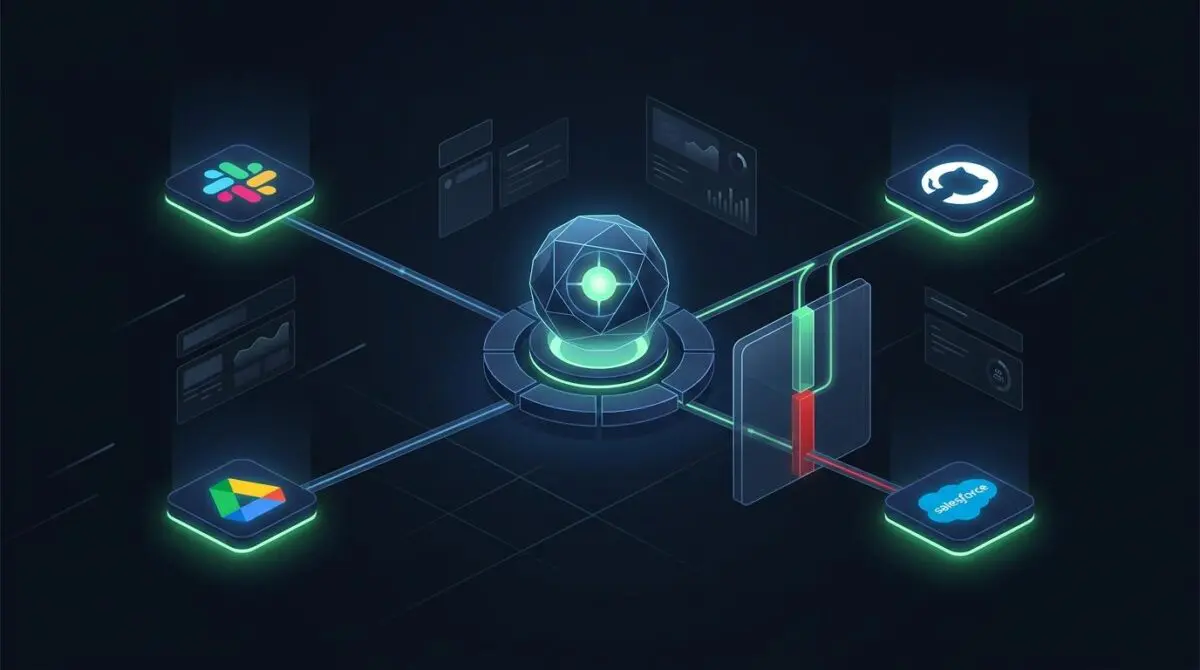
Anthropic has quietly built a connector ecosystem that gives Claude direct access to over 1,200 external services — from Google Drive and Slack to GitHub and Salesforce — transforming the chatbot from a reasoning engine into an actionable automation hub.
The connectors, available to all users including those on free plans, allow Claude to search files, create records, send messages, and execute tasks inside third-party applications without leaving the chat window.
Free-tier users face a single-connector limit.
Paid subscribers unlock multi-connector workflows and access to plugins — pre-built bundles that package connectors alongside skills and sub-agents for specific roles like marketing or financial research.
But the catalog is only part of the story.
Beneath the surface, the Model Context Protocol (MCP) — an open standard Anthropic developed — is fueling an integration explosion that extends far beyond what any single company could curate.
The Three Paths to Connecting Claude: A Technical Breakdown
Zapier’s recent breakdown of the Claude connector landscape identifies three distinct integration tiers, each targeting a different level of technical sophistication and organizational need.
Native connectors form the first tier.
These are first-party integrations available through Anthropic’s Connectors Directory, handling OAuth authentication and exposing scoped operations — search, read, and write — that Claude can invoke within a conversation.
A project manager can ask Claude to pull open issues from Linear, cross-reference them with standup notes in Google Drive, and draft a status update to Slack, all in a single prompt.
Custom MCP servers constitute the second tier.
When an app lacks a native connector, teams can build or deploy their own MCP server and register it as a custom connector through Claude’s settings panel.
This path requires more engineering effort but unlocks integration with any internal tool, proprietary database, or niche service that speaks the MCP protocol.
Team and Enterprise plan administrators control whether custom connectors are enabled organization-wide, adding a governance layer that individual users on personal plans bypass entirely.
The third tier is the Zapier MCP connector — a single integration granting governed access to over 9,000 applications through one authenticated channel.
It operates as a custom Claude connector, but with granular permission scoping that lets administrators specify exactly which apps and actions Claude can touch.
That governance model persists even if a team switches from Claude to ChatGPT, Gemini, or another agent harness.
Zapier MCP works across all of them.
Why Adobe, HubSpot, and 1,600+ Community Developers Are Betting on MCP
The connector ecosystem is growing faster outside Anthropic’s walls than inside them.
Community-maintained directories now track over 1,600 MCP connectors, with dozens more awaiting vendor verification — a signal that the protocol, not any single implementation, is becoming the industry’s integration backbone.
Enterprise platforms are responding accordingly.
Adobe’s official documentation, last updated in late July 2026, details two paths for connecting Claude to Adobe Experience Manager: manually adding AEM’s MCP servers as custom connectors, or installing the Adobe Experience Manager Connector directly from Anthropic’s marketplace.
That marketplace connector launched with feature parity against the Content MCP Server, and Adobe expects tool coverage to expand.
HubSpot followed a similar trajectory.
Its Claude connector, as detailed in HubSpot’s Knowledge Base in early August 2026, lets paid Anthropic subscribers query CRM data, create and update contacts, deals, tickets, and custom objects, log activities, and analyze marketing emails — all from the chat window.
User-level permissions carry through to every operation.
Delete actions are explicitly blocked, a design choice that reveals how seriously enterprise vendors treat the boundary between AI-assisted productivity and AI-initiated data destruction.
The installation requires a HubSpot Super Admin or App Marketplace user to grant permissions, reinforcing that these connectors demand organizational buy-in, not just individual enthusiasm.
For automation professionals, the implication is clear: the chat window is absorbing workflows that previously required dedicated automation platforms, API scripts, or manual context-switching between a dozen browser tabs.
But the real architectural shift is the blending of deterministic automation with on-demand AI reasoning.
Zapier’s platform already demonstrates this hybrid model — trigger-action workflows run in the background without burning tokens, while Claude steps in only where generative intelligence or unstructured reasoning is genuinely needed.
Native Claude connectors cannot replicate that efficiency today.
They fire up a full AI conversation for every interaction, which suits exploratory tasks but becomes expensive and slow for routine data movement.
When Every App Has a Connector, Automation Becomes Invisible
The connector sprawl hitting 1,600-plus integrations signals a future where the question isn’t ‘Can Claude talk to my stack?’ but ‘Which parts of my stack should Claude not touch?’
Governance, not access, becomes the binding constraint — and the platforms that solve scoped, auditable, cross-agent permission models will define the next automation cycle.
For teams building AI-augmented automation pipelines where governance and scale collide, Andres SEO Expert’s programmatic SEO and AI automation consulting addresses exactly this intersection — start the conversation here.
Frequently Asked Questions
What is the Model Context Protocol (MCP) and why is it significant for Claude’s connector ecosystem?
The Model Context Protocol (MCP) is an open standard developed by Anthropic that fuels an integration explosion beyond curated native connectors. It allows teams to build custom connectors for any internal tool, proprietary database, or niche service, and is backed by over 1,600 community-maintained MCP connectors, positioning it as the industry’s integration backbone.
How many applications can Claude connect to in total?
Claude has access to over 1,200 external services through native connectors listed in Anthropic’s Connectors Directory. Additionally, community directories track over 1,600 MCP connectors, and integrations like Zapier MCP provide governed access to more than 9,000 applications through a single channel.
What are the three paths to connecting Claude to external applications?
The three tiers are: native first-party connectors from Anthropic’s Connectors Directory; custom MCP servers built and registered by teams for apps without native connectors; and the Zapier MCP connector, which grants access to over 9,000 apps through one governed integration with granular permission scoping.
Can free users of Claude use connectors?
Yes, all users including those on free plans can use connectors. However, free-tier users face a single-connector limit, while paid subscribers unlock multi-connector workflows and access to pre-built plugins for specific roles like marketing or financial research.
What governance controls are available for custom connectors on Team and Enterprise plans?
Team and Enterprise plan administrators control whether custom connectors are enabled organization-wide. This adds a governance layer that individual users on personal plans bypass entirely. Zapier MCP also allows administrators to specify exactly which apps and actions Claude can touch, and that governance model persists across other agent harnesses.
How do Adobe and HubSpot integrate with Claude?
Adobe offers two paths for Claude integration: manually adding AEM’s MCP servers as custom connectors, or installing the Adobe Experience Manager Connector from Anthropic’s marketplace. HubSpot’s Claude connector lets paid subscribers query CRM data, create and update contacts, deals, tickets, and custom objects, log activities, and analyze marketing emails, with delete actions explicitly blocked.
What is the key difference between native Claude connectors and the Zapier MCP connector for automation?
Native Claude connectors fire up a full AI conversation for every interaction, making them suitable for exploratory tasks but expensive and slow for routine data movement. Zapier MCP integrates with Claude while allowing deterministic trigger-action workflows to run in the background without burning tokens, reserving AI reasoning for tasks that genuinely require generative intelligence.


![MCP: The Missing Layer Between Your Team and AI [Ultimate Guide 2026]](https://andresseo.expert/wp-content/smush-webp/2026/08/why-mcp-is-the-usb-c-moment-for-enterprise-ai-automation-380x212.jpg.webp)