Key Takeaways
- Agentic video skills inspect live Jetson devices and generate verified codec recipes.
- PyNvVideoCodec 2.2 brings GPU-resident frame access to Python via DLPack.
- T3000 emulation on T5000 cuts robotics development cycles before silicon arrives.
Table of Contents
- Jetson’s Agentic Video Layer Turns Prompts into Production-Ready Pipelines
- PyNvVideoCodec 2.2 Lands on Jetson With Native Pythonic Acceleration
- Emulating T3000 on T5000 Cuts Robotics Development Cycles
- Why Jetson’s Agentic Shift Is a Blueprint for Edge AI Infrastructure
- Edge Video AI’s Verifiable Future Arrives on Jetson
Jetson’s Agentic Video Layer Turns Prompts into Production-Ready Pipelines
A developer types ‘How many H.264 1080p30 streams can this Jetson handle for low-latency inference?’ and within moments receives a fully configured, measured, and verified codec workflow — not a datasheet limit or a static code snippet.
That is the core promise JetPack 7.2.1 delivers, as detailed August 11 on the NVIDIA Technical Blog.
The update introduces a foundational agentic video skills layer above the existing Video Codec SDK and the newly added PyNvVideoCodec library.
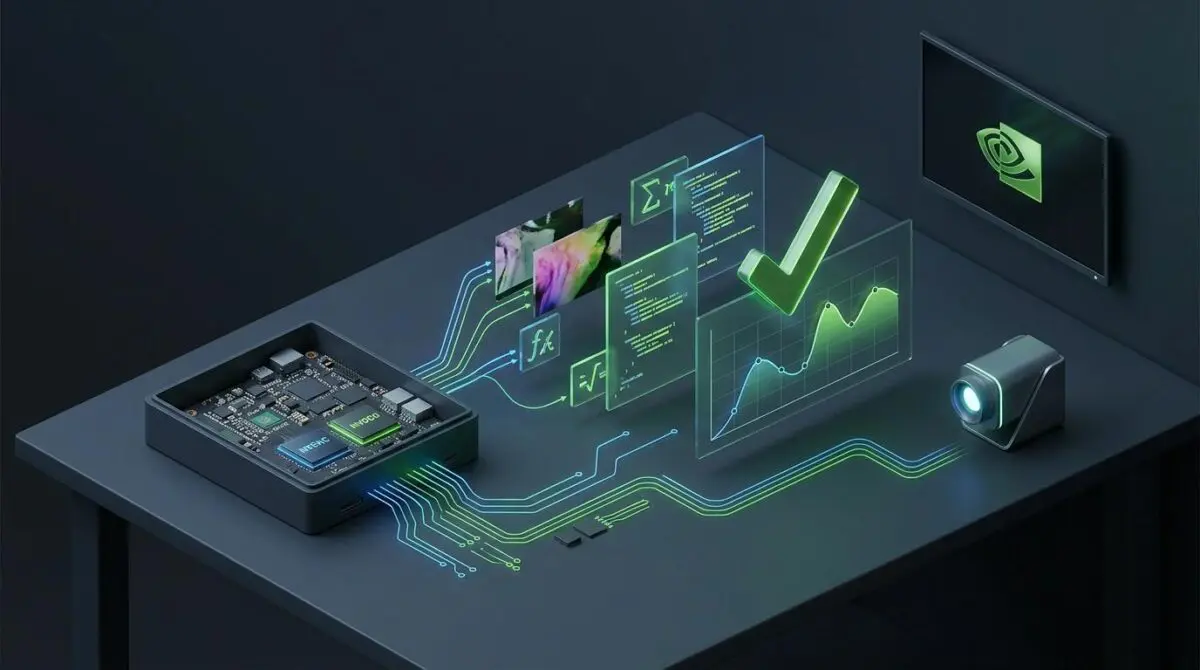
Rather than forcing teams to stitch together manual configurations, the skill inspects the live target device, discovers supported codec capabilities, generates a reproducible encoder recipe, executes the workload, and returns throughput, latency, and quality evidence with warnings.
These skills sit atop the NVENC and NVDEC hardware engines, bridging developer intent and deterministic results for video-heavy AI applications.
JetPack 7.2.1 also brings PyNvVideoCodec 2.2 to Jetson for the first time, giving Python developers frame-level access to GPU-resident video buffers via DLPack and CUDA device memory.
Together, the SDK primitives and the agentic layer accelerate the path from prompt to proven pipeline — a shift that matters most when edge devices operate in safety-critical, bandwidth-constrained, or remotely deployed environments.
PyNvVideoCodec 2.2 Lands on Jetson With Native Pythonic Acceleration
Until this release, hardware-accelerated video encode and decode on Jetson were accessible primarily through C/C++ APIs or high-level GStreamer pipelines.
PyNvVideoCodec changes that by exposing NVENC and NVDEC directly in Python, with frames staying in GPU memory throughout the pipeline.
The library leverages DLPack to hand frames to PyTorch or other AI frameworks without a single device-to-host copy, eliminating the buffer translation overhead that often cripples real-time inference loops.
A threaded decoder pre-fetches frames in a background thread, decoupling decode latency from inference latency — a design choice that keeps GPU utilization high and tail latencies predictable.
Multi-mode frame sampling further refines pipeline efficiency, letting developers trade off temporal resolution against compute budget without rewriting the codec scaffolding.
These capabilities mean a coding assistant can now use a Jetson video skill to verify platform capabilities, configure PyNvVideoCodec, and hand off decoded frames as framework tensors in a repeatable, evidence-backed sequence.
The agentic skill handles the runtime validation; the developer only supplies the AI model and application logic.
NVIDIA’s scope note is clear: this release covers Video Codec SDK and PyNvVideoCodec stages, not GStreamer, V4L2, or full application-level pipelines — but the foundation is deliberately built to compose with future skills for broader end-to-end workflows.
Emulating T3000 on T5000 Cuts Robotics Development Cycles
As detailed in the NVIDIA Technical Blog, another under-the-radar capability in JetPack 7.2.1 is the enablement of T3000 performance emulation on a Jetson T5000 module inside the Jetson Thor AGX Developer Kit.
The T3000 is a compact, power-sipping platform rated at 865 FP4 TFLOPS, aimed squarely at humanoid and mobile robotics where footprint, thermals, and cost dominate the design envelope.
By running T3000-emulated workloads on existing T5000 hardware, developers can prototype and benchmark multimodal AI pipelines months before physical T3000 silicon is in their hands.
The emulation preserves the inference performance profile of the smaller platform while leveraging the more capable T5000 as a high-fidelity stand-in, drastically shortening the design-verify-deploy loop for robotics OEMs.
NVIDIA’s internal teams have documented the emulation approach in the Jetson Linux Developer Guide, and JetPack 7.2.1 makes it a standard, accessible path for the broader developer community.
Why Jetson’s Agentic Shift Is a Blueprint for Edge AI Infrastructure
The addition of agentic video skills signals a broader architectural bet: that the next generation of edge AI tooling must move from static SDKs to runtime-aware, verifiable configuration agents.
JetPack 7.2.1’s skills distinguish between advertised codec capabilities and what actually succeeds on a live target, and they preserve recipes, inputs, outputs, and measurements for full reproducibility — a discipline that has historically been missing from embedded video engineering.
This matters acutely in sectors like autonomous inspection, telemedicine, and industrial automation, where a misconfigured codec rate-control scheme can silently degrade model accuracy downstream.
By embedding this verification layer directly into the JetPack workflow, NVIDIA is effectively packaging years of field-hardened multimedia engineering into a programmatically auditable asset.
The choice to surface skills through a unified ‘jetson-videosdk’ interface also lowers the bar for coding assistants and AI agents to orchestrate video pipelines.
When a coding assistant can call a skill to validate configuration, the human developer is freed to focus on model selection and domain logic rather than buffer management and bitrate math.
NVIDIA has indicated that future JetPack releases will expand the skills surface across developer workflows, strongly suggesting that agentic, evidence-based configuration will become the default mode for Jetson platform software.
Edge Video AI’s Verifiable Future Arrives on Jetson
JetPack 7.2.1 draws a line between writing video code that works in a lab and deploying pipelines that can be measured, reproduced, and trusted at the edge.
That line is now programmable.
For engineering teams building agentic video workflows where verifiability is non-negotiable, Andres SEO Expert’s AI automation services apply the same rigor to pipeline determinism — reach out.
Frequently Asked Questions
What is JetPack 7.2.1 and what does it add to Jetson?
JetPack 7.2.1 is an NVIDIA Jetson platform update that introduces an agentic video skills layer above the Video Codec SDK and PyNvVideoCodec, enabling developers to generate, execute, and verify production-ready codec workflows directly from prompts. It also brings PyNvVideoCodec 2.2 to Jetson for the first time and enables T3000 performance emulation on the T5000 module.
How do agentic video skills work in JetPack 7.2.1?
Agentic video skills inspect the live Jetson target device, discover supported codec capabilities, generate a reproducible encoder recipe, execute the workload, and return throughput, latency, and quality evidence with warnings. They bridge developer intent and deterministic results for video-heavy AI applications, allowing coding assistants to validate configurations automatically.
What is PyNvVideoCodec 2.2 and why is it important for Jetson?
PyNvVideoCodec 2.2 exposes NVENC and NVDEC hardware acceleration directly in Python on Jetson. It uses DLPack to hand frames to AI frameworks like PyTorch without device-to-host copies, reducing buffer overhead. A threaded decoder pre-fetches frames to decouple decode latency from inference latency, keeping GPU utilization high and tail latencies predictable.
What is T3000 emulation on Jetson T5000?
T3000 emulation on a Jetson T5000 module lets developers prototype and benchmark multimodal AI pipelines using the T3000’s performance profile before physical T3000 silicon is available. It preserves the inference performance of the power-efficient T3000 while using the more capable T5000 as a stand-in, shortening robotics development cycles.
Why are agentic video skills important for edge AI infrastructure?
Agentic video skills move edge AI tooling from static SDKs to runtime-aware, verifiable configuration agents. They distinguish between advertised and actual codec capabilities, preserve recipes for reproducibility, and provide evidence-backed validation—critical for safety-critical, bandwidth-constrained, or remotely deployed environments where misconfiguration can silently degrade model accuracy.
What can developers do with agentic video skills and PyNvVideoCodec together?
Developers can use a coding assistant to call a Jetson video skill that verifies platform capabilities, configures PyNvVideoCodec, and hands off decoded frames as framework tensors in a repeatable sequence. The agentic skill handles runtime validation and codec setup, freeing the developer to focus on AI model selection and application logic.