Key Takeaways
- Slack bots that only send notifications aren’t agents—look for interactive Block Kit, tool-calling, and thread-aware memory.
- The 2026 guide evaluates 7 agencies by API depth, integration breadth, and ability to mutate enterprise systems from chat.
- The real automation moat isn’t chat mimicry but API orchestration—choose agencies that execute backend changes, not just replies.
Table of Contents
- The Slack Bot Illusion That Keeps Operations Teams Stuck
- How the Evaluation Framework Separates True Agents From Webhook Alerts
- Seven Agencies and the Slack Workflows They Actually Deliver
- Why API Orchestration Is Becoming the Real Automation Moat
- The 2026 Buy Decision: Interactive Execution Over Chat
The Slack Bot Illusion That Keeps Operations Teams Stuck
Most Slack AI bots still behave like notification relays, not operational agents.
They ping a channel, answer a simple slash command, and stop short of executing real work.
Operational leaders are now drawing a harder line.
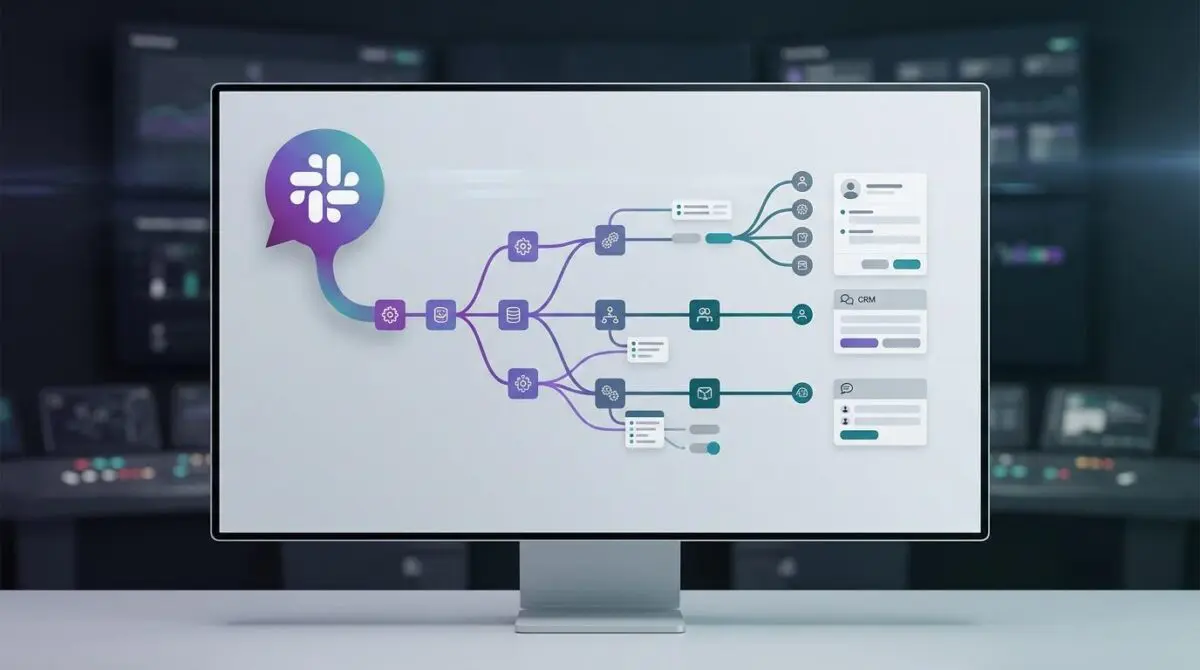
If an agent cannot open a modal, update a CRM, or route an IT ticket from inside Slack, it does not belong in the enterprise automation stack.
The 2026 guide published by N8N Lab evaluates seven agencies that build production-ready Slack AI agents.
It separates basic chatbot providers from partners capable of interactive Block Kit workflows and deep tool-calling.
How the Evaluation Framework Separates True Agents From Webhook Alerts
The evaluation rests on five technical criteria, each designed to expose the gap between a chat wrapper and a true agent.
- Slack API depth — whether the agency uses interactive components like buttons, modals, and multi-select menus instead of plain-text commands.
- Conversational context handling — whether the agent maintains memory across nested Slack threads or treats every message in isolation.
- Tool-calling capability — whether the agent can perform real actions such as creating a Jira task or updating a Salesforce record directly from Slack.
- Integration breadth — which enterprise systems the agent can connect to, including n8n, Notion, CRMs, and identity providers.
- Internal versus external expertise — whether the agency builds internal operational bots, customer-facing Slack Connect deployments, or both.
Those criteria matter because plain-text notifications can fire a webhook.
They cannot open a modal, read a nested thread, or mutate a record in Salesforce or Jira.
Most ROI figures in the guide remain vendor-reported and should be validated against production benchmarks before budget sign-off.
Seven Agencies and the Slack Workflows They Actually Deliver
The guide groups agencies by their strongest operational fit, not by generic chatbot capability.
N8N Lab
N8N Lab treats Slack integration as a first-class delivery pattern across complex n8n workflows.
The team builds interactive command centers for internal requests, multi-tier approvals, and escalation alerts.
Implementation includes native Slack node configuration, custom Block Kit UI design, and LLM-powered tool-calling inside n8n.
Database-backed memory preserves context across long-running threads, while confidence-based routing escalates uncertain cases to human operators.
Typical deployments run three to six weeks, depending on the number of enterprise systems being integrated.
Vendor-reported client outcomes include a 40 percent reduction in IT and operational ticket volume and an average of 15 hours saved per week for operations teams.
Those results have not been independently benchmarked at production scale.
Master of Code Global
Master of Code Global focuses on customer-facing Slack Connect deployments rather than internal back-office routing.
The team builds native Slack apps with advanced conversational UI, secure OAuth, and external tool-calling for support triage in shared channels.
Deployment complexity is high, with timelines running eight to twelve weeks due to native code and external data compliance requirements.
Vendor-reported results include a 35 percent decrease in time-to-resolution for tier-1 support queries and a 50 percent larger client portfolio per customer success manager.
NeuraFlash
NeuraFlash anchors Slack AI agents in the Salesforce ecosystem, connecting conversational threads directly to Sales Cloud and Service Cloud.
The implementation includes Slack-to-Salesforce authentication, RAG pipelines for knowledge retrieval, and Block Kit interfaces for updating deal stages or closing cases.
Setup spans six to ten weeks and depends heavily on CRM complexity.
Vendor-reported outcomes include a 60 percent increase in CRM data compliance and 25 percent faster case resolution through automated swarming.
SoluLab
SoluLab approaches Slack agents from data engineering and RAG architecture rather than task-based tool-calling alone.
The team connects fragmented knowledge bases to a vector database and builds citation-aware Slack answers with interactive verification buttons.
Document permissioning follows the Slack user ID, which keeps retrieval aligned with internal access controls.
Setup ranges from four to eight weeks, depending on internal data quality and vector infrastructure.
The vendor reports a 20 percent productivity boost across engineering and product teams.
Maruti Techlabs
Maruti Techlabs specializes in internal IT helpdesk and HR self-service workflows inside Slack.
The approach integrates ITSM platforms, creates structured self-service modals, and enables tool-calling for actions such as software license provisioning.
Human handoff protocols summarize threads and alert the relevant departmental channel when escalation is needed.
Installations run four to seven weeks and report a 45 percent deflection rate on tier-1 internal tickets.
Vention
Vention builds ground-up native Slack agents using Python, Node.js, and Slack’s Bolt framework.
The engagement targets enterprises with heavily guarded legacy systems that need custom microservices and proprietary tool-calling middleware.
Timelines extend from ten to sixteen weeks, making it the longest development cycle in the guide.
Vendor-reported outcomes focus on legacy interface consolidation and substantial software licensing savings for enterprise clients.
SymphonyAI
SymphonyAI approaches Slack through enterprise service management, unifying IT, HR, legal, and facilities workflows into a single conversational interface.
The implementation emphasizes compliance, audit logging, and dynamic Block Kit presentation based on user roles.
Rollouts take twelve to twenty weeks because of cross-departmental alignment.
Vendor-reported results show a 30 percent reduction in cross-departmental processing time.
Why API Orchestration Is Becoming the Real Automation Moat
The commercial value of a Slack AI agent now depends less on how convincingly it mimics a chat interface and more on how deeply it orchestrates APIs behind the scenes.
That distinction separates bots that render text from agents that execute real business state changes.
Across the automation sector, a few signals have become harder to ignore.
RAG-heavy agencies are being pushed to turn knowledge bases into workflow engines rather than simple answer retrieval.
Authentication has moved from a security checkbox to a reliability question for every tool call.
Chain-of-thought reasoning is being treated as an auditable asset rather than an internal model detail.
The most meaningful tension in the guide is between workflow-based orchestration and ground-up native development.
N8N Lab’s n8n-centric model favors rapid workflow orchestration and deep back-end connectivity.
Vention and Master of Code Global prioritize native code paths for maximum customizability and external security.
SoluLab emphasizes RAG accuracy, while Maruti Techlabs and NeuraFlash optimize for specific systems of record.
The strategic implication for automation buyers is not that one approach wins universally.
It is that the evaluation must center on which systems the agent can actually mutate, not which channels it can send a message to.
Ownership of the automation runtime may matter as much as feature breadth.
Teams that adopt low-code n8n workflows gain speed and maintainability, while fully custom builds offer control at the expense of internal engineering burden.
The 2026 Buy Decision: Interactive Execution Over Chat
Buyers evaluating Slack AI agent partners should reject any vendor that equates Slack integration with outbound notifications. The measurable outcomes sit with agencies that deploy interactive Block Kit components, maintain thread context, and trigger real backend changes. For teams building Slack AI agent workflows that need to scale, Andres SEO Expert’s programmatic SEO AI automation service provides the strategic automation architecture — contact Andres SEO Expert to evaluate your automation roadmap.
Frequently Asked Questions
What separates a true Slack AI agent from a basic chatbot?
A true Slack AI agent uses interactive components like modals and buttons, maintains context across threads, and performs real actions such as updating a CRM or Jira, rather than just sending notifications.
What criteria should be used to evaluate Slack AI agent development agencies?
The evaluation rests on five criteria: Slack API depth, conversational context handling, tool-calling capability, integration breadth, and internal versus external expertise.
Which agencies build Slack AI agents for internal operations versus customer-facing deployments?
N8N Lab, Maruti Techlabs, and Vention focus on internal operations, while Master of Code Global focuses on customer-facing Slack Connect deployments. NeuraFlash anchors in Salesforce, SoluLab focuses on RAG, and SymphonyAI on enterprise service management.
How long does it take to implement a Slack AI agent?
Implementation timelines vary by agency: N8N Lab takes 3-6 weeks, Master of Code Global 8-12 weeks, NeuraFlash 6-10 weeks, SoluLab 4-8 weeks, Maruti Techlabs 4-7 weeks, Vention 10-16 weeks, and SymphonyAI 12-20 weeks.
Why is API orchestration becoming more important than chat interface in Slack agents?
Because the commercial value lies in executing real business state changes through APIs, not just rendering text. RAG-heavy agencies are being pushed to turn knowledge bases into workflow engines, and authentication and chain-of-thought reasoning become auditable assets.
What is the key takeaway for buyers evaluating Slack AI agent partners?
Buyers should reject vendors that equate Slack integration with outbound notifications. The measurable outcomes sit with agencies that deploy interactive Block Kit components, maintain thread context, and trigger real backend changes.