Key Takeaways
- Cosmos 3 Edge, a 4B world model, runs closed-loop robot control entirely on Jetson Thor—no cloud round-trip.
- Post-training uses 76,000 teleoperated trajectories on a 64-node GB200 cluster for 17,400 GPU-hours.
- On-device world models are shifting physical AI from cloud dependence to embedded deployment.
Table of Contents
A 4B World Model Runs Robot Control On-Device
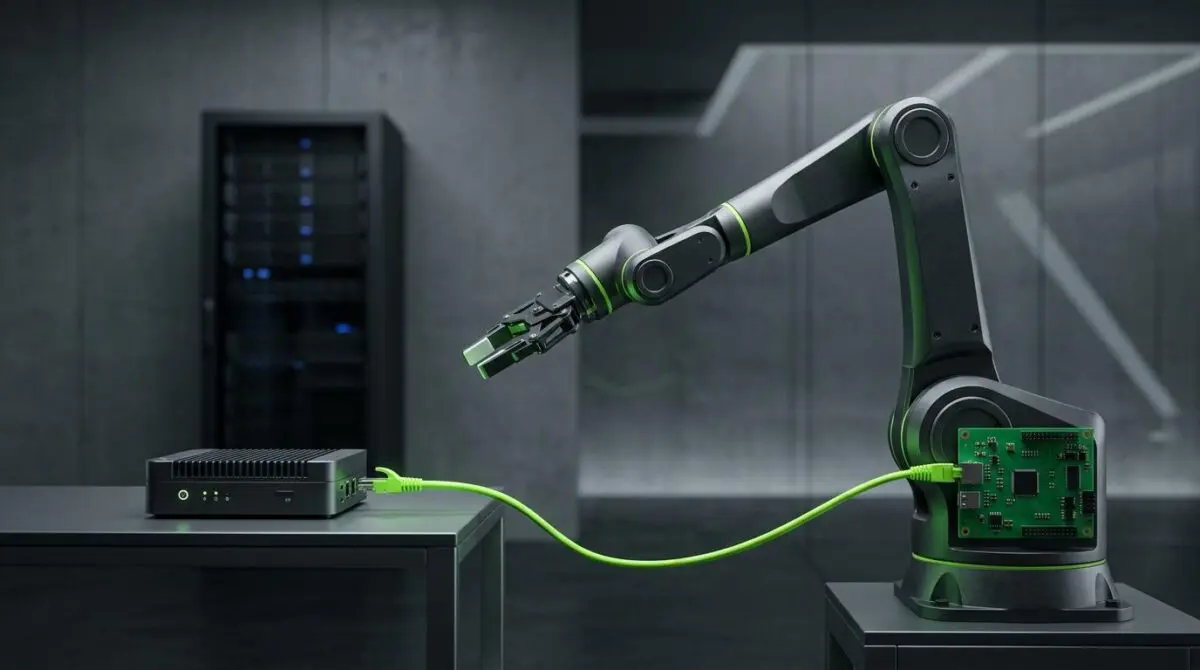
The NVIDIA Developer team published a detailed technical breakdown on August 19, 2026, that shows how to post-train Cosmos 3 Edge, a 4-billion-parameter omni-model, into a robot manipulation policy that runs entirely on Jetson Thor.
The result is a closed-loop control system with no data-center GPU in the loop, a milestone that pushes physical AI from cloud dependence toward embedded deployment.
Cosmos 3 Edge is one member of the Cosmos 3 family, which also includes the 16B Nano and 64B Super variants.
All three sizes were pretrained on the same physical-world data, giving them the same grounding in how objects move, collide, and respond to contact.
What distinguishes Edge is its size: at roughly 9 GB in BF16, its weights fit inside Jetson Thor’s on-board memory.
That makes direct on-device inference possible, while the larger Cosmos 3 variants still require workstation or data-center GPUs.
According to the NVIDIA Developer announcement, the post-trained Edge policy reaches 22.9% success across the closed-loop RoboLab task suite.
The 16B Nano variant reaches 36.8% on the same eval, but it does so with substantially more inference compute.
That tradeoff is the core story: Edge sacrifices some absolute success rate to achieve real-time, fully on-robot autonomy.
Inside the Post-Training Stack
The training recipe starts with the nvidia/Cosmos3-DROID dataset, which contains 76,000 successful teleoperated trajectories.
Those trajectories add up to roughly 350 hours of Franka Panda arm data across 86 tasks and 564 scenes, all collected with a Robotiq gripper.
Data preparation runs in three stages. First, idle and non-task frames are filtered out. Second, only successful demonstrations are selected for training.
Third, random cropping, rescaling, and color jitter are applied during training to improve robustness.
The dataset is packaged in LeRobotDataset v3.0 format at 640 by 360 resolution.
Post-training is not a single-GPU fine-tune. The validated setup uses 64 nodes, each with four GB200 GPUs, for 60,000 iterations.
That run takes about 68 hours and consumes roughly 17,400 GB200-hours, so planning compute accordingly is critical.
The action space is 8-dimensional absolute joint positions: seven arm joints plus a gripper state.
Each inference produces a chunk of 32 future actions at 15 Hz, and the model uses a 3-camera canvas built from a wrist view and two exterior views.
Key hyperparameters include a 2e-4 learning rate, a global batch size of 8192, and freshly initialized action heads with a 5x learning-rate multiplier.
Serving the policy on Jetson Thor uses a WebSocket policy server that speaks the OpenPI protocol.
On a Jetson AGX Thor T5000, each action chunk is generated in about 1.53 seconds at 640 by 540 resolution and 15 Hz.
Because a single chunk covers roughly 2.13 seconds of robot motion, the next chunk is ready before the current one finishes.
That allows continuous streaming on-device, with the arm moving without any cloud round-trip.
Closed-loop evaluation in RoboLab spans 120 language-conditioned manipulation tasks, producing both viewport videos and success logs.
The Market Race for Embedded World Action Models
The significance of Cosmos 3 Edge extends beyond a single tutorial. It marks a shift in how robot manipulation policies are being built.
World action models built on video prediction offer stronger physical generalization and zero-shot transfer to new tasks, robots, and environments than vision-language-action models.
Cosmos 3 itself uses a Mixture-of-Transformers architecture and was trained on roughly 767 million images, 348 million videos of real-world dynamics, and 8 million action samples spanning robot manipulation, autonomous driving, and camera motion.
That multimodal pretraining creates a strong prior for physical interaction, which is why post-training into a manipulation policy needs less task-specific adaptation.
Google DeepMind‘s Gemini Robotics On-Device 2, announced on July 30, 2026, is pursuing a similar goal from a different architectural direction.
Google DeepMind reports that its on-device vision-language-action model is natively multi-embodiment and can adapt to new bi-arm robots in a few hours, typically with fewer than 200 examples.
On Apollo with Inspire hands, the vendor-reported results include 68.4% success for pick up from table, 45.7% for pick up from floor, and 76.3% for pick up from shelf.
On Franka Duo gripper tasks, Google DeepMind reports 74.2% for general pick and place, 78.9% for diverse tool kitting, and 89.6% for precise insertion tasks.
Those numbers are not directly comparable to Cosmos 3 Edge’s 22.9% RoboLab score, because the task suites, evaluation protocols, and manipulation hardware differ.
What the two companies do share is a clear strategic thrust: put world-model or VLA intelligence directly on the robot, not in a distant server.
Analysts caution that benchmark percentages can overstate real-world readiness, because per-step success compounds quickly over long-horizon tasks.
Even so, the race to embedded physical AI is now defined by latency, memory fit, and control frequency rather than raw model size alone.
What On-Device World Models Unlock
On-device world models are no longer a research curiosity; they are a deployable control loop for industrial manipulation, mobile robots, and embodied agents.
The teams that learn to post-train compact world foundations for embedded targets will shape the next wave of physical AI, where autonomy does not depend on cloud connectivity.
For teams building technical AI content that needs to scale across emerging robotics and edge computing topics, the programmatic SEO AI automation service is how Andres SEO Expert approaches it — contact Andres SEO Expert.
Frequently Asked Questions
What is Cosmos 3 Edge?
Cosmos 3 Edge is a 4-billion-parameter world model from NVIDIA that runs robot control entirely on-device using Jetson Thor, without a data-center GPU in the loop.
How does Cosmos 3 Edge achieve on-device robot control?
It is post-trained on teleoperated manipulation data to output 8-dimensional absolute joint positions. The model generates 32 future actions per chunk at 15 Hz, and inference runs on Jetson AGX Thor in about 1.53 seconds per chunk, enabling continuous streaming without cloud round-trips.
What success rate does Cosmos 3 Edge achieve?
The post-trained Edge policy reaches 22.9% success on the closed-loop RoboLab task suite, while the larger 16B Nano variant reaches 36.8% but requires substantially more inference compute.
How is Cosmos 3 Edge post-trained?
It is trained on the nvidia/Cosmos3-DROID dataset with 76,000 successful teleoperated trajectories spanning 86 tasks and 564 scenes. The process uses 64 nodes with four GB200 GPUs each for 60,000 iterations, taking about 68 hours and roughly 17,400 GB200-hours.
What is the difference between Cosmos 3 Edge and Gemini Robotics On-Device 2?
Cosmos 3 Edge is a world action model based on video prediction, while Gemini Robotics On-Device 2 is a vision-language-action model. They have different architectures and are evaluated on different task suites, so their reported success rates are not directly comparable.
Why is on-device world modeling important for robotics?
On-device world models remove the dependency on cloud connectivity, enabling real-time closed-loop control for industrial manipulation and mobile robots. This shifts the competitive focus to latency, memory fit, and control frequency rather than raw model size.
What hardware and inference speed does Cosmos 3 Edge use?
It runs on Jetson AGX Thor T5000 at 640 by 540 resolution and 15 Hz, generating an action chunk in about 1.53 seconds. Since a chunk covers 2.13 seconds of motion, the next chunk is ready before the current one finishes.