Key Takeaways
- MIT researchers screened 11 transition metal nitrides using density functional theory to predict catalytic performance.
- Average nitrogen Bader charge and N2p–metal d band overlap emerged as powerful descriptors for reaction energetics.
- Selectivity challenges remain, as hydrogen evolution outcompetes nitrogen reduction on studied surfaces.
Table of Contents
A Computational Shortcut for Ammonia Catalyst Performance
On August 20, 2026, MIT News reports that MIT researchers have developed a computational method to identify metal nitride catalysts for electrochemical ammonia production without fossil fuels.
The target is one of industrial chemistry’s most entrenched performance barriers: the Haber-Bosch process, which still relies on fossil fuels for heat and hydrogen.
Conventional Haber-Bosch plants operate at 350–500°C and 100–350 atmospheres, consuming roughly 1–2% of global energy annually and contributing about 1.4% of global CO2 emissions.
Electrochemical ammonia production could remove much of that fossil fuel demand, but current production rates and yields remain too low for industrial competition.
Our approach identifies the key physical properties that drive catalytic activity in ammonia production.
That statement, as reported by MIT News, comes from Bilge Yildiz, Breen M. Kerr Professor in the departments of Nuclear Science and Engineering and Materials Science and Engineering.
The open-access study was published Aug. 11 in EES Catalysis, with doctoral students Constantine Athanitis and Filip Grajkowski as co-authors.
The Nitride Descriptors Driving the Screening Model
The researchers concentrated on transition metal nitrides because nitrogen already embedded in the catalyst can participate in the reaction, reducing the energy required to break strong nitrogen bonds.
Rather than trial-and-error screening of millions of possible alloys, the MIT team used density functional theory to model 11 binary, rock-salt-structured transition metal nitrides.
- Screened compounds: ScN, YN, TiN, ZrN, HfN, VN, NbN, TaN, CrN, MoN, and MnN.
- Most favorable mechanism: A bridge-site dissociative Mars–van Krevelen pathway for 9 of the 11 materials.
- Primary bottleneck steps: Second hydrogenation of a surface nitrogen species and coupled third hydrogenation with ammonia desorption.
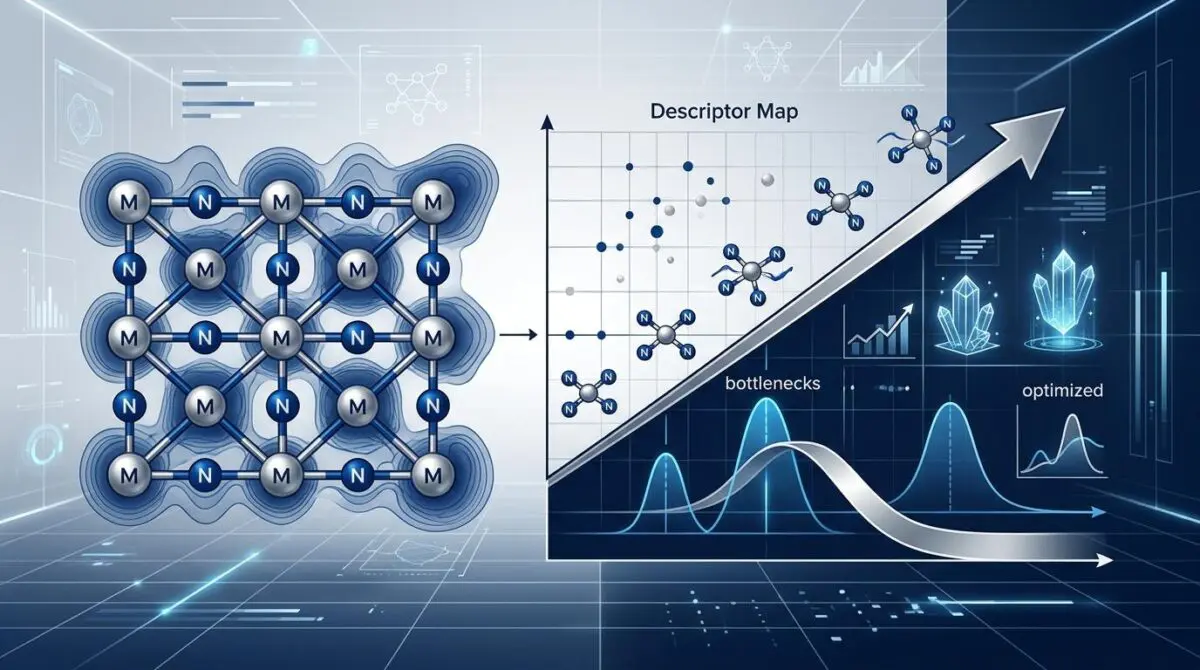
The two descriptor correlations that stood out were the average nitrogen Bader charge and the N2p–Md band overlap.
Average nitrogen Bader charge tracked surface nitrogen hydrogenation energy with an R² of 0.86, while N2p–Md band overlap tracked the coupled third hydrogenation and ammonia desorption energy with an R² of 0.82.
Compositionally, higher metal d electron counts produced more covalent metal–nitrogen bonding and greater band overlap.
The study found that individual nitrogen 2p or metal d band centers did not correlate well with key reaction energies.
Surface nitrogen 2p band centers remained relatively constant across metal compositions, unlike their bulk nitrogen 2p counterparts.
MoN was excluded from descriptor analysis as an outlier because molybdenum has the smallest electronegativity difference with nitrogen among the studied metals.
One major caveat is selectivity: hydrogen evolution was more energetically favorable than nitrogen reduction on every studied transition metal nitride.
A July Electride Result Raises the Competitive Stakes
A separate JACS study, published online July 23, 2026, reported a thermochemical ammonia synthesis route using a two-dimensional yttrium carbide electride.
That design activated nitrogen at electron-rich interlayers while hydrogen dissociated on supported nickel nanoparticles.
The lanthanum-doped Ni/La-Y2C catalyst reached a reported ammonia synthesis rate of 34.6 millimoles per gram per hour at 400°C and 1.0 MPa.
That rate surpassed nickel-based catalysts, the benchmark Cs–Ru/MgO system, and wüstite-based iron under identical conditions.
Because that route is thermochemical rather than electrochemical, it does not directly benchmark the MIT nitride work.
It does, however, sharpen the performance picture for low-emission ammonia: activity must be evaluated against selectivity, pressure, temperature, and hydrogen evolution trade-offs simultaneously.
translating these calculations into practical catalysts will require many additional steps, so meaningful real-world impact is likely still some distance away.
Dane Morgan, a University of Wisconsin engineering professor not involved in the MIT study, offered that caution.
From Theoretical Models to Industrial Ammonia Throughput
The next bottleneck is no longer descriptor discovery; it is demonstrating selectivity and yield in a working reaction cell under production loads. The practical race will be decided by which catalyst design first crosses the cost-competitiveness threshold with Haber-Bosch. For technical leaders building data-driven performance models that turn dense research signals into ranked engineering priorities, programmatic SEO AI automation is how Andres SEO Expert structures complex technical content into authoritative performance narratives — contact Andres SEO Expert.
Frequently Asked Questions
What is the computational shortcut for ammonia catalyst performance described by MIT researchers?
MIT researchers developed a computational method using density functional theory to screen 11 binary rock-salt transition metal nitrides, identifying key physical properties that drive catalytic activity for electrochemical ammonia production without fossil fuels.
Which metal nitrides were screened in the MIT study?
The study screened ScN, YN, TiN, ZrN, HfN, VN, NbN, TaN, CrN, MoN, and MnN—all binary, rock-salt-structured transition metal nitrides.
What are the key descriptors identified for predicting ammonia catalyst performance?
The two key descriptors are the average nitrogen Bader charge, which tracked surface nitrogen hydrogenation energy (R²=0.86), and the N2p–metal d band overlap, which tracked the coupled third hydrogenation and ammonia desorption energy (R²=0.82).
Why is the Haber-Bosch process considered a performance barrier?
Conventional Haber-Bosch plants operate at 350–500°C and 100–350 atmospheres, consuming 1–2% of global energy annually and contributing about 1.4% of global CO2 emissions, driving the need for greener alternatives.
What is the main challenge for electrochemical ammonia production?
Current production rates and yields are too low for industrial competition, and hydrogen evolution is more energetically favorable than nitrogen reduction on every studied transition metal nitride, posing a selectivity challenge.
How does the MIT computational method relate to the July electride-based ammonia synthesis route?
The electride route is thermochemical, not electrochemical, so it does not directly benchmark the MIT nitride work, but it highlights that activity must be evaluated against selectivity, pressure, temperature, and hydrogen evolution trade-offs simultaneously.
What is the next bottleneck after descriptor discovery for ammonia catalysts?
The next bottleneck is demonstrating selectivity and yield in a working reaction cell under production loads; translating calculations into practical catalysts requires many additional steps before real-world impact is achieved.