Key Takeaways
- AI factory output is capped by power, not rack count; static provisioning strands megawatts that could run more GPUs.
- NVIDIA DSX MaxLPS uses Dynamic Power Software to reclaim idle headroom, enabling up to 39% more racks in the same power envelope.
- 45°C liquid cooling cuts facility overhead, turning saved power directly into additional compute capacity.
Table of Contents
Power, Not Racks, Is the New AI Factory Bottleneck
AI factories no longer measure progress by how many GPUs fit in a hall. NVIDIA’s technical blog published an in-depth breakdown of DSX MaxLPS on Aug 21, 2026, arguing that the decisive metric is how much AI output each available megawatt can deliver.
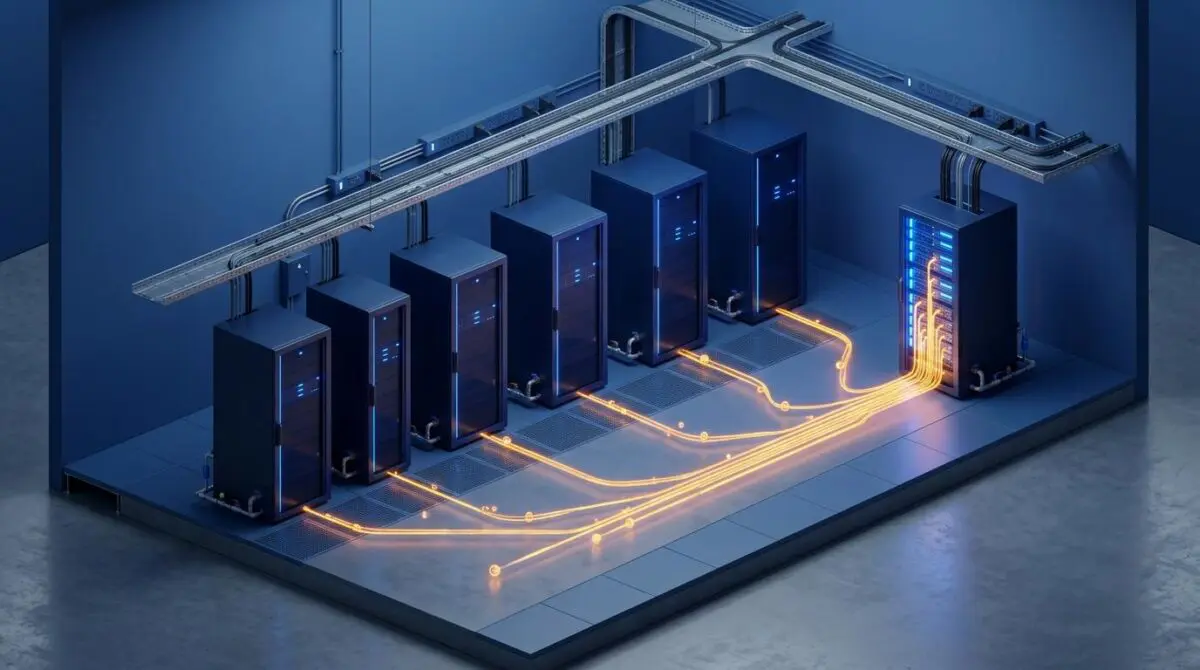
The core problem is static rack provisioning. Data centers allocate worst-case peak power to every rack, even when real workloads leave substantial capacity unused.
That stranded power cannot be loaned to a neighboring rack, and it reduces the share of grid input that actually reaches revenue-generating compute.
Inside NVIDIA DSX MaxLPS: Reclaiming Stranded Megawatts
DSX MaxLPS is a suite of chip, thermal, system, and software technologies designed to maximize AI factory throughput inside a fixed power envelope. As NVIDIA’s developer blog explains, the name refers to Maximum Land Power Shell: land, utility power, and the physical shell that holds compute infrastructure.
The system attacks three layers at once.
- Dynamic power allocation: Continuously monitors and allocates unused power headroom to GPUs.
- Advanced performance per watt techniques: Software power optimization that improves job-level performance at a fixed power budget.
- 45°C thermal efficiency and site design: Cuts cooling overhead through warm-water liquid cooling, converting saved power directly into more compute.
At the heart of the allocation layer is Dynamic Power Software, currently in Developer Preview. DPS models data center topology from utility input down to individual GPUs and continuously compares allocated power against actual consumption.
When racks or GPUs operate below reserved limits, the software reclaims that headroom for other compute inside the same managed group. The site-level power envelope does not change; productivity per megawatt rises.
DSX Exchange, an open source event bus also in Developer Preview, can connect DPS to building management systems, cooling infrastructure, grid interfaces, and schedulers. MaxLPS does not require it, but the integration exposes signals such as seasonal cooling headroom that DPS can act on.
In one illustrative 100 MW AI factory, only 60 MW reaches AI compute. Facility overhead takes 20 MW, rack losses 10 MW, and operational inefficiencies during failures and restarts consume another 10 MW.
That makes dynamic reclamation a direct financial lever. A static site can strand 170 kW of a 540 kW budget, while MaxLPS reclaims that headroom to deploy an additional rack.
The results are not hypothetical. NVIDIA evaluated representative inference workloads on Vera Rubin NVL72 with DeepSeek-R1 and GB200 NVL72 with Kimi-K2.5.
MaxLPS reduced provisioned rack power from 125 kW to 90 kW on GB200 NVL72, and from 136 kW to 101 kW on Vera Rubin NVL72. That enabled 39 percent and 35 percent more racks in the same power envelope, while preserving throughput.
Performance per watt improved roughly 1.5x on GB200 NVL72 and between 1.3x and 1.4x on Vera Rubin NVL72 in those tests. NVIDIA projects that up to 40 percent more Rubin GPU capacity can fit within a fixed power budget when MaxLPS is paired with early data center power planning.
Liquid Cooling’s Market Inflection Arrives with MaxLPS
The 45°C liquid-cooling component lands at a moment when the broader market is accelerating. Mordor Intelligence estimates the data center liquid cooling market reached $5.52 billion in 2025 and projects it to hit $18.79 billion by 2031, a 22.65 percent compound annual growth rate.
That firm also notes that published 2025 estimates vary because of scope and timing differences, so the exact figure matters less than the trajectory.
Direct-to-chip cooling accounted for 42.85 percent of 2025 revenue, while hyperscale data centers represented 38.92 percent. AI and machine learning workloads drove 34.84 percent of spending and are projected to grow at a 25.98 percent CAGR through 2031.
Rack densities above 30 kW and individual H200 GPUs carrying 700 W thermal loads have pushed direct-to-chip cooling into the mainstream. Liquid cooling is now viewed as roughly a 20 percent energy-reduction lever compared with legacy air systems.
Still, less than 30 percent of global data centers currently use liquid cooling. That gap between installed base and GPU thermal reality is the immediate market opening.
Rubin-class reference architectures point to rack power near 225 kW, while some power suppliers are developing architectures for 1 MW racks and larger. Those densities make 45°C inlet operation not just an optimization, but a site-planning requirement.
Global data center electricity consumption is projected to reach about 945 TWh by 2030, more than double 2024 levels. That makes power-budget optimization an industrial-scale necessity rather than a niche engineering preference.
Facility operators still face real barriers. Limited field expertise, expensive brownfield retrofits, fluid material-compatibility concerns, and dielectric supply risk after 3M’s PFAS exit remain active constraints.
Regulatory frameworks are tightening in parallel. EU reporting requirements apply to data centers with at least 500 kW of IT power, and the Energy Efficiency Directive requires heat-recovery evaluation for facilities above 1 MW.
The 45°C Imperative for Day-One Infrastructure Decisions
Physical infrastructure is difficult to change once built, and MaxLPS rewards operators who plan for 45°C inlet operation and rack-position optionality before concrete is poured.
For teams translating AI infrastructure shifts into search-visible authority, programmatic SEO AI automation is how Andres SEO Expert approaches it — contact.
Frequently Asked Questions
What is NVIDIA DSX MaxLPS?
DSX MaxLPS, short for Maximum Land Power Shell, is a suite of chip, thermal, system, and software technologies designed to maximize AI factory throughput inside a fixed power envelope. It combines dynamic power allocation, advanced performance-per-watt software techniques, and 45°C thermal efficiency with warm-water liquid cooling to reduce overhead and reclaim stranded power for more compute.
How does DSX MaxLPS reclaim stranded power?
MaxLPS uses Dynamic Power Software (DPS) to continuously model data center topology from utility input down to individual GPUs, compare allocated power against actual consumption, and dynamically redistribute unused headroom from underutilized racks or GPUs to other compute within the same managed group. This increases productivity per megawatt without changing the site-level power envelope.
What performance per watt improvements did NVIDIA achieve with MaxLPS?
In representative inference workloads, MaxLPS reduced provisioned rack power from 125 kW to 90 kW on GB200 NVL72 and from 136 kW to 101 kW on Vera Rubin NVL72, enabling 39% and 35% more racks respectively in the same power envelope. Performance per watt improved roughly 1.5x on GB200 NVL72 and between 1.3x and 1.4x on Vera Rubin NVL72.
Why is 45°C liquid cooling important for AI data centers?
45°C inlet operation allows warm-water liquid cooling to cut cooling overhead significantly, converting saved power directly into more compute. With rack densities rising toward 225 kW for Rubin-class architectures and even 1 MW in development, 45°C operation becomes a site-planning requirement rather than just an optimization, enabling higher performance within a fixed power budget.
How does Dynamic Power Software work in MaxLPS?
Dynamic Power Software (DPS) is currently in Developer Preview. It models data center topology from utility input down to individual GPUs and continuously compares allocated power against actual consumption. When racks or GPUs operate below reserved limits, DPS reclaims that headroom for other compute inside the same managed group, allowing more productive use of the same total power envelope.
What is the difference between static rack provisioning and MaxLPS power allocation?
Static rack provisioning allocates worst-case peak power to every rack, even when real workloads leave capacity unused, stranding power that cannot be loaned to neighboring racks. MaxLPS dynamically monitors actual consumption and reallocates unused headroom to GPUs that need it, so the same power envelope can support more racks and higher throughput without exceeding the site’s power budget.
What market trends are driving liquid cooling adoption in data centers?
The data center liquid cooling market reached $5.52 billion in 2025 and is projected to hit $18.79 billion by 2031, a 22.65% CAGR. Direct-to-chip cooling accounts for 42.85% of 2025 revenue, with AI and machine learning workloads driving 34.84% of spending. Rack densities above 30 kW and H200 GPUs with 700 W thermal loads have pushed direct-to-chip cooling into the mainstream, even though less than 30% of global data centers currently use liquid cooling.