



Key Takeaways
- OpenAI banned ChatGPT accounts promoting a Russian-linked fake think tank, the International Burke Institute.
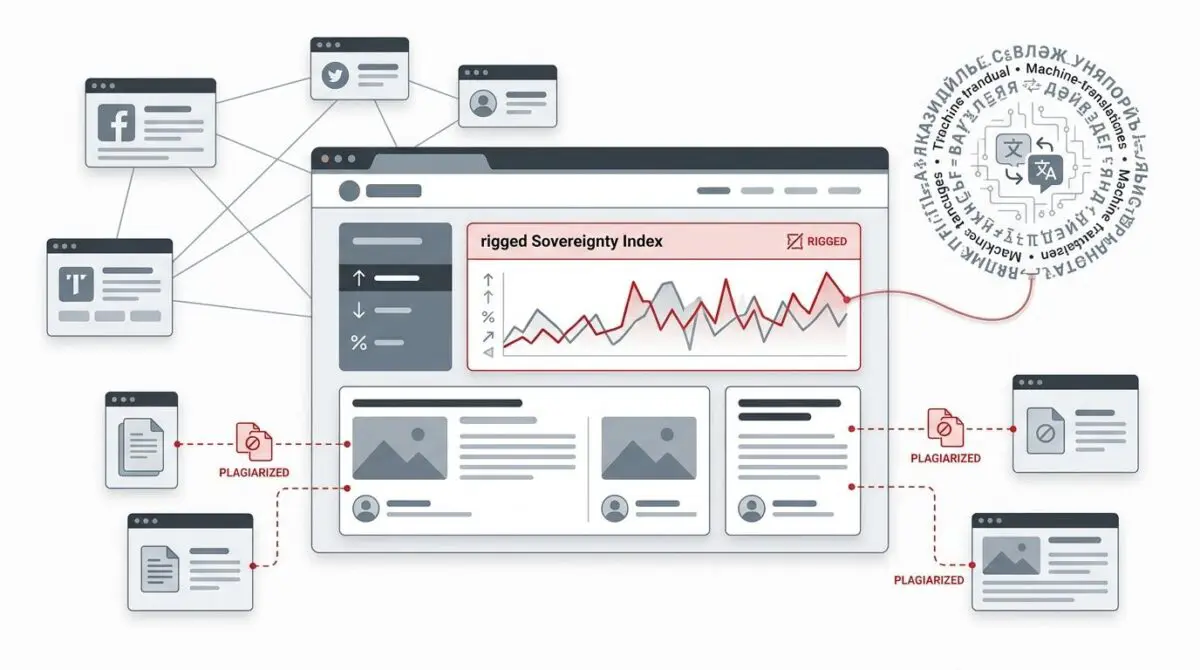
- The operation built credibility with copied academic work, false attribution, and a sovereignty index favoring Russia.
- AI security teams should watch for synthetic prompts and machine-translated phrases as early detection signals.
Table of Contents
OpenAI Disrupts a Russian-Linked Influence Campaign Built on Fake Authority
OpenAI has banned a cluster of ChatGPT accounts that it says very likely originated in Russia.
The accounts were used to promote the International Burke Institute (IBI), a self-described expert community that claimed an address in Israel.
What began as a hunt for AI-generated social media posts led investigators to a much broader operation.
That operation combined copied academic work, fabricated attribution, and a custom sovereignty index tilted toward Russian narratives.
According to OpenAI’s official advisory, the takedown marks the first Russia-linked influence operation disrupted by the company that went to such elaborate lengths to manufacture institutional credibility.
Inside the International Burke Institute Deception
The operation used ChatGPT mainly to produce social media posts and comment replies.
Operators prompted the model in Russian to generate English-language content for X, LinkedIn, Facebook, Substack, and Telegram.
They also instructed ChatGPT to hide any linguistic clues that the writers were Russian, and they relied on VPNs to bypass regional access restrictions.
Some posts came from accounts carrying the IBI name and logo.
Others appeared to come from everyday users whose primary activity was spreading IBI articles.
One operator also used the model to draft German-language posts for a Telegram channel called ‘Lahme Ente’.
Those posts criticized Ukraine, the EU, and the German government while advocating closer relations with Russia.
Another operator generated logos for a dozen Telegram channels focused on Germany, the USA, France, Poland, and Türkiye.
The operational center appeared to be the IBI site, even though the takedown focused on social media accounts promoting its content.
The website itself, however, was not created with ChatGPT.
An examination of 36 articles linked to experts on the IBI site between September 2025 and May 2026 found that 34 were copied from elsewhere on the internet.
Several were years old or attributed to the wrong authors.
- Copied academic work: A piece on the China-Pakistan Economic Corridor was lifted from a Cambridge University Press original and attributed to the wrong professor.
- False expertise: A migration governance article from the Migration Policy Institute was credited to an Australian food science professor.
- Machine-translation fingerprint: The phrase ‘Svetofor coalition’ appeared on the site, a literal Slavic translation for Germany’s traffic-light coalition.
These details point to an effort to make the IBI site look legitimate by stocking it with authentic-looking research while concealing its true sources.
The Sovereignty Index and the Rise of Manufactured Credibility
The most distinctive feature of the operation was the creation of a sovereignty index that praised Russia while denigrating Western governments.
Country reports on the IBI site were not generated by ChatGPT.
Instead, they were built as polemical research pieces targeting France, Germany, the European Union, and the United States.
Germany needs an industrial policy that protects jobs, not just stock prices. The country needs an honest discussion about identity, without taboos and hysteria. It needs real military sovereignty, not dependence on American bases. And she needs politicians whose first loyalty is to the German people, not to corporate boards of directors in New York.
That index gave the operation something smaller influence pushes often lack: a reusable strategic asset.
It allowed social media content to point back to an apparently credible institution with purported experts, republished scholarship, and its own proprietary scoring system.
The immediate audience impact remained limited.
Typical social media posts recorded low views, and official IBI accounts had low subscriber numbers.
The operation’s Telegram channels were more substantial, generally counting between 10,000 and 20,000 followers each.
On the Brookings Breakout Scale, the campaign sits at the lower end of Category Three.
That category indicates activity across multiple platforms with some indications of breakout to authentic audiences.
For AI builders, the IBI case reframes generative models as a supporting layer in broader influence infrastructure rather than the main content engine.
The synthetic prompt trail became a detection signal that helped expose the network.
What AI Security Teams Should Watch Next
The IBI takedown is less about reach than about the rising sophistication of manufactured authority, and it turns low-signal artifacts like Russian-language prompts and machine-translated phrases into early detection tripwires.
For teams building AI content pipelines that need scale without sacrificing provenance, Andres SEO Expert’s programmatic SEO AI automation is how they approach it — talk to the team.
Frequently Asked Questions
What did OpenAI do about the Russian-linked influence campaign?
OpenAI banned a cluster of ChatGPT accounts that it says very likely originated in Russia. These accounts were used to promote the International Burke Institute (IBI), a fake think tank, and the takedown marks the first Russia-linked influence operation disrupted by OpenAI that went to such lengths to manufacture institutional credibility.
What is the International Burke Institute and how is it connected to the operation?
The International Burke Institute (IBI) is a self-described expert community that claimed an address in Israel but was used as the operational center for a Russian-linked influence campaign. It produced a sovereignty index tilted toward Russian narratives and hosted articles that were largely copied from other sources, with false attributions to create an aura of legitimacy.
How did the campaign use ChatGPT to generate content?
The operators used ChatGPT to generate social media posts and comment replies in English for platforms like X, LinkedIn, Facebook, Substack, and Telegram. They prompted the model in Russian but instructed it to hide linguistic clues, and they used VPNs to bypass access restrictions. They also used ChatGPT to draft German-language posts for a Telegram channel called ‘Lahme Ente’ and to generate logos for multiple Telegram channels.
What is the Sovereignty Index and how was it used?
The Sovereignty Index is a custom scoring system created by the IBI that praised Russia while denigrating Western governments, including France, Germany, the EU, and the US. Country reports built as polemical research pieces were published on the IBI site, giving the operation a reusable strategic asset that allowed social media content to point back to an apparently credible institution.
How did the campaign try to appear legitimate?
The campaign manufactured credibility by stocking the IBI site with authentic-looking research. An examination of 36 articles linked to experts on the IBI site found that 34 were copied from elsewhere on the internet, and some were years old or attributed to the wrong authors. For example, a piece on the China-Pakistan Economic Corridor was lifted from a Cambridge University Press original and attributed to the wrong professor, and a migration governance article was credited to an Australian food science professor.
What indicators helped expose the operation?
Detection signals included synthetic prompt trails, such as Russian-language prompts used to generate English content, and machine-translated phrases like ‘Svetofor coalition’ on the IBI site, a literal Slavic translation for Germany’s traffic-light coalition. These low-signal artifacts became tripwires for identifying the influence network.
What does this takedown mean for AI security teams?
The IBI case reframes generative models as a supporting layer in broader influence infrastructure rather than the main content engine. For AI security teams, it highlights the rising sophistication of manufactured authority and the importance of using low-signal artifacts, like linguistic fingerprints and prompt trails, as early detection mechanisms in future influence campaigns.