Key Takeaways
- CW-Net adds a concept classifier to existing planners, producing real-time explanations that are causally faithful, not post-hoc guesses.
- In private-track tests, CW-Net caught a robotaxi’s misconfigured cyclist detection that a safety driver misattributed to a stop.
- With AV deployments growing, explainability is moving from research to a market-level safety requirement, yet public-road validation remains outstanding.
Table of Contents
MIT’s CW-Net Turns Black-Box Driving Logic Into Readable Concepts
Engineers at MIT and autonomous vehicle technology company Motional have built a method that translates the hidden reasoning of self-driving planners into plain, causally faithful concepts.
Reporting from MIT News on September 2, 2026 describes CW-Net, a module that explains vehicle decisions in real time without altering driving performance.
The research appears today in Nature. The team calls the technique the Concept-Wrapper Network, or CW-Net.
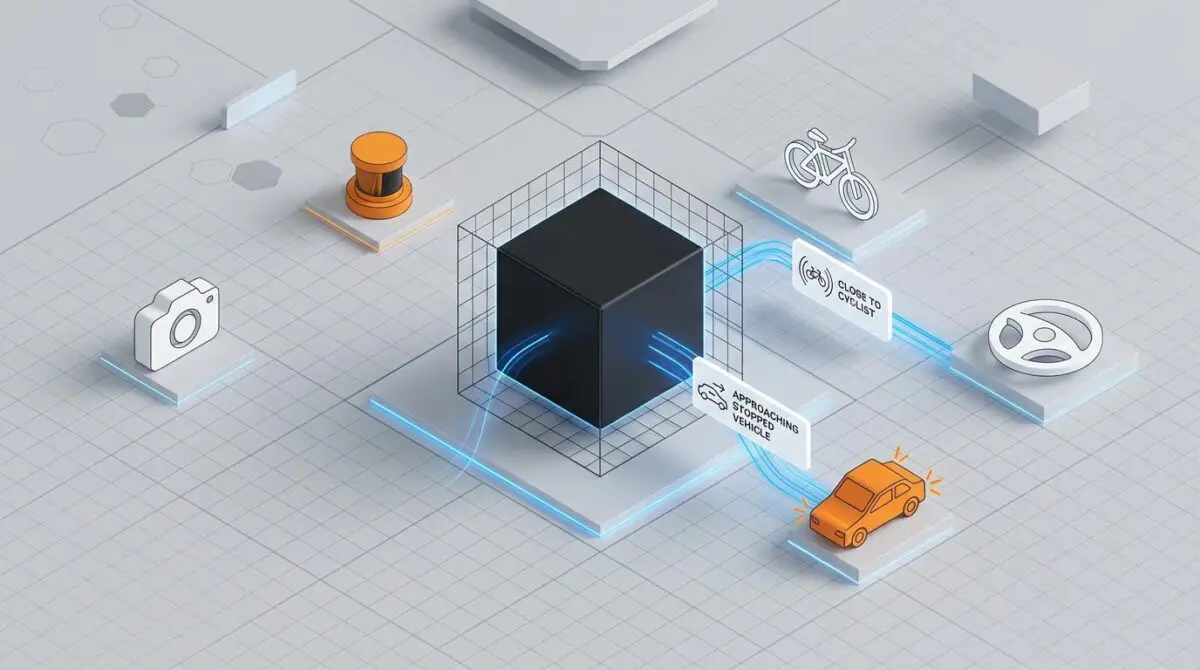
At its core, CW-Net converts opaque deep learning outputs into descriptors such as ‘approaching stopped vehicle’ or ‘close to cyclist.’
Those explanations are not post-hoc guesswork. They are generated from the same concepts the planner must use when it decides what the vehicle should do next.
“Unless we are building these technologies in a way that we can rely on and predict their behavior, then it is a shaky and unsafe foundation for their use.”
That warning comes from Julie Shah, MIT professor and co-senior author of the paper, as reported by MIT News. It frames the core problem CW-Net is designed to solve.
Inside the Concept-Wrapper Network: Causal Faithfulness Without Performance Loss
Modern autonomous driving stacks rely on deep learning planners that ingest camera and lidar data, compress the scene into an internal representation, and output a trajectory.
Those planners usually behave as black boxes. When a vehicle brakes unexpectedly or selects a risky path, safety drivers and engineers cannot easily reconstruct why.
CW-Net sits inside the existing planner architecture as a concept classifier.
It predicts high-level, human-readable state descriptors and then forces the downstream planning layers to use those concepts when selecting the next action.
That constraint is what makes the explanations causally faithful rather than post-hoc rationalizations.
The system outputs explanations alongside the vehicle trajectory in real time. That gives safety drivers actionable feedback during deployment and gives engineers a direct signal for debugging.
The model was trained on 130 million labeled driving scenes.
That scale is central to recognizing concepts across diverse settings while preserving the base planner’s driving decisions.
The most important design constraints are:
- Causal faithfulness: The concepts used for explanation are the same concepts used for planning.
- Performance preservation: The wrapper mimics existing planner behavior so it does not degrade driving quality.
- Real-time output: Explanations arrive with the vehicle trajectory, not in a delayed audit.
Road tests on a private track used a Motional robotaxi with a safety driver.
In one documented scenario, the safety driver assumed the vehicle stopped because it detected a cyclist.
CW-Net revealed that the planner was not properly configured to detect the cyclist and had chosen a trajectory that would have caused a collision.
The vehicle stopped because its emergency braking procedure activated at close range.
Armed with that explanation, the safety driver could intervene earlier or switch to manual control sooner. Engineers could also target the underlying detection failure instead of guessing.
A larger simulation study using real driving situations captured on Las Vegas roads produced similar results.
CW-Net explanations significantly improved participants’ ability to predict how the autonomous vehicle would behave.
Why Explainability Is Becoming a Market-Level Safety Requirement
The market does not lack autonomous deployments. Forbes has cataloged Waymo robotaxis operating across 11 U.S. markets, autonomous truck programs from Kodiak Robotics and Aurora, and freight delivery from Gatik.
But no currently available consumer system reaches Level 3 autonomy.
Sensor performance also degrades when snow, heavy precipitation, or worn lane markings obscure the environment.
That gap between deployment scale and system infallibility is where explainability shifts from research to operational necessity.
Safety incidents remain part of the public record, including the Cruise robotaxi shutdown after a pedestrian injury and the 2018 fatal Uber robotaxi collision with a bicyclist in Tempe, Arizona.
In the aftermath of such events, regulators and operators cannot easily reconstruct whether the failure was perception, planning, or execution.
Devdiscourse argues that black-box decision-making creates a responsibility gap.
A human overseer cannot meaningfully intervene if the vehicle’s detection, maneuver choice, and uncertainty are opaque.
Explainability, in that framing, is not a UX layer. It is a precondition for functional safety, liability assignment, and social acceptance.
A 2026 synthesis published by iaiai.org identifies the same priority across autonomous vehicles and healthcare AI.
Both domains need perception grounded in verified ground truth, uncertainty-aware decision support, and validation under operational constraints.
The synthesis also warns that systematic label errors can push models to optimize the wrong objective and propagate unsafe behavior into deployment.
CW-Net’s reliance on 130 million labeled scenes makes that warning directly relevant.
If concept labels are wrong, the wrapper could faithfully explain the wrong internal logic. That would deepen the trust problem instead of resolving it.
The current evidence is compelling but bounded.
On-track tests used a safety driver in controlled conditions, and the broader validation came from simulations rather than public-road deployments.
Independent production-scale verification across varied weather, traffic density, and edge cases has not yet been publicly established.
What CW-Net Changes for Autonomous Vehicle Operators Today
CW-Net turns the black-box problem from an abstract research concern into an engineering variable that safety drivers and developers can act on immediately.
For autonomous vehicle teams, the next milestone is not just more miles; it is proving that every unexpected maneuver can be explained, audited, and corrected before it becomes a safety event.
For AI teams building explainability and auditability into safety-critical systems, Andres SEO Expert’s programmatic SEO and AI automation applies the same operational discipline to technical content pipelines — contact us.
Frequently Asked Questions
What is MIT’s CW-Net for autonomous vehicles?
CW-Net, or Concept-Wrapper Network, is a module developed by MIT and Motional that translates the hidden reasoning of self-driving vehicle planners into human-readable concepts like ‘approaching stopped vehicle’ or ‘close to cyclist.’ It explains vehicle decisions in real time without altering driving performance and was reported in Nature.
How does CW-Net make self-driving car decisions interpretable?
CW-Net sits inside the existing planner architecture as a concept classifier. It predicts high-level, human-readable state descriptors and forces downstream planning layers to use those concepts when selecting the next action. This constraint ensures the explanations are causally faithful, meaning the concepts used for explanation are the same concepts used for planning, rather than post-hoc rationalizations.
Does CW-Net reduce autonomous vehicle driving performance?
CW-Net is designed with a performance preservation constraint that mimics existing planner behavior, so it does not degrade driving quality. It was trained on 130 million labeled driving scenes to recognize concepts across diverse settings while preserving the base planner’s driving decisions.
Why is explainable AI important for autonomous vehicle safety?
Explainability is becoming a market-level safety requirement because safety incidents remain part of the public record, and regulators cannot easily reconstruct whether failures were due to perception, planning, or execution. Explainable AI helps close the responsibility gap by enabling human overseers to meaningfully intervene when detection, maneuver choice, or uncertainty is opaque. It is a precondition for functional safety, liability assignment, and social acceptance.
How was CW-Net tested and validated?
CW-Net was tested on a private track using a Motional robotaxi with a safety driver, where it revealed a misconfigured cyclist detection that would have caused a collision. It was also evaluated in a larger simulation study using real driving situations from Las Vegas roads, where CW-Net explanations significantly improved participants’ ability to predict autonomous vehicle behavior.
What limitations remain for CW-Net’s explainability approach?
The current evidence is compelling but bounded. On-track tests used a safety driver in controlled conditions, and broader validation came from simulations rather than public-road deployments. Independent production-scale verification across varied weather, traffic density, and edge cases has not yet been publicly established. Additionally, since CW-Net relies on 130 million labeled scenes, systematic label errors could cause it to faithfully explain the wrong internal logic.
How can CW-Net help safety drivers and engineers today?
CW-Net turns the black-box problem into an engineering variable that safety drivers and developers can act on immediately. It outputs explanations alongside the vehicle trajectory in real time, giving safety drivers actionable feedback during deployment and engineers a direct signal for debugging. This helps identify whether failures stem from perception, planning, or execution, allowing earlier intervention and targeted fixes.