


Key Takeaways
- Worker Previews create an isolated deployment per Git branch with its own URL, configuration, state, and observability, all running under the same Worker as production.
- Fresh Durable Object namespaces and Container applications are provisioned for each preview, keeping sessions, migrations, and storage changes away from live production data.
- Cloudflare’s Agent Development Lifecycle pairs preview isolation with Workflows, @cloudflare/ci, and task-bound credentials so agents can test, patch, and verify without a human gate.
Table of Contents
Cloudflare’s Worker Previews Give Every Branch a Production-Like Sandbox
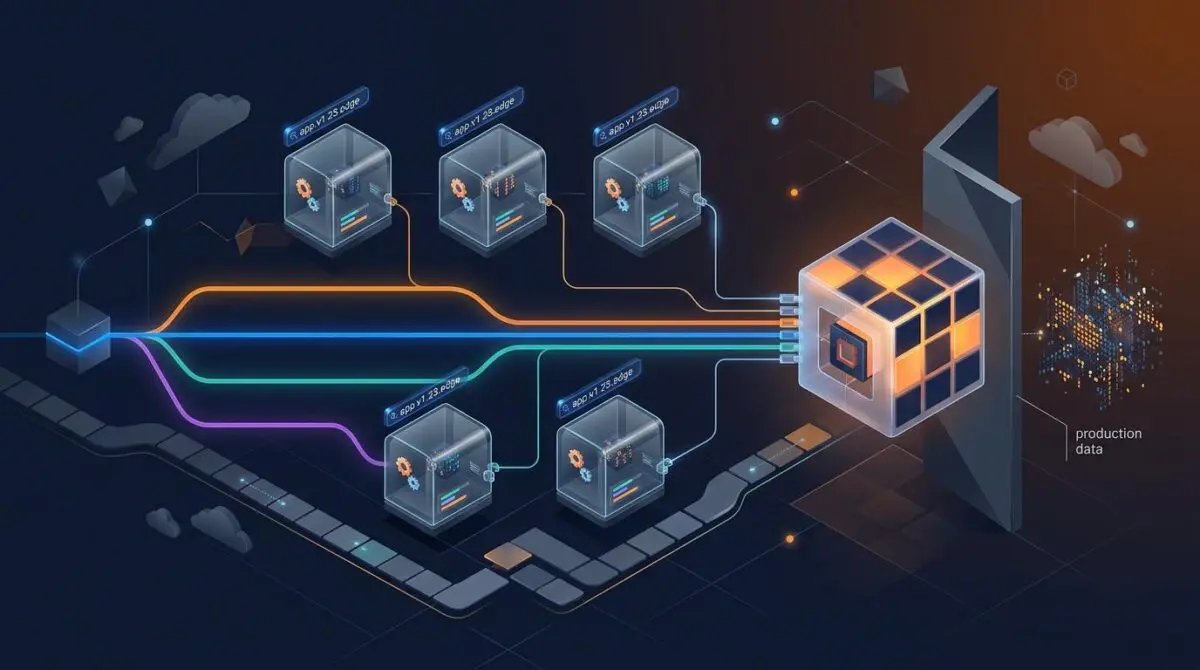
Cloudflare has launched Worker Previews, giving each Git branch an isolated deployment that runs with its own URL, configuration, state, and observability.
The capability targets a familiar failure mode: a change can pass staging and still break in production because it never touched production-grade resources.
With Worker Previews, running npx wrangler preview creates that environment before merge, and every push updates the same stable branch URL.
The result is a pre-production feedback loop in which code can be battle-tested against real runtime behavior before it reaches production traffic, according to Cloudflare.
Inside the Preview Architecture: State, Config, and Observability Per Branch
Cloudflare extends the branch model beyond source code. Production and each preview run under the same Worker, but every preview keeps a separate configuration surface and URL.
The dashboard groups all environments under one Worker breadcrumb, avoiding the older Wrangler environments pattern of deploying and managing a separate Worker per environment.
Cloudflare supports running hundreds of previews at once, with each branch operating independently.
If the Worker is linked to Git through Workers Builds, the preview is created automatically on push.
Stateful Isolation Without Touching Production Data
Stateful resources create the highest isolation risk because Durable Objects follow a singleton execution model.
A single instance owns storage for each object ID. If a preview shared the production namespace, a failed migration or schema change could modify live traffic.
For every npx wrangler preview, Cloudflare provisions a fresh Durable Object namespace and Container application for that branch.
In code, ctx.exports resolves to the production namespace in production and to the preview namespace inside a preview.
That separation keeps sessions, memory, storage changes, and migrations scoped to the branch.
Base Configuration and Custom-Domain Routing
A previews block in the Wrangler configuration defines a base environment for every preview.
Each branch starts from that base, but one preview can override variables, secrets, or bindings without changing production or other previews.
Preview URLs can sit on a custom domain, with Cloudflare Access available to protect them.
This allows authentication providers, cookies, CORS rules, and OAuth redirects to behave the way they will in production.
Cloudflare’s announcement shared a statement from IKEA senior software engineer Santosh Kumar Dwivedi:
Previews gives us the ability to iterate earlier at the edge. For IKEA.com, custom domain support helps us avoid Content Security Policy and cookie issues.
The company has also dogfooded the feature while building CloudflareOS, its open-source platform for safely connecting agents to company systems through Gatekeepers.
Observability and Agent Feedback Loops
Each preview receives its own logs, errors, metrics, and traces, so a failing request does not get lost in production traffic.
Workers Observability produces a waterfall trace for each request, showing fetch activity, binding operations, and handler invocations.
For agent-driven validation, Browser Run can launch the branch URL in a headless browser, step through login flows, capture screenshots, or record replayable DOM events.
Reviewers can watch sessions through Live View or step in with Human in the Loop when automation needs judgment.
That evidence gives agents enough context to deploy, click through a UI, query traces, patch code, redeploy, and verify without leaving the branch.
- Deploy isolated previews from a branch or CI.
- Share a stable URL that updates on every push.
- Isolate Durable Objects, Containers, sessions, and migrations.
- Inspect logs, errors, metrics, and traces per preview.
- Override any single preview’s configuration without disrupting the base.
- Protect preview URLs with custom domains and Cloudflare Access.
Some boundaries remain. For now, a preview’s service binding routes to the production deployment of the bound Worker.
Cloudflare says multi-Worker routing, isolated asynchronous flows, and durable staging environments are on the roadmap.
Why Agent-Created Code Forced a New Deployment Lifecycle
InfoQ reports that Cloudflare’s broader Agent Development Lifecycle announcement frames traditional CI as the bottleneck.
Human-in-the-loop approval creates friction when agents produce large volumes of changes across testing, deployment, and maintenance.
Cloudflare argues that a platform for agent-driven development must be programmatic, horizontally scalable, and event-driven.
Preview deployments are the layer that lets many agents test against isolated production-like environments at once, removing the staging queue.
Cloudflare positions Workflows as the orchestration core for this cycle.
It can provision containers on demand, drive headless browsers, and dispatch subagents.
Its new CI tool, @cloudflare/ci, runs on Workflows and supports step chains, cache reuse, and credentials.
That allows agents to remediate bugs, handle failures, and triage issues without waiting for a human gate.
Observability follows the same agent-scale assumption.
The new dashboard is OpenTelemetry-compatible and captures model calls, tool activity, and token usage.
Native integration with Think, Flue, and the AI SDK ties tracing into the tooling AI developers already use.
Security is also being reshaped around short-lived agency.
The Agent Access Model issues task-bound credentials with a capability ceiling.
A Trust Ratchet mechanism lowers what an agent can do after it accesses protected resources.
Together with preview isolation, these controls create a loop where agent changes are observable, revisable, and constrained.
The same validation pressure is not unique to Workers.
A legal technology platform team at Google Cloud Next Tokyo described the bottleneck as deployment and release rather than code writing.
As AI code generation accelerated, validation became the constraint.
That team split development into an inner loop from local work to pull request and an outer loop from pull request through CI, review, and deployment.
Outer-loop preview environments produced a dedicated URL per pull request, cutting feedback from hours to minutes for developers, designers, QA, and automated tests.
That independent case study reinforces Cloudflare’s position: production-like branch isolation is becoming a baseline requirement for agent-ready engineering.
The Production-Like Branch Becomes the Agent’s Test Harness
Worker Previews change the default from shared staging to isolated, production-grade branches.
For AI teams, that means every agent-generated change can be tested exactly where it will run, with state and traces attached.
Organizations building agent-driven release pipelines that need to scale, programmatic SEO and AI automation is how Andres SEO Expert approaches it — contact us.
Frequently Asked Questions
What are Cloudflare Worker Previews?
Cloudflare Worker Previews are isolated, production-like deployments created for each Git branch. Each preview gets its own URL, configuration, state, and observability, so changes can be tested against real runtime behavior before merging to production.
How do you create a Cloudflare Worker Preview?
Running npx wrangler preview creates a preview environment for the current branch. If the Worker is connected to Git through Workers Builds, Cloudflare creates the preview automatically on every push, and each push updates the same stable branch URL.
How do Worker Previews isolate Durable Objects and Containers?
For every npx wrangler preview, Cloudflare provisions a fresh Durable Object namespace and Container application for that branch. In code, ctx.exports resolves to the production namespace in production and to the preview namespace inside a preview, keeping sessions, memory, storage changes, and migrations scoped to the branch.
Can Worker Previews use custom domains and Cloudflare Access?
Yes. Preview URLs can run on a custom domain, and Cloudflare Access can protect them. This helps authentication providers, cookies, CORS rules, and OAuth redirects behave as they will in production. IKEA noted that custom domain support helped avoid Content Security Policy and cookie issues.
What observability do Worker Previews provide?
Each preview receives its own logs, errors, metrics, and traces. Workers Observability produces a waterfall trace for each request, showing fetch activity, binding operations, and handler invocations. Agents can also use Browser Run to launch the branch URL in a headless browser, capture screenshots, record replayable DOM events, and let reviewers watch via Live View or Human in the Loop.
Why do AI agents need production-like preview environments?
Agent-created code can produce many changes quickly, making human approval and shared staging queues a bottleneck. Cloudflare argues that agent-driven development needs programmatic, horizontally scalable, event-driven platforms. Worker Previews let many agents test against isolated production-like environments at once, with Workflows and @cloudflare/ci supporting orchestration, cache reuse, and automated remediation.
What are the current limitations of Cloudflare Worker Previews?
A preview service binding currently routes to the production deployment of the bound Worker. Cloudflare says multi-Worker routing, isolated asynchronous flows, and durable staging environments are on the roadmap.