
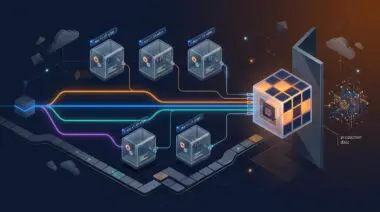




Key Takeaways
- Shopify’s GraphQL agent exceeds frontier-model quality while cutting serving costs 96%, from an estimated $27M to about $1M per year.
- The daily loop mines production failures, repairs trajectories, then runs supervised fine-tuning and GRPO with a calibrated LLM judge as the reward.
- Gist-token compression shrinks the static system prompt from roughly 6,000 to 1,500 tokens with no measured quality loss.
Table of Contents
Shopify’s GraphQL Agent Now Learns From Every Merchant Failure
Shopify has turned a frozen frontier-model baseline into a daily learning system for its GraphQL agent, and the operational numbers are extreme.
A case study published on the PyTorch blog on September 22, 2026, details an agent that now exceeds frontier-model quality while cutting serving costs by 96 percent and end-to-end latency by roughly 38 percent.
The agent handles up to 2,000 merchant requests per minute, converting natural-language store questions into Admin GraphQL API queries and plain-language answers.
More importantly, as the PyTorch blog notes, it no longer treats a rejected output as a one-off incident.
Each failure becomes a compressed lesson that flows back into the model’s weights on a daily cadence.
Inside the Daily Loop: Rubric, Repair, and Reinforcement
The Judge Is the Product Contract
Shopify starts with a scoring rubric spanning completeness, execution, response quality, and safety.
Annotators apply the rubric to randomly sampled production traffic, and inter-annotator agreement is measured with Cohen’s kappa.
A low kappa signals an ambiguous rubric, which gets revised before it can produce an LLM judge.
The team then calibrates the judge with DSPy and reflection-based optimizers such as GEPA and Agentic Context Engineering.
Backtests against previous A/B tests and targeted degradation tests confirm that the judge tracks real product behavior.
Autoresearch Pushes the Harness to Its Ceiling
Before touching model weights, Shopify pushes prompts, tool definitions, and orchestration code as far as possible.
An autoresearch agent proposes changes, scores them against the calibrated judge, and keeps only the improvements.
This stage strengthens the harness but leaves the model’s weights unchanged.
Mining Production Traffic for Hard Negatives
When harness changes plateau, the loop mines anonymized production traffic for conversations the judge scores low.
A panel of frontier reasoning models critiques each failure, and an arbiter merges those critiques into a repair instruction.
The conversation is then replayed from that point.
If the repaired trajectory passes the judge, it becomes training data; if not, Toloka annotators correct it against the same rubric.
Two-Stage Training With PyTorch
Healed trajectories first go through supervised fine-tuning on complete reasoning traces, not just final answers.
Then GRPO uses the calibrated judge as a reward to reinforce the strongest sampled responses.
The pipeline runs daily, and full-parameter fine-tuning is distributed across GPUs using tensor, context, and data parallelism in PyTorch.
Gist Tokens Compress the Prompt Tax
The GraphQL agent’s static system prompt is compressed from roughly 6,000 tokens to about 1,500 learned gist tokens.
A custom PyTorch trainer learns those embeddings by matching a full-prompt teacher’s output distribution while keeping model weights frozen.
vLLM then serves the model with continuous batching, and the shorter prefix removes much of the attention cost paid on every generated token.
Shopify reports no measured quality loss on the judge from the compression.
Why a 96% Serving Cost Cut Changes the Fine-Tuning Calculus
The financial gap between the frontier baseline and the fine-tuned model is not a rounding error.
Shopify estimates that serving the GraphQL agent on a frontier model could cost about $27 million per year based on average token costs.
The specialized model lands closer to $1 million per year, a 96 percent reduction.
That is the difference between a feature that is painful to run at platform scale and one that can remain on for every merchant.
- Serving cost: from an estimated $27 million per year to about $1 million.
- End-to-end latency: down roughly 38% at 350 requests per minute.
- Time-to-first-token: down about 19%.
- Throughput: up about 16% in requests per second and 12% in output tokens per second.
- Infrastructure footprint: about 14% fewer GPUs for the same traffic.
The combination of higher quality, lower cost, and lower latency changes the default assumption for teams running AI at scale.
Frontier models become the launch vehicle, while a specialized training loop becomes the production system.
For AI infrastructure leaders, the lesson is that frozen weights are a cost center; learned weights are a compounding asset.
The Flywheel’s Real Moat Is Institutional Memory
The moat is not the smaller model or the gist tokens; it is the loop that turns merchant experience into better weights every single day.
For teams building production AI that must improve from real usage, that loop is the system to design first.
Programmatic SEO and AI automation at Andres SEO Expert applies the same compounding-loop discipline to content systems — contact Andres SEO Expert.
Frequently Asked Questions
What is Shopify’s GraphQL agent and how does it work?
Shopify’s GraphQL agent converts merchant natural-language store questions into Admin GraphQL API queries and plain-language answers. It handles up to 2,000 merchant requests per minute and now learns from production failures on a daily cadence.
How does Shopify’s continual learning loop improve the GraphQL agent?
The loop scores sampled production traffic with a rubric and calibrated LLM judge, pushes the harness via autoresearch, mines low-scoring conversations as hard negatives, repairs them with frontier reasoning models, and then fine-tunes the model daily using supervised fine-tuning and GRPO.
Why is the judge called the product contract?
The judge is built from a rubric covering completeness, execution, response quality, and safety. Human annotations, Cohen’s kappa, DSPy calibration, backtests, and degradation tests ensure the judge tracks real product behavior before it is used as a reward.
What are gist tokens and why do they matter for serving cost?
Gist tokens compress the GraphQL agent’s static system prompt from roughly 6,000 tokens to about 1,500 learned embeddings. vLLM then serves the shorter prefix with continuous batching, cutting much of the attention cost paid on every generated token with no measured judge quality loss.
How much does Shopify save by fine-tuning instead of using a frontier model?
Shopify estimates frontier-model serving at about $27 million per year versus about $1 million per year for the specialized model, a 96 percent reduction. Latency drops roughly 38 percent, time-to-first-token drops about 19 percent, throughput rises, and infrastructure needs about 14 percent fewer GPUs.
What is the real moat in Shopify’s GraphQL agent system?
The moat is not the smaller model or the gist tokens. It is the daily loop that turns merchant experience, failures, and repairs into better model weights, creating institutional memory and a compounding asset.
What can AI infrastructure leaders learn from Shopify’s continual learning loop?
Frontier models can serve as the launch vehicle, but a specialized continual learning loop should become the production system. Frozen weights are a cost center; learned weights that improve from real usage are a compounding asset.