Executive Summary
- Composable Architecture Transition: Leading institutions are abandoning monolithic cores for API-first, cloud-native ledgers like Mambu and Thought Machine to eliminate technical debt and enable real-time product iteration.
- Agentic Orchestration: The integration of LangGraph and the Model Context Protocol (MCP) is shifting operations from human-led tasks to autonomous Agent-to-Agent (A2A) economies, driving ROI through 75% autonomous query handling.
- Post-Quantum Security Mandate: To protect against long-term decryption risks, the 2026 standard requires Hybrid Cryptographic Architectures utilizing ML-KEM-768 and ML-DSA-65 algorithms for all settlement protocols.
The Shift from Monoliths to Ecosystem Orchestration
The era of the isolated financial platform has ended. In the current landscape, the most successful enterprises are those that view their technology not as a fortress, but as a node in a global, interconnected network. As of 2026, the market has signaled a definitive move toward the collaborative fintech stack—a modular, interoperable system designed to facilitate the seamless flow of value across borders, protocols, and institutional boundaries. This transition is driven by a hyper-concentration of capital, where 80% of venture funding is now directed toward AI-centric infrastructure that prioritizes connectivity over isolation.
For the strategic decision-maker, the goal is no longer just to build a functional product, but to architect a system that is a team player. This means moving away from legacy batch processing and toward real-time, composable layers that can interact with external agents, decentralized treasuries, and unified settlement ledgers. The ROI of this shift is measurable: mature automation programs are reporting returns of up to 520% on document processing, while AI-driven support systems have reduced handle times from nearly nine minutes to under two.
The Composable Core: Defining the Modern Foundation
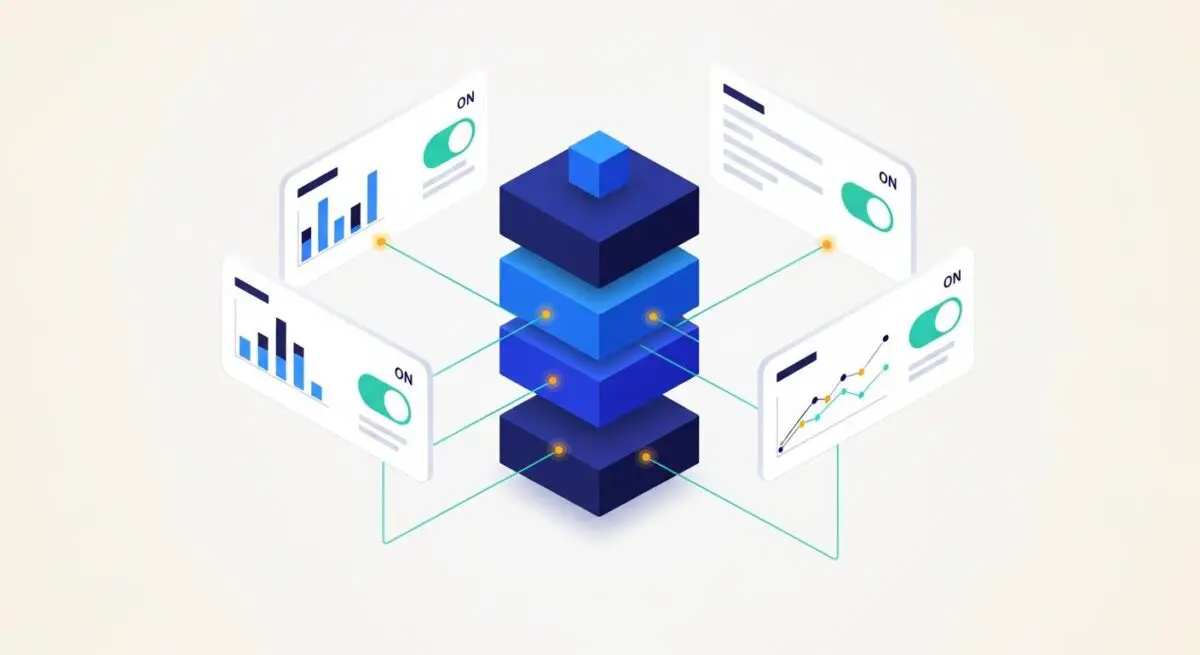
At the heart of the collaborative stack lies Composable Architecture. This approach replaces the traditional, rigid banking core with a series of API-first microservices that can be swapped, updated, or scaled independently. Unlike legacy systems that require months of hard-coding to launch a new financial product, a composable core uses smart contracts and cloud-native ledgers to define products as code. This allows for a plug-and-play environment where a bank or fintech can integrate best-in-class solutions for KYC, lending, or payments without disrupting the entire system.
The Rise of Cloud-Native Ledgers
Providers like Thought Machine and Mambu have become the preferred engines for this transformation. By utilizing a cloud-native approach, these platforms bypass the internal technical debt that has historically hindered innovation. The strategic advantage here is twofold: reduced operational overhead and the ability to participate in the A2A (Agent-to-Agent) economy. When the core ledger is accessible via standardized APIs, autonomous agents can execute complex financial tasks—such as liquidity rebalancing or cross-border settlement—with minimal human intervention.
Autonomous Agent Orchestration and the A2A Economy
The most significant leap in the fintech stack is the integration of autonomous agents. We have moved beyond simple chatbots to deterministic, stateful multi-actor workflows. Using frameworks like LangGraph, enterprises are now deploying agents that can hire other agents to perform specialized tasks. For example, a treasury agent might identify a liquidity gap and autonomously engage a verification agent via the Model Context Protocol (MCP) to validate a counterparty’s credentials before executing a trade.
Deterministic Execution and Auditability
A common hurdle in AI adoption has been the pilot-to-production gap, often caused by the unpredictable nature of large language models. To solve this, the collaborative stack utilizes graph-based orchestration. This ensures that while the agent can reason and make decisions, its execution path remains within a deterministic framework that passes SOC 2 and financial audit trails. This level of control is essential for institutional trust and allows for the scaling of AI deployments to a point where they become cost-neutral within 18 months.
Liquidity Orchestration and Global Settlement Rails
One of the primary frictions in global finance is liquidity fragmentation. Corporate treasurers often manage dozens of banking relationships, leading to billions in trapped capital. The collaborative stack addresses this through interoperability with new settlement protocols like Project Agorá and Project Nexus. These initiatives aim to link domestic instant payment rails—such as FedNow and TIPS—into a unified ledger system.
Tokenized Commercial Deposits
By combining tokenized commercial bank deposits with central bank reserves, the modern stack enables T+0 settlement. This is further supported by the prudentialization of stablecoins under frameworks like the GENIUS Act, which mandates 1:1 backing by high-quality liquid assets. For a team-player stack, this means the ability to move value across different currencies and jurisdictions as easily as sending an email, reducing the reliance on traditional sponsor banks and their associated fees.
Imagine the modern fintech stack as a high-pressure hydraulic system. In this environment, the team player is not the one who holds the most water, but the one who provides the most efficient valves and pipes. Success is measured by the lack of turbulence and the speed at which pressure—or capital—can be redirected to where it is needed most without leaking value through legacy friction.
Security and Post-Quantum Readiness
As the stack becomes more interconnected, the attack surface expands. The 2026 mandate for financial infrastructure is the adoption of Hybrid Cryptographic Architectures. This is a proactive defense against the harvest now, decrypt later risk posed by future quantum computing capabilities. By implementing standardized algorithms such as ML-KEM-768 for key encapsulation, firms are building a trust moat that protects sensitive financial data and settlement instructions.
Regulatory Compliance as a Competitive Edge
While compliance is often viewed as a burden, in the collaborative stack, it is a strategic asset. Adhering to the EU AI Act or PSD3 requirements forces a level of transparency and risk management that builds institutional confidence. Early adopters who implement robust frameworks for AI transparency and open banking interfaces find themselves with direct access to central bank settlement systems, bypassing intermediaries and significantly improving their unit economics.
Andres’ Masterclass: The Wealth Architecture
The transition toward collaborative financial infrastructure is not merely a technical upgrade; it is a fundamental shift in how capital is deployed and managed. We are observing a market where the traditional boundaries between banking, SaaS, and asset management are dissolving. The hidden signal here is the move from speculative growth to high-barrier infrastructure. As capital concentrates into AI-centric platforms, the winners will be those who control the orchestration layer—the software that decides where and how value moves across a fragmented global landscape. This is no longer about owning the customer relationship in a vacuum; it is about owning the interoperability that makes the customer relationship valuable.
From a strategic standpoint, the ROI of the collaborative stack is found in its ability to unlock trapped liquidity and automate complex decision-making at scale. For institutional investors and founders, the focus must remain on the LTV:CAC ratio, which is increasingly dictated by the efficiency of the underlying technology. By investing in composable, agent-ready, and post-quantum secure systems, enterprises are not just future-proofing their operations—they are positioning themselves as the primary conduits for the next generation of global wealth. The roadmap is clear: those who build for connectivity will capture the flow, while those who build in isolation will be bypassed by the very networks they sought to lead.
The Future of Integrated Finance
The ultimate fintech stack is one that prioritizes the collective efficiency of the ecosystem. By embracing modularity, autonomous orchestration, and advanced settlement protocols, organizations can transcend the limitations of legacy finance. This is the blueprint for a resilient, scalable, and highly profitable financial future.
In a landscape defined by rapid technical shifts, strategy is the only sustainable defense. Whether you are architecting for the generative search era or optimizing for operational ROI, the right partnership defines your success. Connect with Andres at Andres SEO Expert to build a future-proof foundation for your enterprise.