

Key Points
- AI-Driven Automated Code Analysis (AACA) shatters the traditional peer-review deadlock, reclaiming up to 14 hours per week for senior engineers by autonomously handling routine security and style checks.
- The industry is rapidly pivoting from general-purpose LLMs to specialized Reasoning Models, enabling deterministic code synthesis and formal verification that catches 92% of deep logical regressions.
- Forward-thinking enterprises are adopting Live Autonomous Refactoring, paving the way for zero-maintenance codebases that dynamically optimize for cloud-spend and CPU/GPU efficiency in real-time.
Table of Contents
The Core Friction: Shattering the Peer-Review Deadlock
According to a May 2026 report from Gartner, 85% of enterprise software engineering teams now utilize autonomous AI agents to perform pre-merge code reviews. This paradigm shift has resulted in a staggering 55% reduction in critical production vulnerabilities compared to 2024. The era of manual, line-by-line human inspection is rapidly coming to a close.
For decades, the software development lifecycle has been bottlenecked by an invisible tax known as the Peer-Review Deadlock. This friction occurs when highly paid developers spend up to 40% of their week waiting for human feedback on pull requests. It is a corporate traffic jam on a multi-billion dollar digital highway.
During this waiting period, context switching destroys developer momentum. Engineers are forced to jump between active development and reviewing legacy code, leading to cognitive fatigue and widespread burnout.
Furthermore, human reviewers often suffer from review fatigue, blindly approving pull requests to clear their queues. This psychological friction leads to the rapid accumulation of technical debt. Trivial syntax errors and glaring security loopholes routinely slip into production simply because the human eye is not designed for exhaustive, deterministic verification.
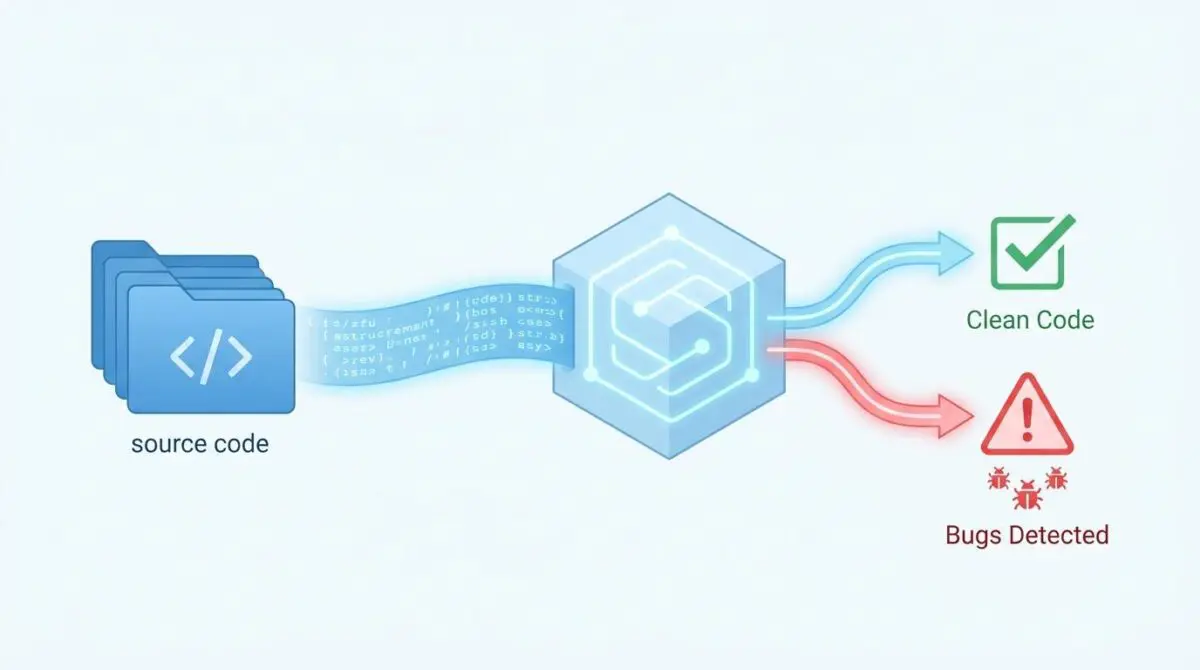
Enter AI-Driven Automated Code Analysis (AACA). This is not merely a developer tool; it is a fundamental restructuring of enterprise engineering architecture. AACA eliminates the Peer-Review Deadlock entirely by automating 90% of routine security and style reviews.
By removing the human bottleneck from the most tedious aspects of quality assurance, organizations are unlocking unprecedented engineering velocity. Enterprise software teams are now experiencing 10x faster release cycles, moving from monthly deployments to continuous, daily delivery without compromising safety.
Market Intelligence & Smart Capital Flow
The financial implications of this technological leap are massive, and institutional investors are taking notice. The smart money is aggressively positioning itself around autonomous engineering workflows. To understand the scale of this disruption, we must look at the underlying market metrics driving this transformation.
Market Intelligence & Data
Projected Market Value
The global market for AI-powered developer tools is expected to reach $15.4 billion by the end of 2026, driven by enterprise adoption of automated security agents as reported by IDC.
Developer Productivity Gain
Forrester Research indicates that the average senior engineer saves 14 hours per week by offloading bug detection and documentation tasks to AI agents in 2026.
Venture Capital Inflow
Crunchbase data shows that $4.8 billion was invested into ‘Agentic Coding’ and ‘Autonomous DevOps’ startups in the first quarter of 2026 alone.
Reduction in Hotfixes
Data from the 2026 DORA Report reveals that organizations using AI-driven automated reviews have seen a 68% decrease in emergency production hotfixes over the last 12 months.
This data paints a clear picture of a market in hyper-growth. Saving 14 hours a week per senior engineer translates to millions of dollars in reclaimed productivity for a mid-sized enterprise.
Instead of hunting for missing semicolons or memory leaks, top-tier talent is now entirely focused on high-level system architecture and product innovation. This is why we are seeing significant venture capital investment in specialized AI coding startups. The capital markets recognize that code generation is only half the battle; code verification is where the true enterprise value lies.
While dominant players like GitHub with their Copilot X-Series and GitLab with Duo Pro hold substantial market share, the landscape is actively being disrupted. Elite venture firms like Founders Fund and Thrive Capital are saturating specialized startups such as Magic.dev and Poolside.
These disruptors are not just building better autocomplete features. They are engineering entirely new paradigms of machine understanding, focusing heavily on deterministic outcomes rather than probabilistic text generation.
The Strategic Deep Dive: Architecture and Psychology
To fully grasp the impact of AACA, executives must look beyond the surface-level productivity metrics. The true revolution lies in the underlying architecture of these AI systems and how they fundamentally alter the psychology of engineering teams. We are witnessing a transition from reactive bug fixing to proactive, autonomous system healing.
The Shift to Agentic Review Workflows
In 2026, the concept of code review has officially transitioned from static linting to Agentic Review Workflows. Traditional static analysis tools were the equivalent of digital spell-checkers. They were noisy, rigid, and lacked contextual awareness, often generating thousands of false positives that developers simply ignored.
Today, AI agents operate with multi-million token context windows. This means the AI does not just read a single isolated snippet of code; it holds the entire repository architecture in its working memory.
Because the AI understands the global state of the application, it can predict how a minor change in a backend database schema will cascade and potentially break a frontend API endpoint. This holistic understanding enables the killer strategy of the modern era: Self-Healing CI/CD pipelines.
In this workflow, AI agents autonomously detect logical regressions the moment code is committed. But they do not stop at detection.
These agents immediately generate a fix, apply it, and verify the patch through synthetic testing environments. All of this happens in milliseconds, long before a human developer even opens the pull request.
The psychological relief this provides to engineering teams is immeasurable. The fear of deploying broken code to production is virtually eliminated, allowing teams to ship features with absolute confidence and aggressive speed.
Reasoning Models Over General LLMs
The early iterations of AI coding assistants relied on general-purpose Large Language Models (LLMs). While impressive, these models were fundamentally probabilistic. They guessed the most likely next sequence of characters, which occasionally resulted in hallucinated functions or subtle security flaws.
The industry has now pivoted sharply toward proprietary Reasoning Models. These models are specifically trained for logic, memory safety, and formal verification.
Internal data from Microsoft’s 2026 Engineering Excellence survey reveals that AI-driven code reviewers now catch 92% of ‘logic bomb’ vulnerabilities that were historically missed by senior human reviewers during the initial development phase. Logic bombs are complex, multi-step vulnerabilities that only trigger under highly specific conditions.
A human reviewer, suffering from cognitive fatigue, will almost always miss these hidden traps. A deterministic Reasoning Model, however, maps every possible execution path with mathematical precision.
This shift toward specialized engineering models is heavily corroborated by the recent Gartner report on AI software engineering trends. The report highlights that the competitive advantage of the next decade will belong to companies that deploy AI not just for code generation, but for rigorous, autonomous code auditing. By moving away from general-purpose LLMs, enterprises are ensuring that their automated reviews are grounded in deterministic logic rather than probabilistic guessing.
The Executive Action Plan: Toward Zero-Maintenance
For C-level executives and technical founders, understanding the current state of AACA is not enough. You must anticipate the next evolutionary leap.
The organizations that dominate their respective markets in the late 2020s will be those that view their codebase not as a static asset, but as a living, self-optimizing organism. The strategic roadmap requires a fundamental shift in how we perceive software maintenance.
Strategic Trajectory
- Transition toward ‘Live Autonomous Refactoring’ as the next major technological evolution.
- Deploy AI systems to continuously monitor production performance and resource consumption.
- Enable automated refactoring of codebase sub-sections in real-time for CPU/GPU efficiency.
- Optimize enterprise cloud-spend through autonomous, performance-driven code adjustments.
- Adopt a ‘Zero-Maintenance’ codebase strategy where AI manages the entire development lifecycle.
- Bridge the gap between proactive bug detection and complex legacy code migration using AI agents.
The next evolution outlined in this trajectory is Live Autonomous Refactoring. Businesses must prepare for AI systems that operate directly alongside production environments. These agents will continuously monitor application performance, identifying bottlenecks and resource-heavy functions.
When a spike in latency is detected, the AI will automatically refactor that specific sub-section of the codebase in real-time. It will rewrite inefficient loops, optimize database queries, and deploy the updated code without human intervention.
This is not just an engineering optimization; it is a direct financial strategy. By allowing AI to optimize for CPU and GPU efficiency dynamically, enterprises can drastically reduce their monthly cloud-spend.
An autonomous agent that shaves milliseconds off a high-volume transaction process can save a company millions in AWS or Azure computing costs annually. This performance-driven code adjustment is the ultimate ROI of AI-driven engineering.
The ultimate goal of this executive plan is the realization of a Zero-Maintenance codebase. In this paradigm, human engineers are entirely removed from the business of legacy code migration and bug patching.
The AI manages the entire lifecycle, ensuring that the infrastructure remains secure, efficient, and modern. Founders must begin bridging the gap today by integrating agentic workflows into their CI/CD pipelines, setting the foundation for fully autonomous operations tomorrow.
Conclusion: The Autonomous Enterprise
The integration of AI-Driven Automated Code Analysis is no longer an experimental luxury. It is a critical survival mechanism in an increasingly aggressive digital economy.
The companies that cling to manual peer-review processes will be out-shipped, out-innovated, and out-maneuvered by competitors leveraging agentic workflows. By shattering the review deadlock and embracing self-healing pipelines, enterprises can achieve unprecedented scale.
The shift toward specialized reasoning models and live autonomous refactoring represents a fundamental change in the economics of software development. It transforms technical debt from a crippling liability into an automated, self-resolving process. As we move closer to the reality of zero-maintenance codebases, the role of the software engineer will elevate from a manual laborer of syntax to a visionary architect of systems.
Navigating the intersection of technology, capital, and market psychology requires a sharp strategy. To future-proof your business architecture and scale with precision, connect with Andres at Andres SEO Expert.
Frequently Asked Questions
What is the Peer-Review Deadlock in software engineering?
The Peer-Review Deadlock is a significant development bottleneck where software engineers spend up to 40% of their week waiting for manual code reviews. This delay causes context switching, cognitive fatigue, and the accumulation of technical debt as human reviewers often approve pull requests quickly to clear queues.
How does AI-Driven Automated Code Analysis (AACA) impact developer productivity?
AACA automates approximately 90% of routine security and style reviews. According to data from 2026, this technology saves senior engineers an average of 14 hours per week, allowing them to focus on high-level architecture and reducing production vulnerabilities by 55%.
What is the difference between Reasoning Models and general LLMs in AI coding?
General LLMs are probabilistic, meaning they guess the next sequence of characters, which can lead to code hallucinations. Reasoning Models are specifically trained for logic, memory safety, and formal verification, allowing them to catch 92% of complex ‘logic bomb’ vulnerabilities with mathematical precision.
What are Agentic Review Workflows and Self-Healing CI/CD?
Agentic Review Workflows use AI agents with massive context windows to understand entire repository architectures. In a Self-Healing CI/CD pipeline, these agents automatically detect logical regressions, generate a fix, and verify the patch through synthetic testing before a human even opens the pull request.
How can autonomous code refactoring lower enterprise cloud costs?
Live Autonomous Refactoring involves AI agents monitoring production environments to identify performance bottlenecks. By automatically rewriting inefficient loops and optimizing database queries for CPU/GPU efficiency, companies can drastically reduce their monthly cloud computing spend on platforms like AWS and Azure.
What defines a Zero-Maintenance codebase strategy?
A Zero-Maintenance codebase strategy is a paradigm where AI systems manage the entire development lifecycle. This includes continuous performance monitoring, automated bug patching, and legacy code migration, effectively removing the need for manual human maintenance of software infrastructure.