



Key Takeaways
- NVIDIA Vera CPU delivers 1.8x faster sustained per-core performance under full load, directly improving RL training and agentic inference.
- Monolithic 88-core design achieves 40% lower peak loaded latency and 3x per-core memory bandwidth vs. x86 CPUs, at half the power.
- By reducing KV-cache evictions, Vera maximizes GPU utilization, translating CPU speed into higher AI factory throughput.
Table of Contents
Agentic AI Meets Its Match: NVIDIA Vera CPU Breaks Cover
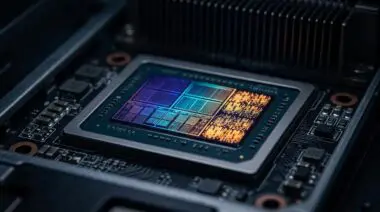
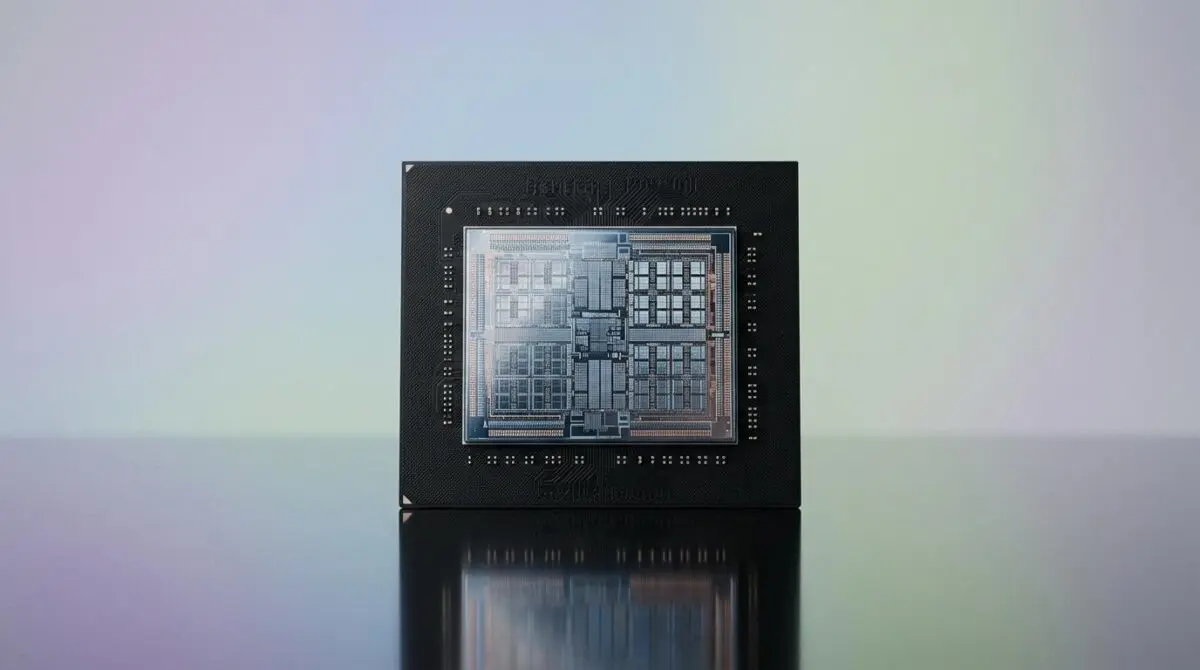
Earlier this week, NVIDIA unveiled the Vera CPU, a monolithic 88-core Arm-based processor purpose-built for agentic AI workloads. Unlike traditional data center CPUs optimized for parallel throughput, Vera is engineered as a ‘max single-threaded CPU at scale,’ delivering 1.8x faster sustained per-core performance under full socket load. The chip directly tackles the sequential bottlenecks that throttle reinforcement learning training, inflate latency in interactive agentic deployments, and waste GPU compute cycles through KV-cache evictions.
How Vera CPU Reshapes the AI Factory CPU Paradigm
Agentic AI systems run sequential workflows: inference, tool calls, code execution, and retrieval. Each step depends on single-threaded CPU speed. Vera’s 88 Olympus cores, unified cache, and Scalable Coherency Fabric deliver 40% lower peak loaded latency and over 3x the per-core memory bandwidth at less than half the power of traditional x86 CPUs, according to NVIDIA. The chip’s design avoids multi-chiplet performance cliffs, ensuring predictable latency even under heavy concurrent load.
Accelerating Reinforcement Learning Feedback Loops
In RL training, the CPU generates environment rollouts that feed gradient updates. A slower CPU leaves evaluations incomplete within the training window. Baseline CPUs complete only 45% of evaluations; Vera’s 1.8x faster cores raise that to 85%, delivering richer feedback for more accurate policy updates. Features like a neural branch predictor and deep out-of-order execution keep pipelines moving through complex control flow in simulators and reward logic.
Cutting Tail Latency for Interactive Agents
For live agentic deployments, predictable latency is critical. Vera’s monolithic die and unified cache reduce variance. The chip achieves 40% lower peak loaded latency versus x86 CPUs, ensuring tool responses stay on schedule. LPDDR5x memory provides up to 1.2 TB/s total bandwidth and 14 GB/s per core, preventing data starvation in multi-tenant sandbox environments.
Maximizing GPU Utilization by Minimizing KV-Cache Recomputation
When CPU-side tool calls take too long, the GPU may evict a session’s KV-cache to accommodate other requests. Vera’s faster execution compresses the gap between GPU steps, reducing eviction pressure. This keeps more context resident in HBM, minimizing expensive recompute. The result: more GPU cycles go to token generation, not rebuilding context.
Why Vera’s Single-Threaded Dominance Matters More Than Core Count
As detailed in the official technical release, NVIDIA is positioning Vera not as a parallel monster but as a ‘max single-threaded CPU at scale.’ Tom’s Hardware reports that the company emphasizes sequential performance as the key advantage for agentic AI. Real-world tests show 1.8x higher agentic sandbox performance under peak load compared to traditional x86 CPUs, as highlighted in a recent NVIDIA Facebook post. This single-threaded focus is a strategic departure from the core-count race that has defined the data center CPU market for a decade.
HPCWire notes that Vera’s strength lies in combining strong per-core performance under load, sufficient memory bandwidth per core, and predictable latency. These attributes are often overlooked in benchmark suites that favor aggregate throughput but are critical for the step-by-step nature of agentic workflows. By optimizing for the median agent’s path, rather than peak parallel throughput, NVIDIA is building a CPU that directly addresses the pain points of modern AI factories.
Furthermore, the revelation that next-gen ‘Rigel’ Arm CPU cores are on the roadmap signals NVIDIA’s long-term commitment to optimizing for sequential AI execution. This positions Vera as not just a product, but a platform shift for how AI infrastructure is designed.
The CPU Is Back: Vera Marks a New Era for AI Infrastructure
The NVIDIA Vera CPU reestablishes the processor as a first-class citizen in the AI factory. By addressing the three critical paths—RL training, interactive latency, and GPU efficiency—Vera enables higher throughput, smarter models, and lower total cost of ownership for agentic AI deployments. As the industry pivots from pure GPU compute to balanced systems, Vera sets a new standard for what a CPU must deliver in the age of agents.
Staying ahead in the rapidly shifting landscape of AI requires precision. To future-proof your digital strategy and scale effortlessly, you need a foundation built on precision. Optimize your site with advanced speed engineering, secure your infrastructure in high-performance hosting environments, and streamline your entire workflow through autonomous AI pipelines. If you are ready to elevate your systems, Connect with Andres at Andres SEO Expert to build your ultimate architecture.
Frequently Asked Questions
What makes the NVIDIA Vera CPU different from traditional data center CPUs?
Unlike traditional CPUs optimized for parallel throughput, Vera is a monolithic 88-core Arm-based CPU engineered for maximum single-threaded performance at scale. It delivers 1.8x faster sustained per-core performance under full socket load, directly addressing the sequential bottlenecks in agentic AI workflows like reinforcement learning, interactive latency, and GPU utilization.
How does Vera improve reinforcement learning training?
In RL training, the CPU generates environment rollouts. Vera’s 1.8x faster cores allow 85% of evaluations to complete within the training window, compared to only 45% with baseline CPUs. This provides richer feedback for more accurate policy updates, thanks to features like a neural branch predictor and deep out-of-order execution.
How does Vera reduce latency for interactive agentic deployments?
Vera’s monolithic die and unified cache reduce variance, achieving 40% lower peak loaded latency versus x86 CPUs. Combined with LPDDR5x memory offering up to 1.2 TB/s total bandwidth and 14 GB/s per core, it ensures predictable and fast tool responses even under heavy concurrent loads.
How does Vera help maximize GPU utilization?
By speeding up CPU-side tool calls, Vera shortens the gap between GPU steps, reducing the pressure to evict KV-cache from HBM. This keeps more context resident, minimizing expensive recomputation and allowing more GPU cycles to be spent on token generation rather than rebuilding context.
Why does NVIDIA emphasize single-threaded performance over core count for Vera?
Agentic AI workflows are inherently sequential (inference, tool calls, code execution). Vera’s design prioritizes strong per-core performance under load, sufficient memory bandwidth per core, and predictable latency—attributes critical for step-by-step agentic tasks but often overlooked in benchmarks that favor aggregate throughput.
What is the significance of the Rigel CPU cores mentioned in the article?
The revelation that next-gen ‘Rigel’ Arm CPU cores are on the roadmap signals NVIDIA’s long-term commitment to optimizing for sequential AI execution. It positions Vera not just as a product but as a platform shift, indicating that future CPUs will continue to target the specific needs of agentic AI workloads.
What are the key architectural features of Vera that enable its performance?
Vera features 88 Olympus cores, a unified cache, and a Scalable Coherency Fabric. It avoids multi-chiplet performance cliffs, ensuring predictable latency. The chip includes a neural branch predictor, deep out-of-order execution, and LPDDR5x memory for high per-core bandwidth, all at less than half the power of traditional x86 CPUs.