Key Takeaways
- Meta’s FBTriton fork consolidates custom GPU compiler optimizations like TLX and autoWS into one distributable package.
- An agentic ingestion loop bundles upstream commits into safe low-risk batches or context-heavy risky chains to manage dependency order.
- A three-tier L1/L2/L3 validation hierarchy balances cost and risk, with a green trunk requiring constant team discipline.
Table of Contents
- Meta Lifts the Lid on FBTriton: The GPU Compiler Fork Running Its AI Fleet
- How Agentic Bundling and Three-Tier Validation Keep a Compiler Fork Alive
- The FBTriton Playbook: What Meta’s Compiler Strategy Means for Enterprise AI Teams
- Flawless CI Is a Team Sport: Hard Lessons from Meta’s Compiler Infrastructure
Meta Lifts the Lid on FBTriton: The GPU Compiler Fork Running Its AI Fleet
Meta’s PyTorch team has published an unusually candid technical deep-dive into FBTriton, the downstream fork of OpenAI’s Triton compiler that powers GPU training and inference workloads across the company’s entire AI infrastructure.
The July 30 post on the PyTorch engineering blog, authored by Xu Zhao, Agron Tsai, Wenyuan Chi, and Alexey Loginov, reveals how Meta consolidates custom GPU compiler innovations — including TLX and autoWS — into a single distributable package while continuously synchronizing with a fast-moving upstream repository.
Since its consolidation in Q3 2025, FBTriton has served as an optimization runway not just for Meta engineers, but for external collaborators including NVIDIA, AMD, and academic partners who co-design compiler and DSL innovations on the platform.
The architecture hinges on two interlocking systems: an agentic ingestion loop that intelligently bundles upstream commits, and a stratified L1/L2/L3 validation hierarchy designed to catch everything from kernel-level numeric mismatches to silent production regressions.
What makes the post remarkable is its willingness to document the gap between engineering ideals and production realities — a topic most infrastructure teams at this scale discuss internally but rarely publish.
How Agentic Bundling and Three-Tier Validation Keep a Compiler Fork Alive
Maintaining a downstream compiler fork while upstream moves fast is a structural headache.
As detailed in the PyTorch blog post, the Meta team chose continuous cherry-picking over periodic full-trunk rebases, betting that decoupling daily development from large-scale merge events would reduce friction.
But architectural divergence creates real tension. FBTriton uses distinct strategies for layout interfaces, quantization, and warp specialization — areas where it diverges materially from upstream Triton’s code paths.
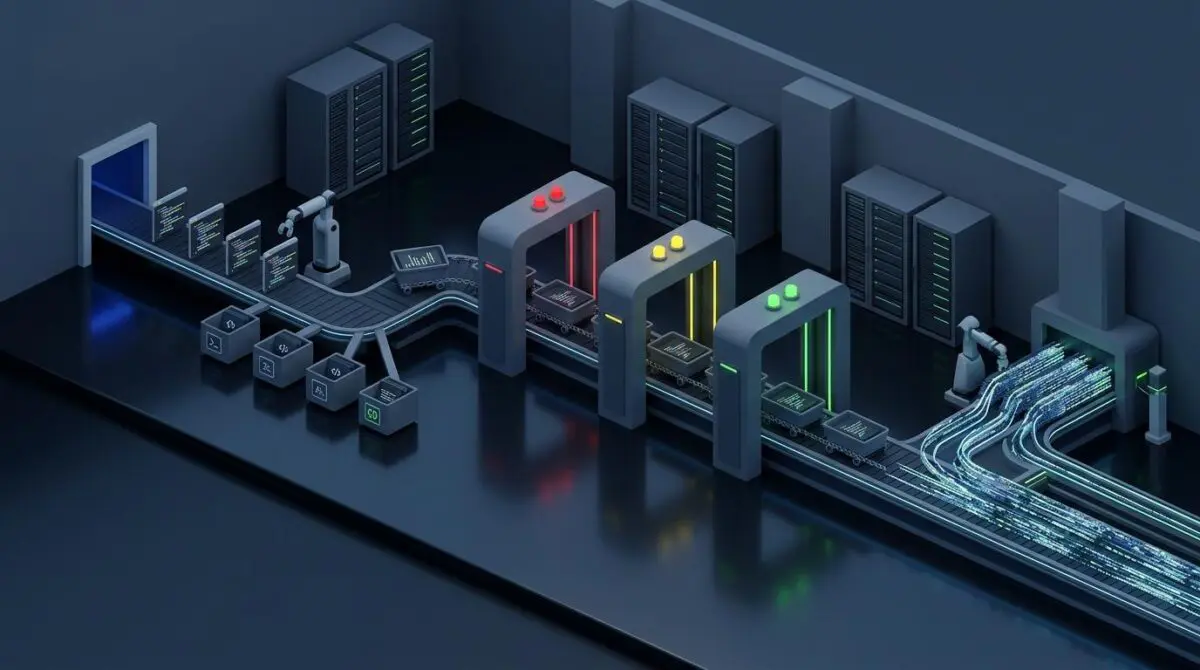
To clear the ingestion backlog without overwhelming CI engineers with manual conflict resolution, the team built an agentic loop that classifies upstream commits into two categories: large low-risk bundles and context-heavy risky chains that preserve dependent change ordering.
Dependency tracking checks whether an incoming patch touches files or symbols linked to an existing risky chain.
If a correlation exists, the patch groups into that chain automatically. Otherwise, the commit lands in a safe batch — one example being commit #1872, which the post cites as a representative low-risk bundle.
This risk-partitioned approach allows out-of-order landing, meaning clean upstream features ship immediately rather than stalling behind a single complex dependency.
Progress is measured through two decoupled metrics. The primary metric is Days Behind Upstream, tracking how far the ingestion tip lags behind the upstream main branch. The counter metric is Backlog Commits, which tracks older unpicked commits still outstanding.
Decoupling these numbers lets CI engineers drive forward progress without conflating it with backlog triage — a subtle operational insight that prevents teams from optimizing the wrong signal.
Inside the L1/L2/L3 Validation Architecture
A risky Triton change — including something as foundational as an LLVM version bump — can trigger cascading regressions that manifest as silent efficiency drops, increased compilation time, or subtle drift in model performance metrics like normalized entropy.
Testing every signal for every commit is financially impossible. A single-GPU correctness check finishes in seconds. Validating job-level metrics may require GPU clusters running for hours.
The team’s solution is a three-tier hierarchy organized by value-to-cost ratio.
L1 diff tests run at every code change, executing LITs, Triton unit tests, TLX tutorial kernel correctness checks, and internal customer kernel tests.
L2 trunk tests are periodic and resource-intensive — think tritonbench runs sweeping required matrix-multiplication shapes or distributed training jobs — and are fully bisectable on metric regressions to automatically locate culprit commits.
L3 manual tests are heavy, on-demand production workloads provided by internal teams that consume significant GPU hours and require explicit metric sign-off from area owners.
This tiered design acknowledges an uncomfortable truth: perfect coverage is uneconomical, so you triage risk by cost.
The Operational Friction No Blueprint Captures
The team learned a painful lesson when a silent bug in an underlying test infrastructure layer began omitting L1 test suites without raising alerts.
False negatives went unmonitored, creating a blind spot that could have masked real regressions. The fix was a saturated validation strategy — adopting diverse testing harnesses like servicelab and spreading compute capacity across both internal and OSS pipelines to eliminate single points of failure.
Another operational reality: errors left on the trunk mask subsequent regressions, yet diff authors often ignore failures that appear unrelated to their code.
These overlapping error lifecycles can paralyze daily triage within days. Maintaining a green trunk, the post argues, demands continuous team discipline rather than tooling alone.
The team also grapples with a context gap. As a core compiler group, they cannot maintain a complete view of every downstream workload and model architecture across Meta’s fleet. The only viable mitigation is a dynamic, continuous context-sharing loop between teams so compiler optimizations stay aligned with evolving fleet realities.
The FBTriton Playbook: What Meta’s Compiler Strategy Means for Enterprise AI Teams
Meta’s decision to publicly document FBTriton’s architecture signals more than technical transparency — it reflects a maturing recognition that AI compiler infrastructure has become strategic terrain.
When companies like Meta invest in downstream compiler forks with agentic ingestion and stratified validation, they are betting that off-the-shelf compiler tooling cannot keep pace with the optimization demands of production-scale AI.
The post’s emphasis on operational metrics — Days Behind Upstream rather than raw commit counts — reveals a philosophy worth studying. The team optimizes for synchronization velocity with upstream, not for vanity metrics that might look good in a dashboard but obscure real engineering debt.
For enterprise AI teams running large-scale GPU workloads, the FBTriton architecture offers a reference model. The agentic bundling approach demonstrates how AI agents can absorb tedious engineering work — merge conflict resolution, infrastructure issue reporting, test result summarization, and error grouping — without replacing the deterministic safety rails that guard compiler correctness.
The post is notably sober about this balance. Agentic solutions are ‘deeply integrated’ into daily workflow, but the team warns explicitly that the underlying physics of compilers and hardware remain unchanged, and that agentic velocity must always be guarded against both AI hallucinations and human error.
This is not the breathless AI-agent triumphalism common in industry discourse. It is a measured, battle-tested assessment from engineers operating at enormous scale.
The validation hierarchy also carries lessons. Many organizations over-test cheap signals and under-test expensive ones, creating an illusion of coverage while leaving their costliest failure modes unchecked. Meta’s explicit L1/L2/L3 stratification by cost-to-value is a framework that generalizes well beyond compiler infrastructure.
The post’s candor about infrastructure single points of failure — that silent test harness bug that went undetected — is the kind of war story that seasoned infrastructure engineers will recognize immediately. Redundancy in validation paths is not paranoia. It is the difference between catching a regression and shipping it to production.
Flawless CI Is a Team Sport: Hard Lessons from Meta’s Compiler Infrastructure
The most striking passage in the PyTorch team’s post may not be about compilers at all.
A high-craftsmanship CI system cannot be built in a day. It requires not only putting code together, but also putting teams together, and sustaining that cultural alignment over time.
This is the hard-won insight that separates infrastructure documentation from infrastructure wisdom.
The engineering ideal — fully autonomous, zero-noise, instantaneous CI/CD that maps perfectly to subsystem-level metrics — collides with production reality. Coarse metrics do not fully capture risk. Fleet-scale stability demands localized operational discipline alongside abstract tracking.
Meta’s FBTriton story is ultimately about managing this collision honestly. The post does not pretend the system is flawless. It documents the context gaps, the overlapping error lifecycles, the silent test harness failures, and the constant vigilance required to keep a green trunk.
For AI infrastructure teams watching this space, the takeaway is clear: compiler strategy is not just a technical decision. It is an organizational commitment that spans tooling, team discipline, partner ecosystems, and the cultural willingness to document failures as openly as successes.
The same principle applies wherever complex technical systems meet operational reality. Whether managing a GPU compiler fork or optimizing the infrastructure that powers high-traffic digital experiences, the gap between ideals and realities is bridged by disciplined process, not just clever architecture. Teams building AI-driven automation pipelines face analogous challenges — agentic velocity must be paired with deterministic guardrails, and continuous validation must catch what coarse metrics miss.
Likewise, the performance engineering discipline that keeps a compiler fork fast and stable shares its DNA with the optimization work that makes web infrastructure resilient under load. And when infrastructure reliability becomes the difference between uptime and outage, the lesson of saturated validation — never trusting a single testing path — applies with equal force to cloud environments serving production traffic.
Building systems that earn trust at scale demands the same craftsmanship the Meta team describes: putting code together, putting teams together, and sustaining that alignment over time. If your own infrastructure projects demand that level of technical rigor — whether in AI automation, performance engineering, or cloud reliability — AI-driven automation pipelines can transform how you scale, while the right performance engineering discipline ensures nothing ships slow, and infrastructure resilience keeps everything running when it matters most.
To explore how these capabilities fit your stack, connect with Andres and start a conversation with Andres SEO Expert.
Frequently Asked Questions
What is FBTriton and how does Meta use it?
FBTriton is Meta’s downstream fork of OpenAI’s Triton compiler, used to power GPU training and inference workloads across Meta’s AI infrastructure. It consolidates custom GPU compiler innovations like TLX and autoWS into a single distributable package while staying synchronized with upstream Triton.
How does Meta synchronize FBTriton with upstream Triton?
Meta uses continuous cherry-picking over periodic full-trunk rebases, decoupling daily development from large-scale merge events. An agentic loop classifies upstream commits into low-risk bundles and context-heavy risky chains, allowing clean upstream features to land immediately.
What is agentic bundling in FBTriton’s ingestion pipeline?
Agentic bundling is an automated system that categorizes upstream commits into safe batches or risky chains based on dependency tracking. It reduces the burden on CI engineers by grouping related changes and preserving order for risky commits, while allowing low-risk bundles to land out-of-order.
What are the L1, L2, and L3 validation tiers in Meta’s compiler testing?
L1 runs at every code change with quick tests like LITs and unit tests. L2 runs periodic resource-intensive trunk tests, such as tritonbench, and is fully bisectable. L3 involves heavy on-demand production workload tests requiring explicit metric sign-off from area owners.
What operational challenges did Meta’s FBTriton team encounter?
They faced a silent bug in test infrastructure that skipped L1 tests without alerts, overlapping error lifecycles that masked regressions, and a context gap between the compiler team and downstream workloads. Solutions included saturated validation and continuous context sharing.
What lessons does FBTriton offer for enterprise AI teams?
FBTriton shows the value of optimizing for synchronization velocity using metrics like ‘Days Behind Upstream’, adopting cost-stratified validation hierarchies, and pairing agentic automation with deterministic guardrails. It also emphasizes cultural alignment and documenting failures for long-term CI reliability.