Key Takeaways
- Born from the 1975 MIT-BIH Arrhythmia Database, PhysioNet has become the global benchmark for biomedical data sharing, cited by over 15,000 studies last year.
- Its tiered access model—Open, Restricted, and Credentialed—enforces rigorous governance while keeping high-quality healthcare datasets accessible to AI researchers.
- As the LLM era demands unprecedented scale, PhysioNet is evolving with user annotations, annual conferences, and open-source infrastructure for future AI training.
Table of Contents
- From Magnetic Tapes to Machine Learning: The Unlikely Birth of Healthcare AI’s Most Critical Data Engine
- How a 1970s Arrhythmia Project Built the Scaffolding for Modern Biomedical AI
- Why PhysioNet’s Access Architecture Matters More Than Ever in the LLM Era
- The Data Commons Model That Outlived Its Founders—And What Comes Next
From Magnetic Tapes to Machine Learning: The Unlikely Birth of Healthcare AI’s Most Critical Data Engine
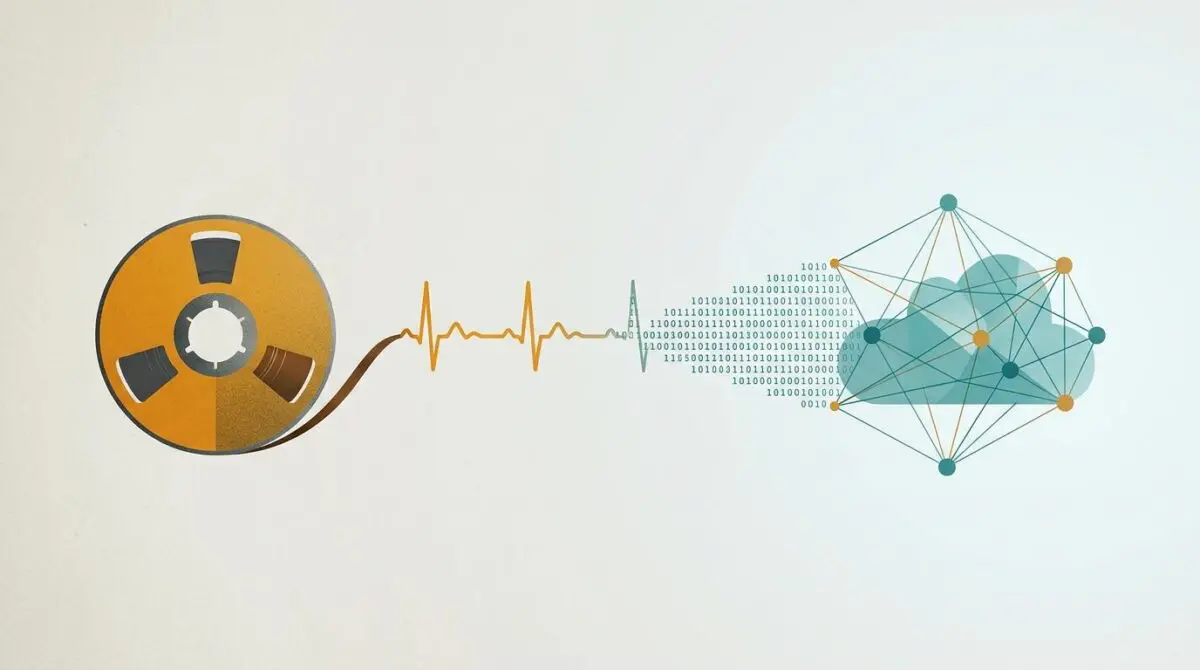
In 1975, a team of MIT and Beth Israel Hospital researchers began hand-digitizing electrocardiogram recordings onto painstakingly duplicated magnetic tapes, building custom computers to annotate more than 100,000 data points by summer 1980.
They expected fewer than a dozen academic groups would ever request a copy.
Instead, MIT News reports that those tapes became the MIT-BIH Arrhythmia Database—the foundational seed of PhysioNet, which launched in 1999 and has since evolved into one of the most comprehensive biomedical and clinical data repositories on the planet.
Last year alone, more than 15,000 scientific publications cited PhysioNet, and registered users now span over 180 countries.
The platform’s trajectory from mailed magnetic reels to a globally adopted data-sharing standard reshaped not just cardiology research, but the entire landscape of healthcare artificial intelligence.
How a 1970s Arrhythmia Project Built the Scaffolding for Modern Biomedical AI
Thomas Heldt, Richard J. Cohen Professor in Medicine and Biomedical Physics and associate director of MIT’s Institute for Medical Engineering and Science, describes PhysioNet’s founding as ‘incredibly visionary’—a phrase that undersells how radical the concept was at the time.
Before cloud-based collaboration became the default, medical data lived in isolated silos.
Investigators who needed clinical datasets had no choice but to gather them independently, making cross-study comparisons nearly impossible and driving research costs prohibitively high.
As documented by MIT News, the MIT-BIH Arrhythmia Database broke that paradigm by design.
Over a decade, the founding team mailed roughly 100 copies of their annotated recordings to research groups worldwide, establishing a precedent that data sharing could accelerate discovery rather than threaten academic competitiveness.
By 2009, the platform had already undergone multiple technological metamorphoses—magnetic tapes gave way to burned CD-ROMs, which yielded to FTP servers on the nascent internet.
That same year, a PhD student named Tom Pollard, now a research scientist at MIT’s Laboratory for Computational Physiology and technical director of PhysioNet, confronted a data bottleneck while studying critically ill patients at a London hospital system.
Hospital information systems were built for patient care and administration, not research reuse.
Data fragmentation across disparate systems made curating coherent research resources both difficult and expensive.
Pollard’s search for a solution led him to MIMIC—the Medical Information Mart for Intensive Care—a de-identified electronic health record database hosted by PhysioNet.
That discovery altered the course of his career: after completing his dissertation with MIMIC at its core, Pollard relocated to MIT to help build the database’s next generation.
Why PhysioNet’s Access Architecture Matters More Than Ever in the LLM Era
The platform now operates under a three-tier access model—Open Access, Restricted Access, and Credentialed Access—each calibrated to the sensitivity of the underlying data.
As outlined by CASRAI, the credentialing process requires researchers to complete a CITI Program course on data or specimens-only research and sign resource-specific Data Use Agreements that bind individuals, not institutions.
These agreements universally forbid re-identification, raw data redistribution, and sharing with non-credentialed parties.
Critically, secondary use of de-identified credentialed data does not automatically bypass institutional review board oversight; that determination remains with the researcher’s home institution.
This governance framework has made PhysioNet the de facto standard for health AI research.
Google DeepMind researcher Vivek Natarajan has stated that both PhysioNet and MIMIC ‘set the standard, and it’s still the standard right now.’
The platform hosts what Natarajan describes as the highest-quality datasets available for healthcare AI research, making it an ‘important cornerstone that has catalyzed all the progress in health-care AI over the last decade.’
Ziad Obermeyer, associate professor at UC Berkeley’s School of Public Health, articulated a deeper structural insight: the true bottleneck in research is not ideas or talent, but friction.
When data access is slow, expensive, and difficult, the ideas that perish first are the high-risk ones—the experiments that probably will not succeed but would be transformative if they did.
‘PhysioNet lowers the fixed cost of trying ambitious ideas,’ Obermeyer noted, ‘and that changes what science becomes possible.’
The platform’s user community has undergone a seismic demographic shift.
Originally dominated by biomedical signal processing specialists and cardiovascular researchers, PhysioNet now serves staff at large technology companies, educators, medical practitioners across every specialty, and—most significantly—researchers in health-related machine learning and AI.
Heldt confirms that AI and ML practitioners now ‘dominate the user community,’ a transformation that mirrors the broader collision between healthcare and computational intelligence.
The Data Commons Model That Outlived Its Founders—And What Comes Next
On July 14, 2026, PhysioNet co-founder Roger G. Mark died at age 87.
His passing, announced on the PhysioNet website, closes a chapter that began with a conviction he expressed in a 2017 faculty profile: ‘Data should be available for use by essentially the entire world community of research people.’
Mark and his collaborator George Moody, who also died before receiving joint recognition, were awarded the 2026 IEEE Biomedical Engineering Award for ‘leadership in ECG signal processing and global dissemination of curated biomedical and clinical databases, thereby accelerating biomedical research worldwide.’
The platform they built now faces its next evolutionary pressure: the LLM era demands data at scales and levels of curation that even PhysioNet’s current architecture was not originally designed to accommodate.
Pollard and Heldt envision an annual conference and a pilot system enabling users to annotate data and contribute domain expertise directly into the platform, enriching resources for an increasingly interdisciplinary research community.
The source code for PhysioNet remains public, and derivative platforms like Health Data Nexus have already emerged from its architectural DNA.
What started as 100 mailed magnetic tapes has become a self-sustaining ecosystem where data contributors and data consumers feed the same loop, accelerating discovery in a field where speed translates directly into saved lives.
The infrastructure decisions made today—around access governance, annotation quality, and interoperability with AI training pipelines—will determine whether PhysioNet remains the standard for another quarter-century or becomes a revered ancestor in a rapidly maturing ecosystem.
For organizations building AI systems that depend on high-integrity biomedical data, the lesson is clear: the quality of your models is a direct function of the quality and accessibility of the data infrastructure beneath them. Whether you are architecting programmatic data pipelines, optimizing cloud environments for large-scale training workloads, or engineering platforms that demand both speed and compliance, the foundational principles PhysioNet demonstrated—open access paired with rigorous governance—apply far beyond healthcare.
Andres SEO Expert specializes in translating these same principles into technical reality, from AI automation workflows to managed cloud infrastructure engineered for performance at scale—AI automation and programmatic pipeline design that turns raw data into structured advantage, managed cloud hosting built for demanding production environments, and the strategic technical counsel that ensures your platform is ready for what the next decade demands. Andres SEO Expert brings the engineering rigor your infrastructure deserves. Connect with Andres to start the conversation.
Frequently Asked Questions
What is PhysioNet and why is it important for healthcare AI?
PhysioNet is a comprehensive biomedical and clinical data repository launched in 1999 that hosts curated datasets like the MIT-BIH Arrhythmia Database and MIMIC. It has become the de facto standard for health AI research, with over 15,000 scientific publications citing it last year.
How does PhysioNet’s three-tier access model work?
PhysioNet uses Open Access, Restricted Access, and Credentialed Access tiers. Credentialed Access requires completing a CITI Program course and signing Data Use Agreements that prohibit re-identification, raw data redistribution, and sharing with non-credentialed parties.
What is the MIT-BIH Arrhythmia Database?
The MIT-BIH Arrhythmia Database is the foundational dataset of PhysioNet, created in 1975 by MIT and Beth Israel Hospital researchers who hand-digitized ECG recordings onto magnetic tapes. It became the seed for PhysioNet and established a precedent for global data sharing.
Why is data access the true bottleneck in research according to Ziad Obermeyer?
Ziad Obermeyer argues that the bottleneck is friction, not ideas or talent. When data access is slow, expensive, and difficult, high-risk transformative ideas perish first. PhysioNet lowers the fixed cost of trying ambitious ideas, changing what science becomes possible.
What role did Roger G. Mark play in PhysioNet’s development?
Roger G. Mark was a co-founder of PhysioNet who championed the belief that data should be available to the entire world research community. He died in 2026 and received the IEEE Biomedical Engineering Award for leadership in ECG signal processing and global dissemination of curated biomedical databases.
How is PhysioNet adapting to the LLM era?
PhysioNet is responding to the LLM era’s demand for large-scale data and curation by planning an annual conference and a pilot system that lets users annotate data and contribute domain expertise. This enriches resources for an increasingly interdisciplinary research community.