


Key Takeaways
- 95% of ChatGPT users also use Google, and this overlap stayed flat for 8 months—proving AI is additive, not a replacement.
- AI’s impact is fragmenting (ChatGPT’s share fell from 76% to 53%) and shifting from rankings to citations, with AI referral traffic converting at 14-17%.
- Brands must adopt an and-strategy: keep SEO fundamentals while adding AI visibility metrics like citation frequency and share of model.
Table of Contents
95% Overlap, Zero Movement: The Data Point That Silences the Replacement Narrative
Worldwide visits to generative AI platforms hit 9.5 billion a month in May 2026, a 70% year-over-year surge that, read in isolation, screams displacement.
App downloads reached 4.4 billion over the same window, up 58%, reinforcing the impression of a user base abandoning traditional search en masse.
Similarweb reports a single figure that demolishes that interpretation: the share of ChatGPT users who also use Google sat at 95% in September 2025, and eight months later, after hundreds of millions of new visits, it remains 95%.
If generative AI were substituting for search, that overlap number would be falling as users switched over. It isn’t moving at all.
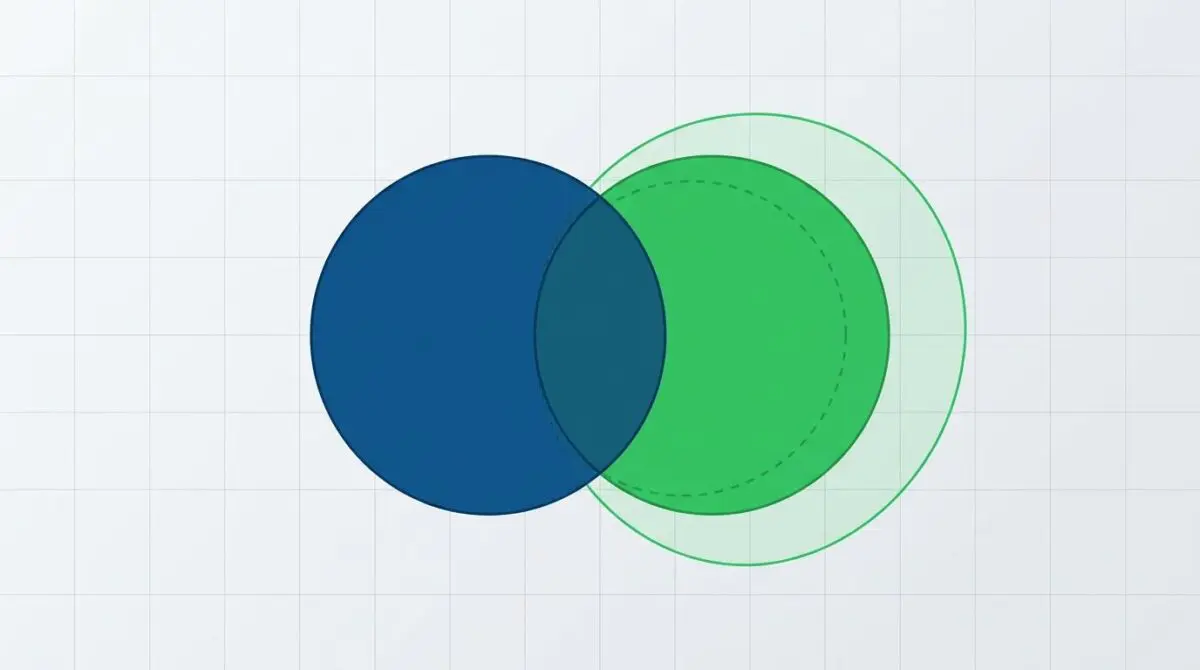
Substitution and addition produce opposite signatures in user overlap data.
A declining overlap would signal users dropping Google as they adopt AI platforms.
A flat overlap while total usage explodes—exactly what the data shows—is the fingerprint of a population adding tools to an existing habit, not swapping one for another.
Growth Without Displacement: How to Read the Numbers Side by Side
The confusion plaguing the search industry stems from comparing two metrics that measure entirely different phenomena.
Usage growth answers ‘how much are people using AI.’ Overlap answers ‘are they using it instead of search, or in addition to it.’
Growth alone cannot distinguish substitution from expansion—you need to know what happened to the old behavior while the new one expanded.
As detailed in Similarweb’s analysis, the overlap number provides exactly that second data point, and it says addition, not replacement.
ChatGPT’s share of worldwide generative AI web traffic slid from roughly 76% a year ago to around 53% today, as Gemini, Claude, Perplexity, and DeepSeek absorb the difference.
That is redistribution within the AI category, not a shift away from search.
If generative AI were genuinely displacing search, the more likely pattern would be consolidation around a single winner—the way real replacements typically unfold.
A four-way split instead looks like a category still sorting out its winners, with a user base hedging across multiple unproven tools while keeping a stable fallback like search firmly in rotation.
The report carries a structural caveat worth naming rather than glossing over: it explicitly excludes generative AI API usage, desktop applications, and in-app AI features.
Those are precisely the segments most likely to be replacing search-like workflows—a developer calling an API to summarize documentation, or a power user running everything through a desktop client, never appears in this dataset.
If real substitution is happening anywhere, this methodology is structurally blind to the population most likely to show it.
That doesn’t undercut the finding; it scopes it.
Within the browser- and app-based audience the report can actually observe, overlap is flat.
Whether the same holds for the heaviest, most workflow-integrated users is a separate question this data cannot answer.
Gemini’s worldwide app audience grew from roughly 401 million monthly active users in June 2025 to nearly 716 million in May 2026—a 78% increase in under a year.
Yet Google’s own search index remains the substrate several of these AI products depend on to answer anything.
Growth in one does not require decline in the other when the AI layer is largely built on top of the search layer rather than instead of it.
The demographic data reinforces the expansion narrative from a different angle.
Gen AI users aged 18-34 made up 61% of the user base in May 2024; by 2026 that had fallen to 50%.
An 11-point swing in roughly two years is large in proportional terms—larger, relative to its own base, than either of the headline 70% or 58% growth figures.
The other half of the user base, everyone 35 and older, has grown large enough this early to pull the average down 11 points in two years.
That is a demographic shift moving considerably faster than the search-substitution behavior this article is built around, which has not moved at all in eight months.
ChatGPT’s ad penetration data tells a parallel story about monetization risk.
Ad penetration inside ChatGPT chats nearly doubled in the same window the overlap number sat still—from 14% in May 2026 to 26% by June 2026.
Normally, a platform builds a captive, differentiated audience first and monetizes second.
Here, ads are scaling into a user base that is still 95% shared with a competitor’s product.
That is a structurally weaker position than the usual ‘attention captured, monetization follows’ story: ChatGPT is monetizing an audience it does not yet have any exclusive claim on.
The Citation Economy: Why Visibility Metrics Are Replacing Traffic Dashboards
If overlap is flat, the framing that traffic is being stolen from search does not hold up—and neither does the instinct to keep watching organic-click dashboards as the main scoreboard.
The behavior that is actually changing is not whether people search.
It is what happens between the search and the click, and increasingly, whether there is a click at all.
According to Conductor’s analysis, AI referral traffic accounted for just 1.08% of all website visits across ten industries studied.
Information Technology led at 2.80%, followed by Consumer Staples at 1.91%.
ChatGPT dominated AI referral delivery, responsible for 87.4% of all AI-driven visits across the tracked industries.
Meanwhile, 25.11% of 21.9 million Google searches triggered an AI Overview result, with Healthcare seeing the highest rate at 48.75% and Real Estate the lowest at 4.48%.
These numbers reveal a landscape where AI visibility is still small in absolute volume but concentrated in specific verticals where informational intent dominates.
The organic click-through rate dropped sharply—by some measures as much as 61%—on Google queries where an AI Overview appeared.
Yet organic search remains the largest traffic source overall, particularly in Healthcare where it drives 42.4% of visits.
The real structural shift is happening in the relationship between ranking and citation.
The overlap between Google’s top-10 organic results and the sources AI platforms cite has collapsed from roughly 75% in mid-2025 to somewhere between 17% and 38% in early 2026.
Ranking on page one of Google no longer guarantees visibility inside AI-generated answers.
The pages that rank and the pages that get cited are increasingly different pages, even within the same domain.
Citation presence inside ChatGPT prompts climbed from about 1.6% in June 2025 to 6.8% by May 2026, meaning the model is naming sources more often than it did a year ago.
But the destination pages are frequently not the ones traditional SEO would predict.
This uncoupling creates a new competitive surface that most brands are not yet measuring.
Only a small fraction of marketers—approximately 14%—actively track AI search performance, despite higher claimed rates of optimization activity.
Meanwhile, AI referral traffic converts at dramatically higher rates than organic search.
Where Google organic conversion hovers in the low single digits, AI-driven referrals from platforms like ChatGPT and Claude have shown conversion rates in the 14% to 17% range.
Small volume, disproportionately high value: that is the profile of a channel in its earliest formation, not one that can be ignored until it matures.
The metrics that actually capture what is happening in this environment track presence rather than clicks.
Citation frequency measures how often your content gets named inside an AI answer.
Share of model tracks the percentage of AI responses in your category that mention your brand at all.
Branded search lift captures whether people who saw you inside an AI answer later searched your name directly—a conversion event most analytics tools never connect back to the AI session that caused it.
The top cited page types in AI Overviews are blogs, videos, articles, news content, and product pages, according to Conductor’s research, suggesting that the content formats that win in AI visibility are not radically different from those that win in organic—but the selection mechanics are.
The And-Strategy: Building Brands for a Dual-Layer Discovery Ecosystem
Put the pieces next to each other, and the picture holds together with unusual clarity.
Usage climbed 70% year over year while overlap did not move.
ChatGPT’s share fragmented across four rising rivals instead of consolidating into a single successor.
Citation presence and AI Overview appearance both climbed in the same window while the overlap ratio stayed frozen.
None of that is what displacement looks like.
All of it is what a discovery layer looks like while it is still being built on top of search rather than instead of it.
That does not mean nothing changed—it means the change is not the one the ‘AI is replacing search’ headlines describe.
Brands that pull back from SEO fundamentals because they have decided search is dying are reacting to a story the data does not support.
Brands that ignore AI visibility because search is ‘still fine’ are missing the layer where an increasing share of consideration now happens before a click is even possible.
Both mistakes come from treating this as an either/or question when the numbers say it is an and.
The practical shift is not strategic, it is measurement.
Keep the organic foundation intact, since AI Overviews and AI Mode still draw from the same index that foundation depends on.
Add citation frequency and share of model next to it, since those are the numbers that would actually move if the substitution story were true.
For GEO practitioners and brands building visibility strategies in this dual-layer environment, the path forward demands both technical SEO rigor and a deliberate AI citation strategy—ensuring content is structured, authoritative, and surfaced in the formats AI models actually reference. Partnering with a team that understands how to engineer visibility across both the traditional search index and the emerging AI citation layer is no longer optional; it is the operational difference between being cited and being invisible.
For brands ready to build that dual-layer presence, programmatic SEO and AI automation workflows can accelerate citation growth at scale while keeping the underlying technical foundation fast, crawlable, and indexable. To assess where your visibility stands across both surfaces, reach out to Andres for a strategic audit, or learn more about the methodology behind Andres SEO Expert.
Frequently Asked Questions
Is generative AI replacing traditional search engines?
No. Similarweb data shows that 95% of ChatGPT users also use Google, and this overlap has remained unchanged for eight months despite large growth in AI usage. This flat overlap indicates addition, not substitution, as users add AI tools to existing search habits.
What percentage of website traffic comes from AI platforms?
According to Conductor’s analysis, AI referral traffic accounted for just 1.08% of all website visits across ten industries studied, with Information Technology at 2.80% and Consumer Staples at 1.91%.
How does AI referral traffic conversion compare to organic search?
AI-driven referrals convert at rates in the 14% to 17% range, while Google organic conversion hovers in the low single digits. This makes AI a high-value, low-volume channel.
Why has the overlap between Google rankings and AI citations dropped?
The overlap between Google’s top-10 organic results and sources AI platforms cite collapsed from roughly 75% in mid-2025 to between 17% and 38% in early 2026. Ranking on page one no longer guarantees visibility in AI answers because citation selection mechanics differ.
What metrics should marketers track to measure AI visibility?
Brands should track citation frequency, share of model, and branded search lift, along with AI Overview appearance. Only about 14% of marketers actively track AI search performance.
How should brands adjust their SEO strategy for the AI era?
Brands should keep their organic foundation intact since AI Overviews draw from the same index, and add an explicit AI citation strategy. This includes programmatic SEO and AI automation to scale citations while maintaining technical SEO rigor, as described in the article’s And-Strategy.