Key Takeaways
- ChatGPT’s clickable links triggered a 354.7% week-over-week surge in homepage referrals — and AI-sent visitors convert at 7% vs. 5% from search.
- In a seven-criterion audit, monday.com scored 10/14 for AI readiness while ClickUp scored 5/14; consistent CTAs and contextual headlines made the difference.
- AI citations point to deep pages, but 59% of referral traffic lands on homepages — so optimize for already-informed visitors with clear intent routing.
Table of Contents
The 354 Percent Overnight Surge That Nobody’s Homepage Was Ready For
On May 7, 2026, ChatGPT began turning brand names inside its answers into clickable links instead of footnote-style citations.
Total ChatGPT referrals jumped 157.7 percent week over week.
Homepage referrals specifically surged 354.7 percent — more than twice the rate of the overall increase.
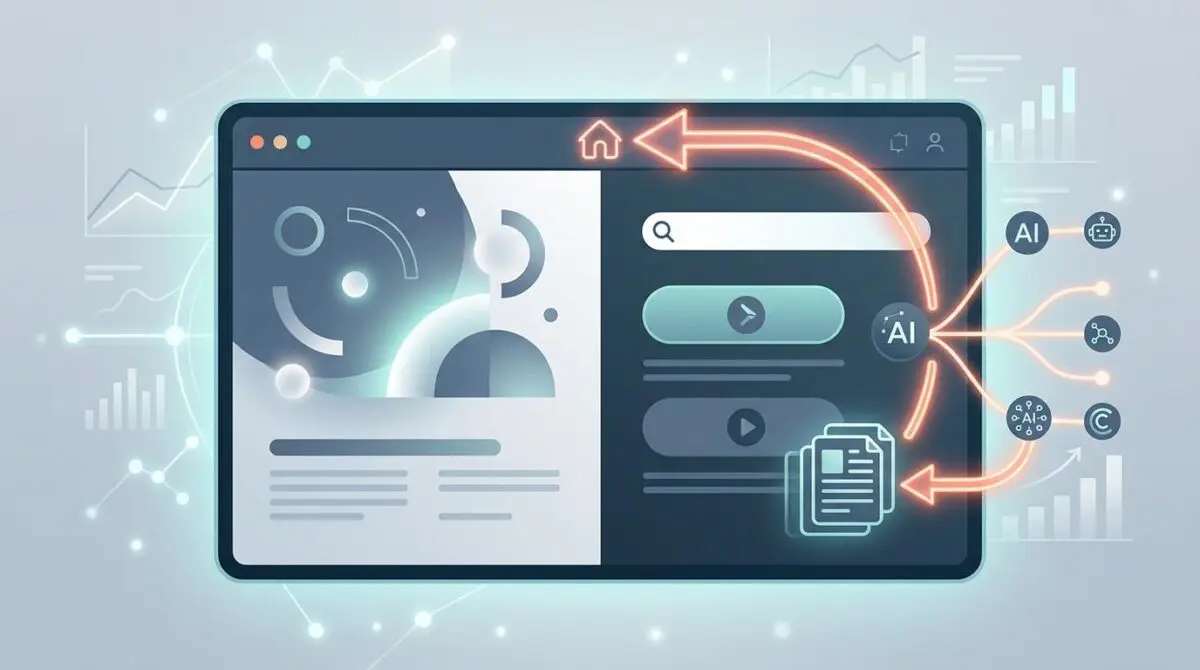
The mechanism behind that lopsided spike had been hiding in plain sight for months. AI systems pull answers from deep pages — comparison charts, documentation blocks, FAQ sections — but the link they hand to the human overwhelmingly lands on the homepage instead.
Similarweb‘s 2026 Generative AI Landscape report documented the pattern with hard numbers: 65 percent of URLs ChatGPT cites sit two or three folders deep in a site’s structure, yet nearly 59 percent of its referral traffic lands on the homepage.
Before the May update, roughly 26 to 32 percent of ChatGPT referrals hit the homepage. Afterward, that share jumped to approximately 60 percent and has held steady since.
The traffic is not a lesser substitute for organic search either. Visitors referred from ChatGPT spend roughly 15 minutes on site and view 12 pages on average, compared to 8 minutes and 9 pages for Google-referred visitors.
They convert at 7 percent versus 5 percent.
Whatever this channel is, it sends fewer people than search — and markedly better ones.
Those visitors arrive already briefed. The AI already told them who the brand is and what it does. The standard ‘who are we, what do we do’ homepage template was built for a stranger — and that stranger is no longer the one showing up.
ClickUp vs. monday.com: A Seven-Criterion Stress Test Exposes the AI Readiness Gap
An already-informed visitor needs a fast, direct path to a decision — not a funnel designed for someone hearing about the brand for the first time.
That premise anchors the AI Referral Architecture Audit, a seven-criterion scoring framework that evaluates whether a homepage is built for the visitor who already knows the brand or the one who does not.
Each criterion is scored 0 to 2. A zero means the element is missing. A one means it is partially present. A two means it is fully there. Fourteen points possible; ten or above signals readiness for AI-referred traffic.
The seven criteria are: CTA consistency, context fit, intent routing, visible trust signals, reputation fit, search and navigation prominence, and mobile load speed.
Software to replace all software
ClickUp’s homepage was run through this rubric alongside direct competitor monday.com, using real source code inspection, live page-load measurements via Chrome’s Navigation Timing API, and live G2 review data.
The results were stark. ClickUp scored 5 out of 14. monday.com scored 10 out of 14.
ClickUp runs at least ten different competing calls to action across twelve instances on a single page — ‘Get a Demo,’ ‘Sign Up,’ ‘Build your own agent,’ ‘Get started. It’s FREE!,’ ‘Get started with Brain,’ and more. That scores zero on CTA consistency.
monday.com repeats one action — ‘Get Started’ — 77 times with no competing alternative. That scores a clean two.
ClickUp’s headline, ‘Software to replace all software,’ is a vague tagline that neither over-explains the category nor clearly speaks to an already-informed buyer. It scores one on context fit.
People and agents working as one team
monday.com’s headline never explains the product category at all. It only makes sense to someone who already knows the platform now centers on agentic workflows — exactly the kind of detail an AI system would have already provided. That scores two.
On intent routing, ClickUp has no persona or department links on the page itself. A row of feature tags toggles which screenshot displays — a feature directory every visitor sees identically, not a route based on who they are. Zero points.
monday.com places real department sections — Marketing, Sales, IT, HR — directly on the page where a scrolling visitor encounters them. Two points.
ClickUp’s trust signals — ‘85% of Fortune 500 companies,’ ‘92,400 hours saved,’ ‘3M+ tasks automated by Agents’ — are specific and quantified, but they sit far down the page beyond a long stretch of AI Agent marketing. Near the top, all a visitor sees is the generic ‘Trusted by the best.’ That scores one.
monday.com leads with ‘trusted by over 60% of the Fortune 500’ immediately below its headline. Two points.
On reputation fit, both scored one. ClickUp’s G2 reviews praise flexibility but flag being ‘overwhelming due to the extensive features available’ — a friction the homepage’s own CTA clutter echoes rather than contradicts.
monday.com’s G2 reviews credit ‘ease of use and powerful automation,’ not AI agents. The headline leads with a theme its own reviewers do not spontaneously praise — a mismatch in emphasis, not a contradiction.
Neither homepage has a real search function. ClickUp’s only search-labeled input turned out to be a cookie-consent list filter. monday.com has zero search elements of any kind. Both score zero.
On mobile load speed, ClickUp’s Time to First Byte averaged roughly 59 milliseconds, solidly good, with DOMContentLoaded averaging about 953 milliseconds. Both fall in the good range — two points.
monday.com’s TTFB averaged roughly 387 milliseconds, in the ‘needs improvement’ range, with DOMContentLoaded averaging about 773 milliseconds. Only one of the two measures is good — one point.
The scorecard isolates a clear failure pattern: no single call to action, no segmented paths for different visitor types, no search, and trust signals buried too deep to matter. ClickUp’s one real strength — server speed — cannot compensate for the structural gaps that prevent a visitor from reaching a decision quickly.
The fix for search prominence is both simple and technically precise. A visible, intent-matching search bar paired with autocomplete and synonym matching lets an already-briefed visitor route immediately to the specific thing an AI told them about.
Behind it, Schema.org’s SearchAction markup makes the search function machine-readable — the same mechanism Google uses to power sitelinks search boxes.
For mobile load speed, monday.com’s gap sits upstream of the homepage itself: faster edge caching or CDN configuration reduces TTFB directly.
Five of the remaining fixes fit in a single operational checklist: pick one primary CTA and repeat it consistently, cut the category explainer from headlines entirely, put real persona sections directly on the page rather than in navigation dropdowns, move a quantified proof point near the headline, and read recent reviews before finalizing homepage copy to catch emphasis mismatches.
When AI Citations Point One Way and Clicks Go Another
The ClickUp and monday.com audit is a microcosm of a structural problem that extends far beyond any single site.
Search Engine Journal recently surfaced corroborating data from multiple independent sources that confirms the citation-click mismatch is systemic.
Previsible’s analysis of 6.77 million AI-referred sessions across 166 websites found that 28.8 percent of ChatGPT referrals land on internal search results pages — a page type that, on most websites, has never been optimized for acquisition at all.
Ahrefs reported that over 80 percent of its AI search referral traffic arrived at its homepage, product pages, and free tools rather than its extensive library of editorial content.
The pattern mirrors the classic paid-search mistake of sending specific ad clicks to a generic landing page — except now the highest-intent visitor class the web has produced is landing on the most generic page most websites own.
Aleyda Solis quantified the split with precision in a 2026 analysis spanning 40 sites across four verticals: brand-entry pages captured 57.7 percent of AI traffic but only 3.0 percent of AI citations. Discovery and evaluation pages earned 57.0 percent of AI citations but only 8.9 percent of AI traffic.
Tracking a single blended score between visibility and referrals hides which half of the job is failing. The recommended fix is two separate ledgers — one tracking AI-cited URLs, one tracking AI-referral landing URLs — with citation goals set on discovery pages and click goals set on brand-entry and product pages.
For ClickUp specifically, US AI referral visits averaged roughly 39,000 per month from December 2025 through June 2026, against average US organic search clicks of roughly 454,000 per month. That is approximately 8.6 percent of organic volume.
monday.com shows the same pattern at roughly 6 percent of its own organic volume. Small in absolute terms for both companies — and structurally growing faster on the one page most sites have not redesigned for it.
Average monthly web visits across generative AI platforms worldwide reached 9.5 billion between June 2025 and May 2026, up 70 percent year over year. That growth curve, combined with the post-May-7 shift in how links are surfaced, means the homepage’s share of AI referrals is unlikely to shrink.
Orbit Media analyzed AI crawl and referral data across 74 Cloudflare accounts and found that homepages receive roughly 15 times more AI attention than other page types. They named a related phenomenon the ‘Dark Library Effect’: articles get read and summarized by AI systems but rarely get the click, while the homepage does.
A second pathway compounds the effect. Users who receive a brand recommendation from ChatGPT are 2.5 times more likely to visit that brand’s site within the next seven days than to visit an unrecommended competitor — even with no link and no prior visit.
When they do visit, over half of those AI-influenced visits — 55.9 percent — arrive through search, compared to 40.4 percent for visits with no AI influence. The user remembers the brand and searches for it. Branded search results are dominated by the homepage.
In neither pathway does the visitor land on the page that actually contained the information the AI surfaced.
The structural fixes that close the seven-criterion gaps also feed directly into answer engine optimization performance. A page an AI system trusts enough to send a visitor to is, functionally, a page it already trusts enough to answer with.
The Split-Personality Homepage Is Here to Stay
For more than two decades, a homepage had one job: introduce a cold visitor to a brand they had never heard of. AI did not break that job — it added a second visitor type who already finished the introduction somewhere else, and most homepages are still only built for the first one.
For teams auditing their AI referral architecture and finding structural gaps across the seven criteria, Andres SEO Expert’s programmatic SEO and AI automation framework provides the technical scaffolding to close them — reach out here.
Frequently Asked Questions
Why did ChatGPT referrals to homepages surge 354.7 percent?
On May 7, 2026, ChatGPT began turning brand names into clickable links instead of footnote-style citations, causing homepage referrals to surge 354.7 percent week over week—more than twice the overall referral increase. AI systems pull answers from deep pages but often hand users the homepage link.
What is the AI Referral Architecture Audit?
It is a seven-criterion scoring framework that evaluates whether a homepage is built for already-informed AI-referred visitors. Criteria include CTA consistency, context fit, intent routing, visible trust signals, reputation fit, search and navigation prominence, and mobile load speed, scored 0 to 2 each for a total of 14 points.
How did ClickUp and monday.com score on the AI readiness audit?
ClickUp scored 5 out of 14, while monday.com scored 10 out of 14. ClickUp failed on CTA consistency, intent routing, and search prominence, while monday.com excelled with a single repeated ‘Get Started’ CTA and on-page persona sections.
What is the citation-click divergence in AI referrals?
It is the mismatch where AI citations often point to deep content pages (65 percent sit two or three folders deep), but the majority of referral traffic lands on the homepage (around 59 percent). This means the page that actually contains the cited information rarely receives the visit.
How should teams track AI citations versus AI referral traffic?
Tracking a single blended score hides which half is failing. The recommended fix is to maintain two separate ledgers—one for AI-cited URLs and one for AI-referral landing URLs—setting citation goals on discovery pages and click goals on brand-entry and product pages.
What are the key fixes for improving AI referral readiness on a homepage?
Teams should pick one primary CTA and repeat it consistently, remove category explainers from headlines, place persona sections directly on the page, move quantified proof points near the headline, add visible search with autocomplete and Schema.org SearchAction markup, and align homepage copy with recent review sentiment.
What is the split-personality homepage concept?
AI-referred visitors arrive already briefed on the brand, yet most homepages are still built for cold visitors. The homepage must now serve two personas: the stranger needing an introduction and the informed visitor needing a fast decision path—making the split-personality homepage a permanent requirement.