Key Takeaways
- The architecture combines Strands Robots, LeRobot, and Hugging Face Storage Buckets into one continuous loop.
- Byte-level deduplication in buckets reduces upload costs by moving only changed chunks instead of entire files.
- Streaming datasets from buckets lets training start without waiting for full downloads, cutting latency.
Table of Contents
A Single Loop Now Joins Robot Data, Training, and Deployment
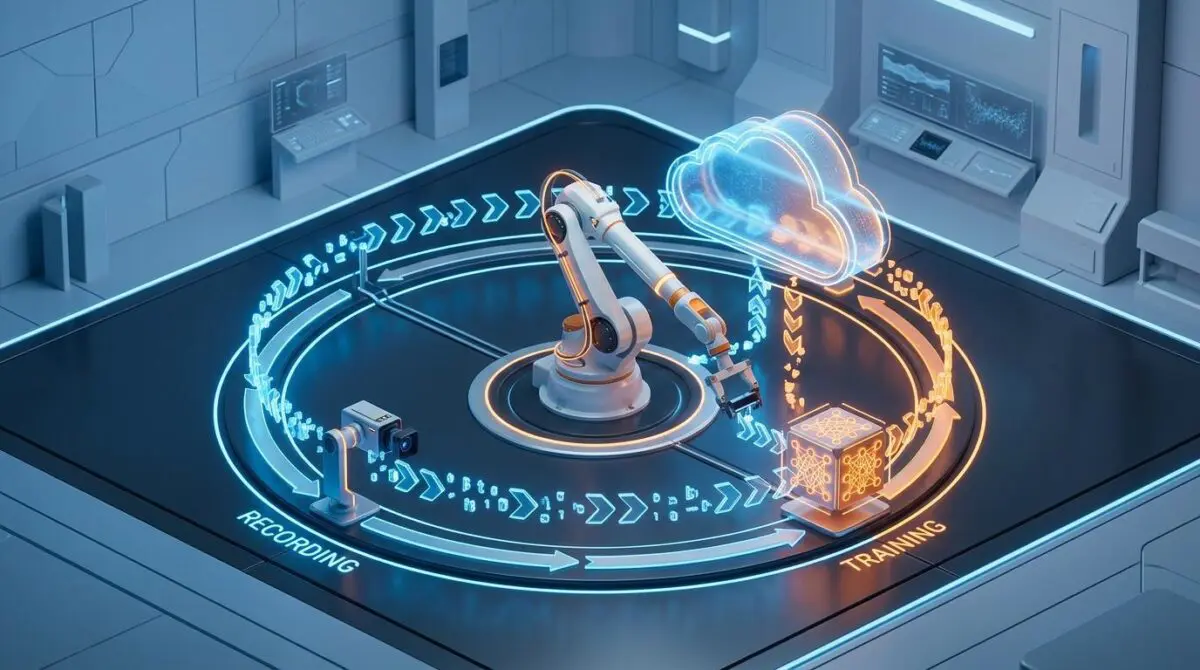
As of August 13, 2026, a new technical workflow collapses robot data collection, training, and deployment into one continuous loop.
The architecture combines Strands Robots, an open-source AWS SDK, with LeRobot and Hugging Face Storage Buckets to remove redundant transfers that normally accumulate across collection campaigns.
The practical result is a working layer where byte changes move between recording and training instead of entire datasets.
Inside the Streaming Loop: Buckets, Deduplication, and LeRobot Shards
According to the Hugging Face blog, the system runs through four stages, each sharing the same LeRobot on-disk format.
Record Without a Versioned Repository in the Way
An agent receives a natural-language prompt, creates a scene, and records a LeRobotDataset through the shared DatasetRecorder.
Once the episode ends, sync_dataset_to_bucket writes the dataset into a bucket path without requiring a live recording session.
The same path works for physical SO-101 arms.
On hardware, LeRobot’s record CLI handles leader-follower bring-up and lands the dataset on disk in the same simulation format, so the same sync call moves it into a bucket.
Byte-Level Deduplication Changes the Sync Cost
A versioned repository re-uploads whole files after small changes.
Buckets remove that cost because Xet-backed storage deduplicates uploads at the byte level with content-defined chunking.
Changing one percent of a 500 MB object moved 5.5 MB.
Five percent moved 27.5 MB, and ten percent moved 55 MB.
Those figures come from vendor-reported bucket benchmarks, so real-world savings will vary by scene and recording cadence.
The Strands Robots recorder uses LeRobot’s shard layout: Parquet shards roll at 100 MB and per-camera MP4 shards at 200 MB.
A sync after a day of collection uploads only new trailing shards and the one partially filled shard that grew.
Streaming Batches Without Waiting for a Download
Training no longer waits for a full download.
stream_dataset reads batches directly from the bucket with byte-range reads over large shards, while camera frames are decoded on the fly from remote MP4 files.
The same reader feeds a PyTorch DataLoader, so ACT training uses ordinary PyTorch code.
LeRobot’s trainer accepts a bucket through a repo_type parameter with streaming enabled, rejecting configurations that try to use a bucket without streaming.
Pre-warming caches bucket data at edge locations near compute clusters.
In the vendor benchmark, a warm CDN read reached roughly 1,086 MB/s on a 10 GB payload and 1,124 MB/s on 100 GB, compared with 780 MB/s cold at 10 GB.
On one measured configuration, 500 ACT optimizer steps on a 120-frame episode took 133 seconds on a single NVIDIA L4.
Closing the Loop on Physical Hardware
After training, the checkpoint loads through the same create_policy entry point and deploys to a physical robot with one keyword change to mode=’real’.
The demonstrations that hardware records then return to the same bucket, closing the loop.
If data already lives on Amazon S3, the LeRobot directory structure stores there unchanged.
Buckets add a Hub-native route for sync and streaming without provisioning storage first.
Operational Guardrails for a Live Data Loop
Live collection changes the trust model.
Prompt injection, write-scope credentials, and overwrite-in-place behavior require tighter controls once an agent writes to shared storage.
The bucket keeps no revision history, so versioned dataset repositories remain the reviewed artifact.
The Robotics Data Layer Turns Strategic
LeRobot is already a reference format for robot learning data.
More than 90,000 datasets and models from over 8,000 publishers use the LeRobot format, which makes a newly recorded dataset immediately readable across a broad ecosystem.
LeRobotDataset v3.0 standardized multimodal robot-learning data, while LeRobot 0.6.0 added unified evaluation, simulation benchmarks, and new policy families.
A recent arXiv paper describing the CoLI continuum robot platform offers independent evidence of that pull.
The authors report 12 out of 12 successful object placements, 10 out of 12 switch toggles, and 10 out of 12 planar pushes using ACT policies.
Those results are specific to a single continuum manipulator and do not test the AWS bucket workflow, but they show how LeRobot now operates as a common research substrate.
The strategic signal is that robot data infrastructure is consolidating around streaming-native formats and mutable working storage.
Vendor-reported deduplication benchmarks should be tested against a team’s own scene composition and recording cadence before they become procurement assumptions.
From One Arm to a Fleet Without Breaking the Pipeline
The technical barrier is no longer whether one robot can feed its own training pipeline, but whether the operational layer around that loop is disciplined enough to scale past a single arm.
For teams turning fast-moving AI infrastructure shifts into search-ready authority content, programmatic SEO and AI automation is how Andres SEO Expert approaches it — start the conversation here.
Frequently Asked Questions
What is the streaming data loop described in the article?
It is a workflow that connects robot data collection, training, and deployment into a single continuous loop. It uses Strands Robots, an open-source AWS SDK, with LeRobot and Hugging Face Storage Buckets to stream byte-level changes between recording and training, avoiding redundant dataset transfers.
How does byte-level deduplication reduce sync costs?
Xet-backed buckets deduplicate uploads at the byte level using content-defined chunking. Instead of re-uploading whole files after small changes, only the changed bytes are transferred. For example, changing one percent of a 500 MB object moved only 5.5 MB, with similar proportional savings for larger changes.
How does training stream data directly from cloud buckets?
Training does not wait for a full download. The stream_dataset function reads batches directly from the bucket with byte-range reads, while camera frames are decoded on the fly from remote MP4 files. The same reader feeds a PyTorch DataLoader, allowing ACT training to run on a bucket with streaming enabled.
How does the workflow close the loop on physical hardware?
After training, the checkpoint loads through the same create_policy entry point and deploys to a physical robot with one keyword change to mode=’real’. Demonstrations recorded from hardware return to the same bucket, closing the loop and enabling continuous improvement.
Why is the LeRobot format becoming strategic for robotics data?
LeRobot is a reference format used by over 90,000 datasets and models from more than 8,000 publishers. Its standardized structure (LeRobotDataset v3.0) and unified evaluation tools make new recordings immediately readable across a broad ecosystem, consolidating robotics data infrastructure around streaming-native formats.
What operational guardrails are needed for a live data loop?
Live collection changes the trust model. Prompt injection, write-scope credentials, and overwrite-in-place behavior require tighter controls once an agent writes to shared storage. Since buckets keep no revision history, versioned dataset repositories remain the reviewed artifact.
Can this workflow scale from a single arm to a fleet?
The technical barrier is no longer whether one robot can feed its own training pipeline, but whether the operational layer is disciplined enough to scale past a single arm. Teams need to manage credentials, data governance, and infrastructure to support multiple robots feeding the same loop.