Key Takeaways
- OpenAI, SB Energy, NVIDIA, and the Department of Energy are building an 8-gigawatt AI campus at a former uranium enrichment site in Pike County, Ohio.
- The project will generate 35,000 construction jobs and 2,500 long-term operating roles, while delivering $160 million in community and student benefits.
- The data center will use closed-loop cooling and pay for its own grid upgrades, so Ohio ratepayers won’t foot the bill for infrastructure.
Table of Contents
An 8-Gigawatt AI Campus Lands in Southern Ohio
OpenAI confirmed on August 17 that it has entered an agreement to secure approximately 8 gigawatts of IT capacity at the PORTS-Pike Technology Campus in Pike County, Ohio.
The deal pulls together SB Energy, NVIDIA, and the U.S. Department of Energy to convert a former Cold War-era enrichment facility into one of the largest AI compute projects ever announced.
Projections call for 35,000 construction jobs across a six-year buildout that runs through 2032 and 2,500 long-term operating positions once the campus reaches steady state.
The deal pairs the buildout with roughly $160 million in community and student benefits, including workforce training and Codex credits for Ohio college students.
From Gaseous Diffusion to Closed-Loop AI Compute
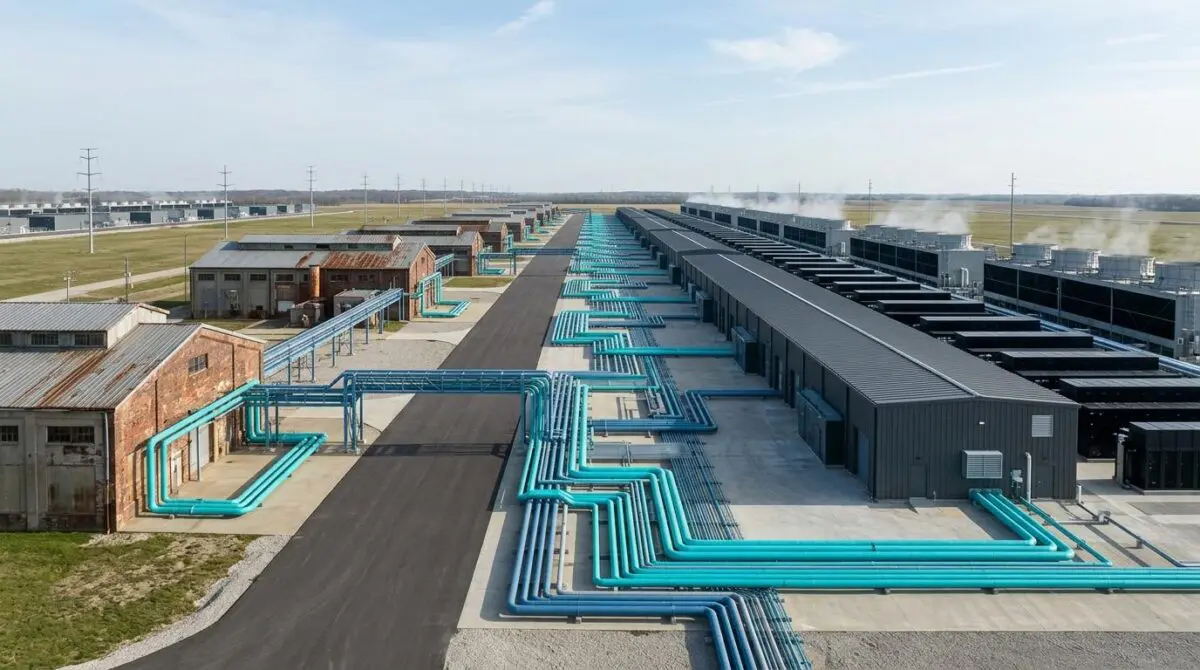
The PORTS-Pike campus sits on private land and remediated land controlled by the Department of Energy at the former Portsmouth Gaseous Diffusion Plant.
SB Energy will build, own, and operate the data center under a 20-year lease to OpenAI, with the site exclusively hosting NVIDIA AI compute infrastructure.
Power and Grid Costs Stay Off Ohio Ratepayers
The project will pay its own energy and infrastructure costs.
SB Energy will cover the full cost of grid upgrades and new transmission lines, and those costs will not be shifted to Ohio ratepayers or other regional customers.
The first 800 megawatts are expected to come online in 2028, largely using existing AEP infrastructure.
Later phases will require new power plants connected to the grid, including natural gas generation, along with additional transmission and associated infrastructure.
Water Recirculation Replaces Legacy Cooling Towers
The data center will use closed-loop, air-cooled cooling systems that recirculate water instead of relying on cooling towers that continuously consume water.
Once the cooling system is filled, ongoing water use is expected to resemble that of an office building supporting a similar number of people, covering sinks, restrooms, equipment washdown, maintenance, and landscaping.
PORTS-Pike is working with the Department of Energy to tap the existing onsite water system, and project partners will fund new water infrastructure for local municipalities.
Project-level water use will be publicly reported after site design is finalized.
Local Labor and Codex Credits Anchor Community Access
PORTS-Pike Campus signed a memorandum of understanding with North America’s Building Trades Unions, with plans to coordinate through the Ohio State Building and Construction Trades Council and affiliated crafts.
Up to $84 million in Codex credits will be available to roughly 844,000 eligible Ohio college, community college, and technical school students during the 2026-2027 academic year.
Each eligible student can receive $100 in ChatGPT credits, giving them hands-on exposure to AI-assisted software and technical project work.
Combined with SB Energy’s existing $40 million community agreement and an additional $40 million fund from OpenAI, the benefits package tops $160 million for Pike County and Ohio residents.
The community grant will target priorities such as schools, public safety, health care, utilities, workforce training, housing, veterans’ services, small businesses, and support for working families.
The project is expected to generate hundreds of millions of dollars in state and local tax revenue over its lifetime, with property tax revenue primarily supporting public schools.
An annual report will cover local hiring, community investment, water use, and project-related energy use.
The $500 Billion Financing Picture Behind Pike County
Reporting from The Wall Street Journal in late July framed the Ohio campus as the largest data-center project announced to date.
The report put the total cost above $500 billion, including chips, and said Nvidia was in talks to provide roughly a $250 billion financial backstop.
Groundbreaking for the Ohio complex was reported in March, though the full buildout runs through 2032.
Reuters later reported that the guarantee had been revised downward, with initial support expected to cover less than $120 billion and Nvidia discussing an equity investment of up to $3 billion in SB Energy.
Reuters also noted that had discussed tying half of the equity commitment to SB Energy’s planned initial public offering, which could raise at least $5 billion as soon as next month.
The August 17 terms place Nvidia’s equity at $1.5 billion, paired with credit support for the initial 4.25 IT gigawatts.
That shrinking gap between early backstop chatter and the announced equity tier is the real financial story: the project is being structured in stages, not as a single sweeping guarantee.
Data centers already consume roughly 4.4 percent of U.S. electricity, and broader projections show data center power consumption doubling by 2028.
That makes a former DOE-controlled site with existing grid infrastructure and room for new gas generation unusually valuable.
OpenAI is contracting for capacity based on long-term frontier training needs and growing demand for its products, with payments beginning only as completed capacity becomes available.
However, development still hinges on permits, environmental reviews, financing, and new transmission infrastructure, leaving final timelines subject to execution risk.
NVIDIA and OpenAI are collaborating through design, testing, and commissioning at the data center.
The two companies plan to publish a technical white paper on resilient infrastructure design, component qualification, and software-level workload management at cluster scale.
The goal is to make PORTS-Pike a reference model for future next-generation supercomputer design.
What Pike County Signals for Frontier AI Infrastructure
PORTS-Pike is the clearest signal yet that frontier AI has become an energy and infrastructure contest, not just a model contest.
For teams building editorial and automation pipelines around AI infrastructure coverage, programmatic SEO and AI automation is how Andres SEO Expert approaches it — talk to the team.
Frequently Asked Questions
What is the PORTS-Pike Technology Campus AI project in Ohio?
OpenAI has agreed to secure about 8 gigawatts of IT capacity at the PORTS-Pike Technology Campus in Pike County, Ohio, a former Cold War-era uranium enrichment site. SB Energy will build and operate the data center under a 20-year lease to OpenAI, with NVIDIA supplying AI compute infrastructure, supported by the U.S. Department of Energy.
How much power will the OpenAI data center in Ohio use?
The project is expected to secure approximately 8 gigawatts of IT capacity. The first 800 megawatts are expected to come online in 2028, with later phases adding new power plants, including natural gas generation. Data centers already consume about 4.4 percent of U.S. electricity, and projections show data center power use doubling by 2028.
Will the Ohio AI data center project raise electricity costs for residents?
No. The project will pay for its own energy and infrastructure costs. SB Energy will cover the full cost of grid upgrades and new transmission lines, and those costs will not be shifted to Ohio ratepayers or other regional customers.
How will the PORTS-Pike data center cool its systems without wasting water?
The data center will use closed-loop, air-cooled cooling systems that recirculate water rather than cooling towers that continually consume water. Once filled, ongoing water use is expected to be similar to an office building supporting the same number of people, covering sinks, restrooms, maintenance, and landscaping.
Who is funding the $500 billion AI data center project?
Total project costs are reported above $500 billion, including chips. The Wall Street Journal reported NVIDIA was in talks to provide a roughly $250 billion financial backstop; later reports revised that to less than $120 billion in credit support, plus an NVIDIA equity investment of $1.5 billion. SB Energy is also planning an IPO that could raise at least $5 billion.
What community benefits and jobs will the Ohio AI campus bring?
The buildout is projected to create 35,000 construction jobs over six years and 2,500 long-term operating positions. Benefits include up to $84 million in Codex credits for eligible Ohio college students, plus a $40 million community agreement from SB Energy and a $40 million fund from OpenAI, totaling over $160 million for local schools, public safety, workforce training, housing, and more.
When will the first phase of the Ohio AI campus come online?
The first 800 megawatts are expected to come online in 2028, using largely existing AEP infrastructure. The full buildout runs through 2032, subject to permits, environmental reviews, financing, and new transmission infrastructure.