Key Takeaways
- 13 AI-written adapters unlock 7,960 Hugging Face models on IBM’s Spyre.
- Adapters swap unsupported ops for equivalent forms without changing the math.
- The adapter layer becomes a permanent bridge while the compiler matures.
Table of Contents
Thirteen AI-Written Adapters Put 7,960 Hugging Face Models on IBM’s Spyre
IBM’s Spyre engineering team has demonstrated that a small set of AI-written runtime adapters can bring stock Hugging Face Transformers models to the Spyre AI accelerator without waiting for the compiler stack to mature.
PyTorch’s August 20 technical analysis reports that 13 distinct adapters cover 7,960 of the 10,000 most-downloaded Hugging Face embedding models.
Of those covered models, 6,804 passed end-to-end testing on Spyre by late June 2026.
The result, documented in PyTorch’s technical analysis, reframes AI model enablement as a continuous, agent-assisted process rather than a slow, specialist-led bottleneck.
How Runtime Adapters Bridge Transformer Logic and a Young Compiler Stack
Spyre is a dataflow-driven accelerator built on IBM’s AIU architecture, with small cores connected by a high-bandwidth ring and local scratchpad memory.
Unlike conventional GPUs that execute explicit instruction streams, Spyre triggers computation when data reaches a compute engine.
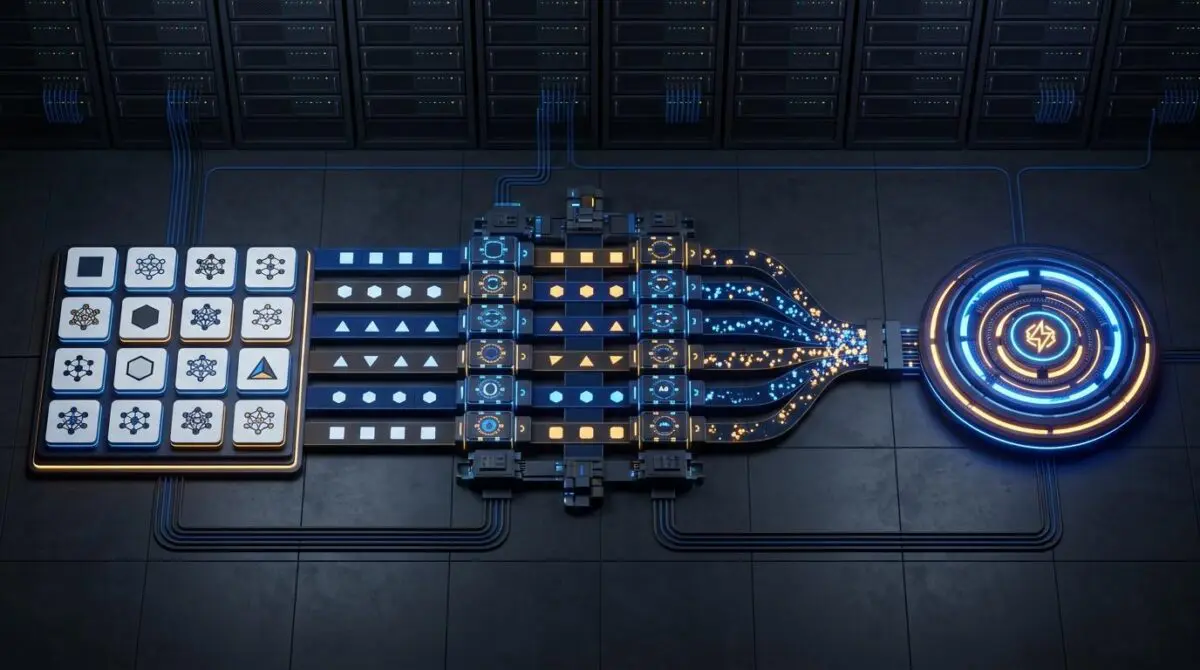
The adapter layer functions as temporary scaffolding that swaps unsupported operations for mathematically equivalent forms while preserving the model’s computation.
Each adapter targets a specific gap where a Hugging Face model expresses an operation the torch-spyre compiler cannot yet lower cleanly.
For example, the gelu_new activation in GPT-2 and GPT-Neo uses the tanh approximation with torch.pow(x, 3.0).
On Spyre, a one-line replacement of that cube with x * x * x produces identical math through a path the compiler handles.
Other adaptations reshape data before it reaches the hardware.
The final LM head projection in many transformer models must slice the vocabulary dimension into fixed-size blocks and distribute those blocks across Spyre cores.
If the block count has a large prime factor, one core can inherit a slice that exceeds a hard on-device memory limit.
Padding the vocabulary to a factorable size keeps the output unchanged while letting the matrix multiply distribute cleanly.
These examples share a common discipline: the adapter changes how the model is expressed, but never what it computes.
The process depends on AI agents that read both the Hugging Face Transformers codebase and the torch-spyre backend at once.
That cross-referencing was previously too slow to attempt at ecosystem scale.
Coverage compounds because each adapter lowers the cost of enabling the next model that resembles it.
Most new models are variations on an architecture already brought up, so a single adapter tends to unlock an entire family.
Human supervision remains essential for localization and diagnosis, especially because compiler fusion can make an operation pass alone but fail in context.
Running stock Hugging Face models end to end surfaces recurring failure families.
- Missing lowering paths — fused shapes the stack cannot yet compile even when individual operations work.
- Device-only numerical behavior — overflow or NaN values that stay finite on CPU and GPU references.
- Alignment and padding assumptions — shape mismatches that quietly corrupt results.
Spyre’s Enterprise Footprint and the Mainframe AI Investment Equation
The adapter work lands at a moment when IBM is pushing Spyre beyond experimental silicon into production systems.
The Spyre accelerator is available across z17, LinuxONE 5, and Power11 platforms.
It is packaged as a 75W PCIe card with 128 GB of LPDDR5 and 32 accelerator cores on a 5nm process.
Up to 48 Spyre cards can cluster in a Z or LinuxONE system, compared with 16 in Power.
TechTarget reports that the IBM z17 mainframe, introduced in April 2025, includes the 5nm Telum II processor and Spyre accelerators capable of processing 450 billion inference operations per day with 1 millisecond latency.
More than 70 percent of Fortune 500 companies use IBM mainframes, including 45 of the 50 largest banks.
That installed base gives the adapter strategy a direct enterprise path: the same Hugging Face models that run in cloud environments can now move closer to mission-critical mainframe data.
IBM Redbooks published a Redpaper titled ‘Implementing AI on Power11: Introducing the IBM Spyre Accelerator’ on March 30, 2026.
The publication recorded 4,368 downloads in a recent month, signaling strong practitioner interest in Spyre deployment patterns.
At the same time, the market context is not without friction.
Gartner warned in June 2026 that more than 70 percent of mainframe exit projects will fail because organizations overestimate generative AI capabilities.
That caution contrasts sharply with the adapter strategy’s pragmatic claim: AI agents did not eliminate the need for human debugging, but they compressed the cost of covering entire model families.
The distinction matters for AI infrastructure leaders evaluating whether to invest in specialized accelerators or wait for mature generic stacks.
If a small team can keep a young accelerator current with thousands of Hugging Face models, the switching cost of new silicon drops.
IBM’s broader zSystems business is already responding to that logic.
IDC research shows that 88 percent of mainframe users expect to rely on mainframes for current workloads over the next five years.
AI is now the top strategic workload driving refreshes, and 82 percent of users plan to significantly improve data integration for AI support within two years.
Mainframe adoption grew 51 percent through the first quarter of 2026.
Yet IBM’s preliminary second-quarter 2026 revenue of $17.2 billion came in below the $17.85 billion analyst estimate, with infrastructure revenue sliding 7 percent.
That financial signal keeps the pressure on Spyre and the adapter layer to prove that AI enablement can convert quickly into workload retention and expansion.
The Adapter Layer Becomes a Permanent Capability
For AI teams tracking the gap between new model releases and hardware readiness, Spyre now offers a concrete proof point: a living adapter layer can keep an accelerator viable while the compiler matures.
For teams building scalable technical content and AI automation pipelines around emerging model stacks, Andres SEO Expert’s programmatic SEO AI automation service is how it approaches the same operational discipline — contact us.
Frequently Asked Questions
How many Hugging Face models does IBM’s Spyre adapter support?
Thirteen AI-written adapters cover 7,960 of the 10,000 most-downloaded Hugging Face embedding models, and 6,804 passed end-to-end testing on Spyre by late June 2026.
What is the role of runtime adapters in IBM Spyre?
Runtime adapters act as temporary scaffolding that swaps unsupported operations for mathematically equivalent forms, bridging gaps where the torch-spyre compiler cannot lower operations cleanly while preserving the model’s computation.
How does Spyre differ from conventional GPUs?
Spyre is a dataflow-driven accelerator that triggers computation when data reaches a compute engine, unlike conventional GPUs that execute explicit instruction streams.
What are the recurring failure families when running stock Hugging Face models on Spyre?
The recurring failure families are missing lowering paths (fused shapes the stack cannot compile), device-only numerical behavior (overflow or NaN values), and alignment and padding assumptions that cause shape mismatches.
What hardware platforms support the IBM Spyre accelerator?
The Spyre accelerator is available across IBM z17, LinuxONE 5, and Power11 platforms, with up to 48 Spyre cards in a Z or LinuxONE system and 16 in Power systems.
What did IBM Redbooks publish regarding Spyre?
IBM Redbooks published a Redpaper titled ‘Implementing AI on Power11: Introducing the IBM Spyre Accelerator’ on March 30, 2026, which recorded 4,368 downloads in a recent month.
How does the adapter strategy reduce switching costs for new silicon?
By using a small set of AI-written adapters to keep a young accelerator current with thousands of Hugging Face models, the cost of enabling new hardware drops significantly, making it easier to adopt specialized accelerators.