Key Takeaways
- DSpark’s speculative decoding achieves up to 3.18x higher throughput on H100 and 2.87x on-device, without changing output quality.
- The included draft models for LFM2.5 variants improve function-calling latency by 57% on average.
- DSpark integrates with SGLang and llama.cpp, enabling immediate deployment for edge and data center inference.
Table of Contents
DSpark Turns Token Decoding Into a Throughput Race
Liquid AI’s DSpark release, published on August 20, 2026, changes the unit economics of token generation for edge and data center inference.
A technical article on Hugging Face reports that the release adds draft model checkpoints for three LFM2.5 models: LFM2.5-1.2B-Instruct, LFM2.5-2.6B, and LFM2.5-8B-A1B.
The headline benefit is a 3.18x throughput improvement on an H100 and a 2.87x on-device jump without changing greedy output.
For function-calling workloads, the 2.6B model sees a 57% average latency reduction, a signal aimed at agentic edge deployment, according to the Hugging Face blog.
Inside the Architecture and Throughput Leap
LLM decoding is memory-bound. Most latency comes from streaming weights from DRAM into SRAM, not from raw computation.
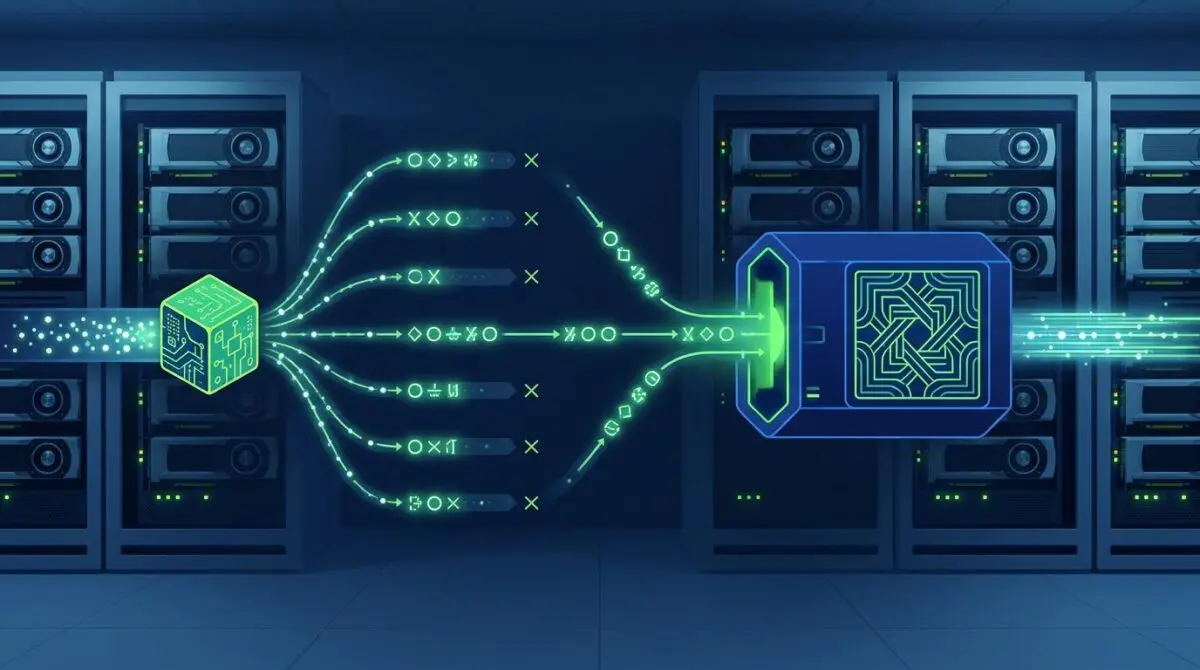
Speculative decoding changes the cost structure by using a lightweight draft model to propose multiple candidate tokens. The target model verifies them in one forward pass, spreading a single weight load across every accepted token.
DSpark builds on EAGLE-3 and DFlash but adds three components.
The draft model uses a parallel backbone conditioned on the target model’s context features, a sequential Markov head that strengthens inter-token dependency, and a confidence-scheduled verifier that prunes low-confidence suffixes before verification becomes more costly than savings.
Each released draft model is roughly 300M parameters, built from five decoder layers and a block size of nine. Liquid AI trained the checkpoints on a mix of SFT, chat, code, and function-calling data for 15 epochs, then selected the highest-acceptance epoch rather than the lowest-loss epoch.
Quality parity is structural. A draft token is accepted only when it matches the target model’s distribution, so rejected tokens are replaced by the target’s own choice.
The emitted sequence is therefore identical to baseline greedy by construction.
That guarantee is the key deployment argument: benchmark accuracy such as pass@1 or exact match does not shift.
- LFM2.5-1.2B-Instruct-DSpark: 295.7M draft parameters.
- LFM2.5-2.6B-DSpark: 327.7M draft parameters.
- LFM2.5-8B-A1B-DSpark: 327.7M draft parameters.
Liquid AI tested with SGLang on a single H100 80GB in BF16 and with llama.cpp on an M4 Max MacBook Pro using FP16 GGUF weights. Both setups used a DSpark block size of nine, a batch size of one, and a temperature of zero.
For LFM2.5-2.6B, mean speedup reached 2.67x on the H100 and 2.27x on the M4 Max. The MacBook configuration averaged about 139 tokens per second, which the release positions above many proprietary cloud-model throughput levels.
For LFM2.5-1.2B-Instruct, mean H100 speedup landed at 2.10x while on-device throughput averaged 2.54x. Acceptance variance across datasets created speedup swings as wide as 52% for that model.
The LFM2.5-8B-A1B draft model reached 3.18x on MATH500 for H100 inference, the strongest single-dataset result in the release. On the M4 Max, however, the mean gain was only 1.18x, a gap tied to the current MoE implementation in llama.cpp’s Metal backend.
Across multi-tool scenarios, DSpark reduced function-calling latency by 57% on average for LFM2.5-2.6B. Day-one support for llama.cpp and SGLang is upstream, which lowers the integration burden for teams that already run those serving stacks.
The Edge AI Market Signal Behind a 3.18x H100 Jump
Speculative decoding is moving from a research technique to a productized edge lever. An arXiv survey published on August 11, 2026, on optimizing large models and AI agents for edge deployment provides a useful reference for why this matters.
The survey notes that typical on-device small language models operate between 1B and 3B parameters, with local latency in the 10 to 100 millisecond range and power draw below 10W. LFM2.5-2.6B falls inside that envelope while DSpark pushes token output far beyond standard baseline decoding.
In the survey’s speculative sampling section, FR-Spec is described as reducing LM Head computation overhead by 75% and achieving an average 1.12x speedup over EAGLE-2. DSpark’s published 2.27x on-device mean for LFM2.5-2.6B is substantially higher, although the comparison is directional rather than a controlled benchmark match because the underlying models, hardware, and verification settings differ.
The survey also characterizes EAGLE-2 as tree-based and MTP as a single-layer draft model. DSpark’s parallel backbone, Markov head, and confidence scheduler add a more complex dependency structure, which helps explain the stronger acceptance rates at later token positions.
Liquid AI’s published evaluation is confined to five benchmark datasets and specific SGLang and llama.cpp builds on an H100 and an M4 Max MacBook Pro. The 8B-A1B on-device result shows how much backend maturity still controls real-world Mixture-of-Experts gains on Metal.
The 57% average function-calling latency reduction for LFM2.5-2.6B matters most in agentic loops. Every user action can trigger multiple model calls, so lower per-call latency compounds into a materially more responsive local agent.
The Draft Model Moment for Local AI
LFM2.5-DSpark turns speculative decoding into a shipping product result rather than a lab benchmark. For teams turning faster LLM inference into production SEO and content automation pipelines, programmatic SEO AI automation is how Andres SEO Expert approaches it — contact the team here.
Frequently Asked Questions
What is DSpark and how does it improve LLM inference throughput?
DSpark is Liquid AI’s speculative decoding release for LFM2.5 models that adds lightweight draft checkpoints. It improves throughput by 3.18x on an H100 and 2.87x on-device, and reduces function-calling latency by 57% for the 2.6B model.
How does speculative decoding work in DSpark?
Speculative decoding uses a lightweight draft model to propose multiple candidate tokens, and the target model verifies them in one forward pass. DSpark builds on EAGLE-3 and DFlash with a parallel backbone, a sequential Markov head, and a confidence-scheduled verifier.
What are the published speedup numbers for DSpark across hardware?
For LFM2.5-2.6B, mean speedup reached 2.67x on H100 and 2.27x on M4 Max. The 1.2B model achieved 2.10x on H100 and 2.54x on-device. The 8B-A1B model reached 3.18x on MATH500 for H100 but only 1.18x on M4 Max due to backend maturity.
Does DSpark change the model’s output quality or accuracy?
No. DSpark maintains greedy output by construction. A draft token is accepted only if it matches the target model’s distribution; otherwise, the target’s own choice replaces it. So benchmark accuracy such as pass@1 or exact match does not shift.
Which LFM2.5 models have DSpark checkpoints and what are their sizes?
DSpark checkpoints are available for LFM2.5-1.2B-Instruct (295.7M draft parameters), LFM2.5-2.6B (327.7M), and LFM2.5-8B-A1B (327.7M). Each uses five decoder layers and a block size of nine.
What is the edge AI significance of DSpark’s function-calling latency reduction?
The 2.6B model saw a 57% average latency reduction in multi-tool scenarios. In agentic loops, every user action can trigger multiple model calls, so lower per-call latency compounds into a more responsive local agent, making it a key signal for edge deployment.
How does DSpark compare to other speculative decoding techniques like EAGLE-2 or FR-Spec?
DSpark builds on EAGLE-3 and DFlash, adding a parallel backbone, Markov head, and confidence scheduler. The arXiv survey notes FR-Spec reduces LM Head overhead by 75% with 1.12x speedup over EAGLE-2, while DSpark’s published 2.27x on-device mean for the 2.6B model is substantially higher, though the comparison is directional.