



Key Takeaways
- CUDA Python 1.0 delivers a stable, unified API across runtime, libraries, and kernel authoring.
- Semantic versioning protects production AI workloads from unexpected breaking changes.
- Shared cuda.core objects eliminate interop friction across PyTorch, CuPy, and Numba.
Table of Contents
NVIDIA Draws a Hard Line Under Python GPU Fragmentation
With CUDA 13.3, NVIDIA has made Python a first-class control surface for its entire GPU platform, collapsing years of fragmented CUDA binding layers into a single supported stack.
NVIDIA’s developer blog confirmed the milestone on August 25, 2026, positioning Python as a supported way to use the CUDA platform.
For developers, the practical shift is immediate: CUDA resources such as devices, streams, and buffers now behave as ordinary Python objects that can cross library boundaries without copying data or negotiating interchange protocols.
That has not been true for most of the Python GPU ecosystem, where PyTorch, CuPy, and RAPIDS each reached CUDA through their own private layers.
The 1.0 Stack: From Low-Level Bindings to Kernel Authoring
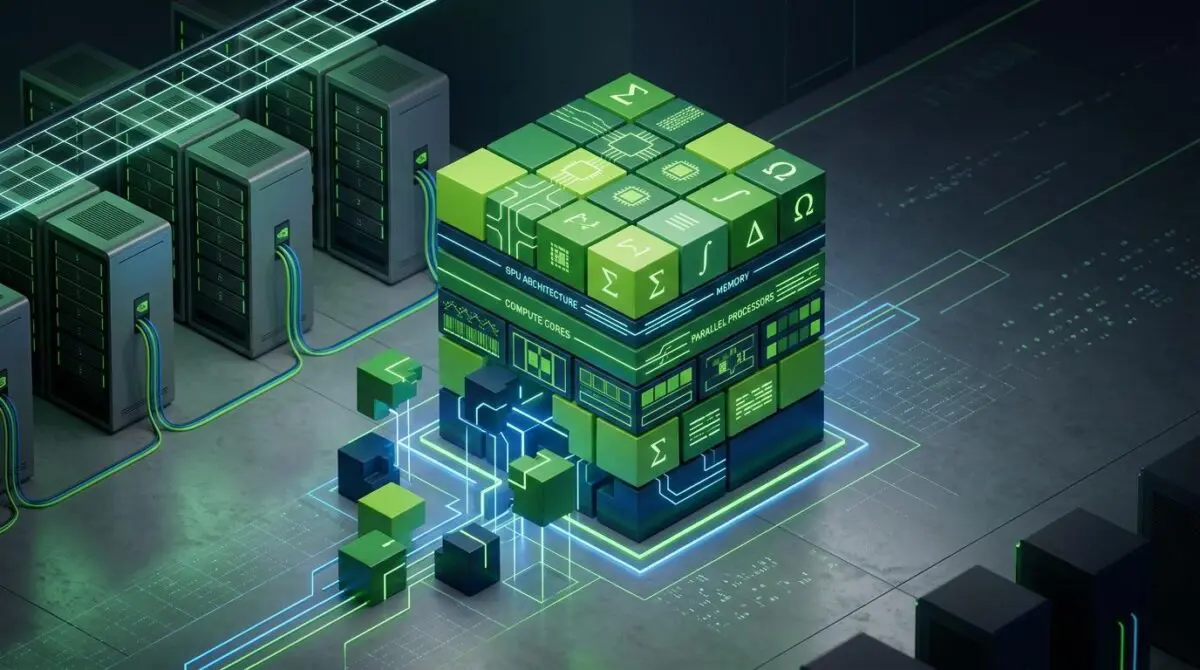
As detailed in NVIDIA’s developer blog, CUDA Python 1.0 is not a version number typed into pip. It names a coordinated milestone across independently versioned components that map onto a three-tier architecture.
The bottom tier is the runtime system. It covers device management, memory allocation, streams, synchronization, CUDA graphs, and JIT compilation.
- cuda.core 1.0.0 — Pythonic access to the CUDA runtime, with resources as real Python objects and failures as exceptions.
- cuda.bindings 13.3.0 — Low-level one-to-one coverage of CUDA host APIs, versioned to the CUDA Toolkit.
- cuda-pathfinder — Locates the CUDA components installed in a given environment.
Above the runtime sit NVIDIA’s library interfaces. cuda.compute 1.0.0 brings the CUDA Core Compute Libraries parallel algorithms to Python as host-callable building blocks.
Sort, scan, reduce, transform, unique, histogram, and top-k are available as ordinary function calls on GPU arrays. Version 1.0 also allows customizing algorithm behavior with ordinary Python functions, including lambdas.
nvmath-python 1.0 covers the math libraries. NCCL4Py and NVSHMEM4P expose communication libraries, returning resources as cuda.core buffers.
At the top tier sits kernel authoring. Numba compiles a Python subset into SIMT kernels, while cutile-python and cuteDSL target block-level and Tensor Core programming.
Numba CUDA MLIR is a newer kernel generator built on MLIR and the modern NVVM toolchain. It delivers faster warm JIT compiles and lower launch latency, but it is not yet covered by the 1.0 semantic-versioning commitment.
cuda.core reaching 1.0 is the centerpiece of the release. It consolidates stabilized APIs into a single supported surface and adds three capabilities worth watching.
- Green contexts — Partition GPU SMs into disjoint groups to shield latency-sensitive kernels from throughput workloads.
- Process checkpointing — Snapshot the full CUDA state of a running process and restore it later.
- Inter-process sharing — Share GPU memory between processes without copying through the host.
Because every component uses the same cuda.core objects, a Numba kernel and a cuda.compute call can operate on the same GPU buffer in the same stream. That shared foundation removes the need for separate interchange protocols.
Why Semantic Versioning Changes the Build-vs-Buy Calculus
For AI teams, the strategic weight of CUDA Python 1.0 is not the API surface itself. It is the consolidation of the Python GPU ecosystem around a single NVIDIA-maintained foundation.
Before this release, application developers inherited whichever CUDA binding layer their dependencies happened to use. Library authors either adopted someone else’s layer or built a private one, adding more fragmentation to the ecosystem.
That dynamic has started to reverse. PyTorch already depends on cuda.bindings in its CUDA wheels, and CuPy gains a simpler build and a smaller import footprint.
Each library that moves onto the shared layer removes private binding code from the dependency graph. The result is fewer version conflicts, fewer interop bugs, and fewer disagreements about which CUDA context is active.
Semantic versioning is the second structural shift. Breaking API changes occur only in major releases.
Minor releases add features, patch releases fix bugs, and public APIs scheduled for removal are deprecated first with a replacement path.
That commitment lowers the risk of building production AI infrastructure on Python GPU libraries. Teams can adopt cuda.core, cuda.compute, or nvmath-python without assuming that the next upgrade will silently break their workloads.
Advanced platform capabilities also become more accessible. Green contexts can partition streaming multiprocessors for mixed latency and throughput workloads, a pattern that matters for teams serving simultaneous inference and batch jobs on the same GPU.
The New Default for AI and Accelerated Computing Workflows
For AI engineering teams, CUDA Python 1.0 removes the false choice between ergonomic Python development and full CUDA platform access, making GPU library code cheaper to maintain and less likely to fracture across competing runtime layers. For teams building GPU-accelerated AI pipelines that need to scale, programmatic SEO AI automation is how Andres SEO Expert applies the same systematic engineering discipline — contact Andres SEO Expert.
Frequently Asked Questions
What is CUDA Python 1.0 and why is it significant?
CUDA Python 1.0 is a coordinated milestone from NVIDIA that makes Python a first-class control surface for the entire CUDA platform. It unifies previously fragmented CUDA binding layers into a single supported stack, enabling resources like devices, streams, and buffers to behave as ordinary Python objects that can cross library boundaries without copying data or negotiating interchange protocols.
What are the main components of the CUDA Python 1.0 stack?
The stack is organized into three tiers. The runtime tier includes cuda.core 1.0.0 for Pythonic CUDA runtime access, cuda.bindings 13.3.0 for low-level host API coverage, and cuda-pathfinder for locating CUDA components. The library tier includes cuda.compute 1.0.0 for Core Compute Libraries and nvmath-python 1.0 for math and communication libraries. The kernel authoring tier includes Numba, cutile-python, cuteDSL, and Numba CUDA MLIR.
How does CUDA Python 1.0 reduce GPU ecosystem fragmentation?
Before this release, each Python GPU library like PyTorch, CuPy, or RAPIDS reached CUDA through its own private binding layer. CUDA Python 1.0 consolidates these layers into a single NVIDIA-maintained foundation. Libraries such as PyTorch already depend on cuda.bindings, and CuPy benefits from a simpler build and smaller import footprint. This shared foundation reduces version conflicts, interop bugs, and disagreements about which CUDA context is active.
What new capabilities does cuda.core 1.0 introduce?
cuda.core 1.0 adds three notable capabilities: green contexts, which partition GPU streaming multiprocessors into disjoint groups to shield latency-sensitive kernels from throughput workloads; process checkpointing, which snapshots and restores the full CUDA state of a running process; and inter-process sharing, which allows GPU memory to be shared between processes without host-side copying. It also stabilizes APIs for device management, streams, memory allocation, CUDA graphs, and JIT compilation.
What does semantic versioning mean for CUDA Python libraries?
Semantic versioning means breaking API changes occur only in major releases. Minor releases add features, patch releases fix bugs, and public APIs scheduled for removal are deprecated first with a replacement path. This commitment lowers the risk of building production AI infrastructure on Python GPU libraries, allowing teams to adopt cuda.core, cuda.compute, or nvmath-python without assuming the next upgrade will silently break their workloads.
How does CUDA Python relate to PyTorch and CuPy?
CUDA Python 1.0 provides a shared foundation that PyTorch and CuPy can build upon. PyTorch already depends on cuda.bindings in its CUDA wheels, and CuPy gains a simpler build and smaller import footprint by moving onto the shared layer. This reduces private binding code in dependency graphs and makes it easier for these libraries to interoperate with the broader CUDA Python ecosystem using common cuda.core objects.
What is the difference between cuda.core and cuda.bindings?
cuda.bindings is a low-level one-to-one coverage of CUDA host APIs, versioned to the CUDA Toolkit, providing direct function calls. cuda.core is a higher-level Pythonic layer that wraps the runtime, exposing resources as real Python objects, using exceptions for failures, and adding features like green contexts, checkpointing, and inter-process sharing. Both are part of the same runtime tier in CUDA Python 1.0, with cuda.core built on top of the bindings for a more ergonomic developer experience.