Key Takeaways
- NVIDIA Dynamo’s shadow engine recovery slashes LLM failure recovery from 283 to 7.3 seconds.
- GPU Memory Service keeps model weights resident, eliminating cold restarts for inference engines.
- Seven-second failover transforms GPU economics and Kubernetes SLOs for production LLM fleets.
Table of Contents
A 39-Fold Cut in Failure Recovery Time Resets AI Inference Expectations
The most expensive second in production LLM inference is not a token generation spike. It is the several minutes after a worker process dies.
NVIDIA Developer Blog reports that a preview feature in NVIDIA Dynamo now compresses that failure window from 283 seconds to 7.3 seconds.
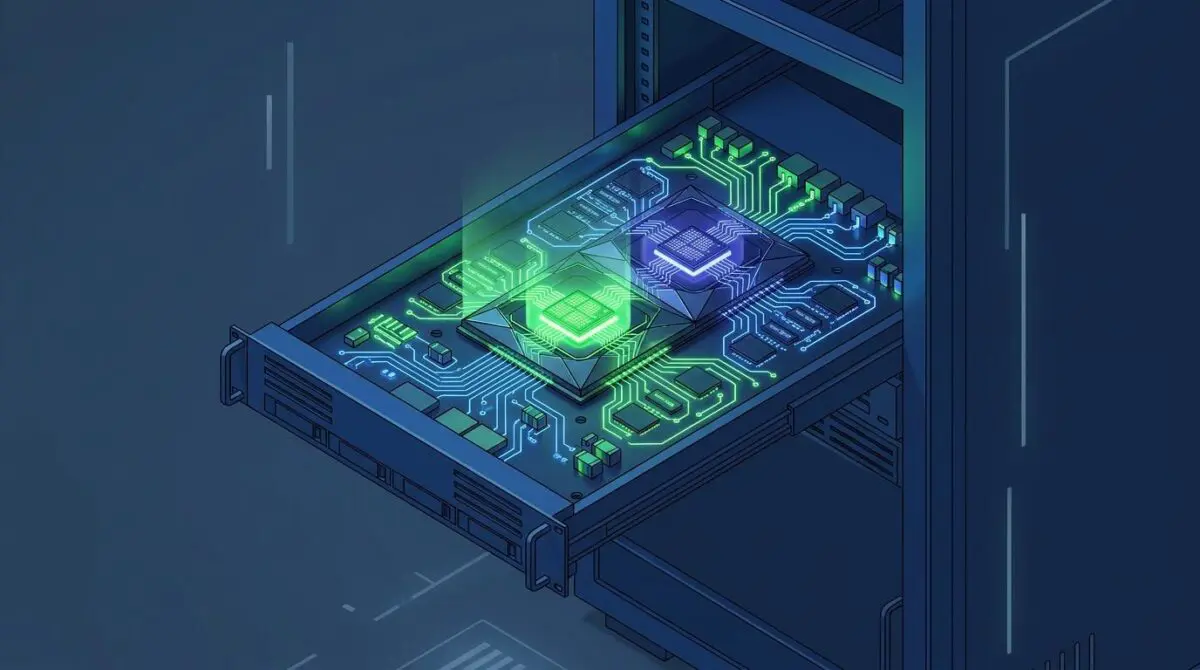
Shadow engine recovery keeps a fully initialized standby engine parked on the same GPUs as the active engine. When the active process fails, the shadow wakes and resumes serving without reloading model weights from storage.
Inside the Weight-Persistence and Standby Engine Architecture
As the NVIDIA Developer Blog explains, cold restarts are slow for two structural reasons.
- Weights are tied to the engine process. GPU memory belongs to a CUDA context, and that context dies with the process.
- Some initialization state is non-transferable. NCCL communicators and captured CUDA graphs are bound to the running process and cannot be inherited.
Shadow engine recovery decouples weight lifetime from the engine process through the GPU Memory Service, or GMS. GMS runs as a per-GPU sidecar that owns physical GPU memory on behalf of inference engines.
Engines connect to GMS, import handles, and map the same physical pages into their own virtual address spaces. That reference-counted mapping keeps weights resident even when the failed engine’s CUDA context is removed.
The approach is built on the CUDA Virtual Memory Management API. A kernel reading a GMS-backed weight dereferences an ordinary pointer into the same HBM region, so the read cost is no higher than an engine-allocated allocation.
Practical integration is narrow. vLLM, SGLang, and NVIDIA TensorRT-LLM adopt GMS through a custom torch.cuda.CUDAPluggableAllocator bound to the weight memory pool.
After integrating GMS, a shadow engine runs the same startup path as an active engine. It connects to the local GMS, imports weight mappings, establishes communicators, captures CUDA graphs, and then parks.
A parked shadow retains only its CUDA context, captured graphs, communicators, and weight mappings. It holds no separate copy of the weights and no materialized KV cache.
Each worker packages two engine containers, a GMS sidecar, and a shared POSIX file lock to elect the active engine. When the active process dies, the kernel releases the lock and the shadow acquires it before re-registering with the router.
The critical path includes lock acquisition, weight remapping, and KV cache materialization. In the benchmark, fault detection took 1.7 seconds and shadow promotion took 5.6 seconds.
What Seven-Second Failover Means for GPU Economics and Kubernetes SLOs
In a two-worker GLM-5.2 deployment on NVIDIA B200 nodes, engineers deliberately terminated one worker with SIGKILL. The workload ran with two workers serving NVFP4-quantized GLM-5.2, TP=8, a 200K max context, and an FP8 KV cache.
Under cold restart, the remaining worker absorbed all traffic for 283 seconds. Median time-to-first-token after the fault reached 23,815 milliseconds, while p50 decode rate fell to 12 tokens per second per user.
With shadow engine recovery, the second worker returned in 7.3 seconds. Median TTFT after the fault dropped to 1,311 milliseconds and p50 decode rate recovered to 46 tokens per second per user.
Out of 399 requests in the observation window, 201 exceeded five seconds to first token in the baseline. With shadow recovery, that number fell to 1, and no requests fell below 20 tokens per second per user.
For platform teams, this shifts recovery from a multi-minute capacity outage to a brief routing blip. It also changes standby capacity economics because weights are not duplicated in HBM.
The preview does require operational maturity. Clusters need Kubernetes 1.34 or newer with Dynamic Resource Allocation enabled and the NVIDIA GPU DRA driver installed.
Current limitations are equally clear. Hardware, node, and multi-node failures still rely on standard rescheduling, and promoted shadows start with empty KV caches.
Carrying cache state across a promotion is an active line of work. vLLM remains the primary supported backend for the preview.
From Cold Restarts to Continuous Capacity in Production LLM Fleets
Seven-second recovery changes the operational math for teams running latency-sensitive LLM workloads on Kubernetes. For teams building AI infrastructure content and technical authority around GPU inference, programmatic SEO AI automation is how Andres SEO Expert approaches it — contact us here.
Frequently Asked Questions
What is NVIDIA Dynamo shadow engine recovery?
Shadow engine recovery is a preview feature in NVIDIA Dynamo that keeps a fully initialized standby engine parked on the same GPUs as the active engine. When the active process fails, the shadow wakes and resumes serving without reloading model weights from storage, cutting failure recovery time from 283 seconds to 7.3 seconds.
How does shadow engine recovery achieve seven-second failover?
It decouples weight lifetime from the engine process using the GPU Memory Service (GMS). GMS runs as a per-GPU sidecar that owns physical GPU memory, allowing engines to map the same physical pages into their own virtual address spaces. This keeps weights resident even when the failed engine’s CUDA context is removed, enabling a parked shadow engine to promote quickly by acquiring a POSIX file lock and re-registering with the router.
What is the GPU Memory Service (GMS) in NVIDIA Dynamo?
GMS is a per-GPU sidecar process that owns physical GPU memory on behalf of inference engines. Engines connect to GMS, import handles, and map the same physical pages into their own virtual address spaces. It uses the CUDA Virtual Memory Management API, allowing weights to persist independently of the engine process.
What performance improvements were seen with shadow engine recovery in the NVIDIA benchmark?
In a two-worker GLM-5.2 deployment on NVIDIA B200 nodes, shadow engine recovery reduced recovery time from 283 seconds to 7.3 seconds. Median time-to-first-token after a fault dropped from 23,815 ms to 1,311 ms, and p50 decode rate recovered to 46 tokens per second per user, compared to 12 tokens per second per user with cold restart.
What are the prerequisites for using shadow engine recovery?
Shadow engine recovery requires Kubernetes 1.34 or newer with Dynamic Resource Allocation (DRA) enabled and the NVIDIA GPU DRA driver installed. The preview primarily supports vLLM as the backend.
What are the current limitations of NVIDIA Dynamo shadow engine recovery?
Hardware, node, and multi-node failures still rely on standard rescheduling. Promoted shadows start with empty KV caches, and carrying cache state across a promotion is an active area of work. The preview primarily supports vLLM.
How does shadow engine recovery affect GPU economics and Kubernetes SLOs?
It shifts recovery from a multi-minute capacity outage to a brief routing blip, improving SLO compliance. It also changes standby capacity economics because weights are not duplicated in HBM, as the shadow engine references the same physical memory through GMS.