
Key Takeaways
- NVIDIA NuRec reconstructs real drives with 3D Gaussian splatting and re-renders them from any target vehicle’s camera rig.
- Synthetic carline adaptation lets teams train perception models before physical fleets exist, turning one dataset into many.
- The workflow spots coverage gaps and focuses real-world data collection, using Harmonizer to polish rendered frames.
Table of Contents
The Carline Problem That Breaks Perception Models
The same autonomous driving perception stack can interpret the same street differently depending on the carline carrying it.
A perception stack is shaped by the vehicle that carries it.
Move a model from an SUV to a sedan, and sensor placement, calibration, fields of view, occlusions, and body geometry all shift at once.
A pedestrian near the edge of coverage may become ambiguous, a curb may fade from view, and a traffic light may fall into a different part of the frame.
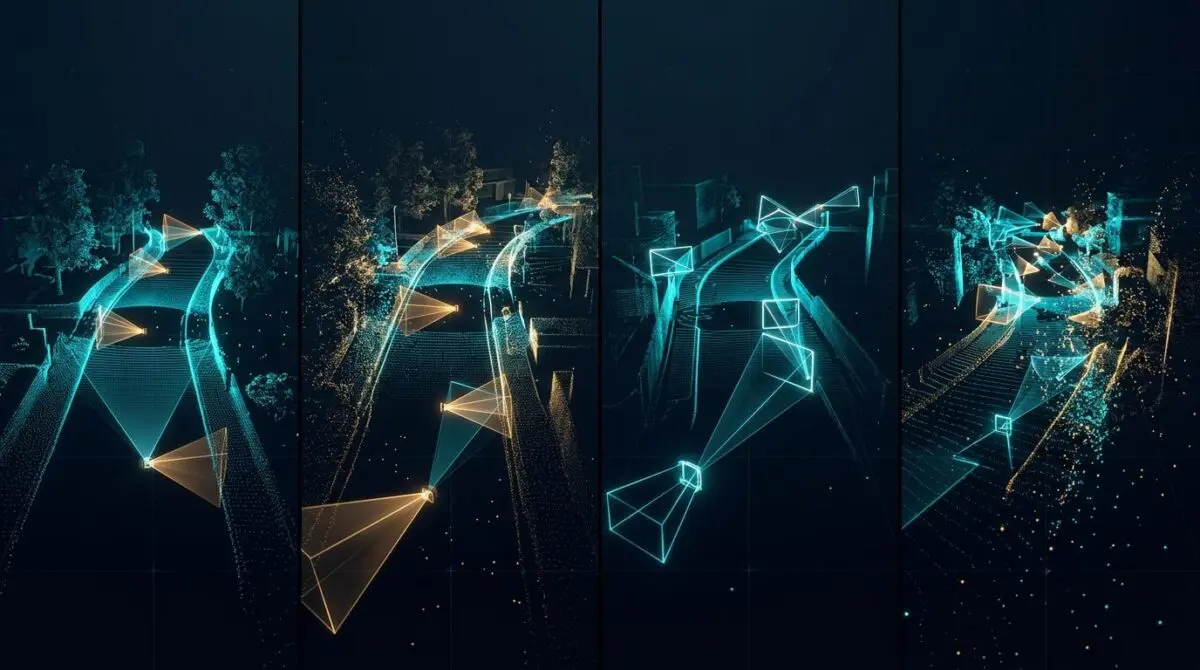
NVIDIA’s developer blog details a route around that problem: reconstruct recorded drives with 3D Gaussian splatting, render them from a target vehicle’s camera rig, and use the output to train perception models before the physical fleet exists.
That workflow sits at the center of NVIDIA Omniverse NuRec.
From Gaussian Splats to Trainable Synthetic Frames
NuRec starts with real-world driving scenes captured by an existing vehicle.
It reconstructs each environment using 3D Gaussian splatting and then projects those Gaussians through a specified camera model.
The approach enables novel-view synthesis that goes beyond simple viewpoint shifts.
- Camera transforms: NuRec can change camera extrinsics, intrinsics, field of view, and lens model, including pinhole, fisheye, and f-theta configurations.
- Reusable scene assets: The reconstructed scene keeps original rig trajectories, per-camera calibration, dynamic object tracks, and map data.
- Label alignment: Those retained assets help align or adapt labels for objects, lanes, traffic lights, and road boundaries in the newly rendered views.
The public Physical AI NuRec Dataset on Hugging Face provides more than 1,500 neural-reconstructed scenes.
Each reconstructed scene spans roughly 20 seconds and originates from six source views.
The camera array includes a 120-degree front-wide lens, a 30-degree front-telephoto lens, 120-degree cross-left and cross-right cameras, and 70-degree rear-left and rear-right cameras.
A four-step adaptation path
The practical workflow breaks into four stages.
First, engineers download a gated scene and authenticate through Hugging Face.
Second, they render the scene from a target carline’s sensor rig, which can define different camera positions, resolutions, field-of-view settings, and lens models.
Third, they refine the frames with NVIDIA Harmonizer, a temporally aware post-processing model that cleans up view-dependent artifacts, inconsistent color, and poorly reconstructed dynamic objects.
Fourth, they feed the refined data into a perception-training pipeline.
The NVIDIA/nurec-skills repository packages these steps as agent skills for locating datasets, running renders, and applying Harmonizer.
The target camera does not need a one-to-one match with any source camera.
It can use a different position, orientation, resolution, field of view, or calibration, provided its pose is expressed in the same coordinate frame and its lens model is supported.
Where post-processing stops
NVIDIA Harmonizer improves visual consistency, but its role is bounded.
It cannot repair incorrect calibration, recover scene coverage that was never reconstructed, or replace target-camera validation.
Those limits matter because synthetic data quality depends on correct rig geometry and source reconstruction coverage.
What Synthetic Carline Adaptation Means for AV Engineering
The carline adaptation problem is not a data quantity problem.
It is a configuration problem.
Engineers often cannot collect a new real-world dataset for every vehicle variant, especially early in development when target fleets may not be available.
NuRec changes the economics by turning existing recorded drives into reusable source material for many potential carlines.
An internal automated driving program at NVIDIA recorded relative gains in object-detection precision and recall after training on NuRec-rendered synthetic data for a new carline compared with a zero-shot baseline.
Those reported gains are relative to a zero-shot starting point and came from internal program evaluation rather than an external benchmark.
A shift in data economics
The workflow lets development teams interrogate existing drives before committing to physical collection.
- Target-rig preview: Teams can see what a scenario would look like from the target carline.
- Coverage discovery: They can identify which existing drives cover the new vehicle well.
- Weak-spot detection: Geometry changes can expose blind spots or edge-of-coverage issues early.
- Gap prioritization: Teams can focus real-world collection only where synthetic rendering falls short.
That makes the physical test fleet a validation asset rather than the only source of labeled training data.
For AI teams working on physical systems, the workflow also points to a broader pattern: domain adaptation for robotics may increasingly rely on neural reconstruction and differentiable rendering rather than exhaustive retraining from scratch.
The End of the One-Dataset-Per-Vehicle Era
NuRec reclassifies recorded driving data as a transferable engineering asset, not a single-vehicle snapshot.
For AV teams, that means perception adaptation can begin before the target carline physically exists.
For teams turning complex AI workflows like this into discoverable technical content, programmatic SEO AI automation is how Andres SEO Expert approaches it — contact us.
Frequently Asked Questions
What is the carline problem in autonomous driving perception?
The same perception stack can interpret the same street differently depending on the vehicle platform, or carline, carrying it. Sensor placement, calibration, fields of view, occlusions, and body geometry all shift when moving a model from one vehicle type to another, causing issues like ambiguous pedestrians, fading curbs, or traffic lights appearing in different parts of the frame.
How does NVIDIA NuRec use 3D Gaussian splatting for carline adaptation?
NuRec reconstructs real-world driving scenes using 3D Gaussian splatting, then projects those Gaussians through a specified target camera model. This enables novel-view synthesis that can change camera extrinsics, intrinsics, field of view, and lens model (pinhole, fisheye, f-theta), producing trainable synthetic frames that match a new carline’s sensor rig before physical vehicles exist.
What are the four steps in the NuRec workflow for adapting perception models?
The workflow involves: 1) downloading a gated scene from Hugging Face, 2) rendering the scene from the target carline’s sensor rig with different camera positions, resolutions, FOV, and lens models, 3) refining rendered frames with NVIDIA Harmonizer to clean up artifacts, and 4) feeding the refined data into a perception-training pipeline. The NVIDIA/nurec-skills repository packages these steps as agent skills.
What are the limitations of NVIDIA Harmonizer in synthetic data rendering?
NVIDIA Harmonizer improves temporal and visual consistency but cannot repair incorrect calibration, recover scene coverage that was never reconstructed, or replace target-camera validation. Synthetic data quality still depends on correct rig geometry and source reconstruction coverage.
How does synthetic carline adaptation change AV engineering data economics?
It shifts from a data quantity problem to a configuration problem. By reusing recorded drives and rendering them for different carlines, teams can preview target-rig perspectives, discover coverage, detect weak spots early, and prioritize real-world collection only where synthetic rendering falls short. This makes physical test fleets validation assets rather than the only source of labeled training data.
Can NuRec render from a target camera that does not match any source camera?
Yes. The target camera does not need a one-to-one match with any source camera. It can use a different position, orientation, resolution, field of view, or calibration, as long as its pose is expressed in the same coordinate frame and its lens model is supported.
What is the NVIDIA/nurec-skills repository?
The NVIDIA/nurec-skills repository packages the NuRec workflow as agent skills for locating datasets, running renders, and applying Harmonizer. It helps engineers operationalize the process of generating synthetic training data for new carlines from recorded drives.