




Key Takeaways
- NVIDIA and CrowdStrike compressed offense and defense into a machine-speed closed loop using open Nemotron models and Falcon telemetry.
- A six-gate validation harness raised backtest detection to 41.9%, a 2.5x improvement over the default open-model pipeline.
- Open detections generalized at 45% vs 29% for frontier in live fire, making the self-correcting harness the new security moat.
Table of Contents
Machine-Speed Offense and Defense Just Became a Single Closed Loop
NVIDIA and CrowdStrike have compressed an entire offensive-defensive security exercise into a continuous loop that runs at machine speed inside an isolated environment modeled on NVIDIA accelerated computing infrastructure.
A technical report from the NVIDIA Developer Blog details how the pairing combined NVIDIA Nemotron open models, CrowdStrike Falcon telemetry, and a specialized validation harness to expose detection gaps, generate rules, and force attackers toward harder paths.
In the evaluated open-model configuration, Nemotron 3 Ultra governed defensive orchestration while a fine-tuned Nemotron 3 Super acted as a bounded expert for detection generation and repair.
The optimized open pipeline reached a 41.9% mean backtest detection rate across six sessions.
That represents a 2.5x gain over the default harness using Nemotron 3 Ultra alone.
Six Gate Checks Turn Raw Telemetry Into Gold Detections
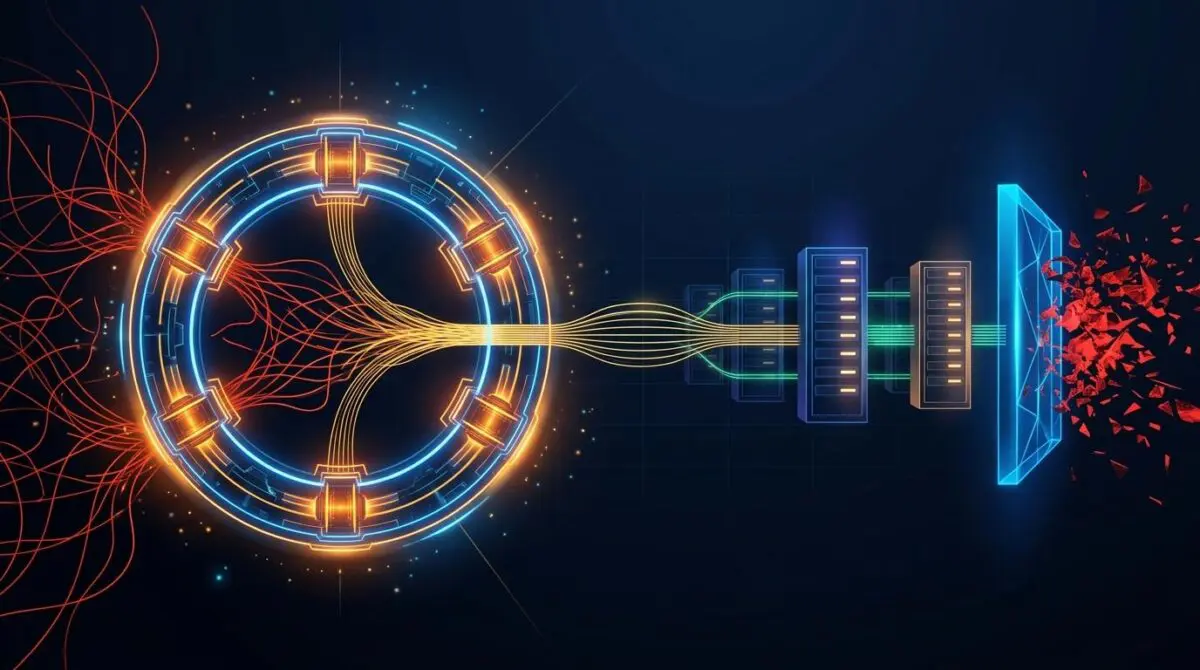
The system replaces manual red-team handoffs with a four-stage loop: execute and capture, process and reconstruct, generate and validate, and retest.
Every attack leaves an action trace and Falcon sensor telemetry, which the defensive agent uses to reconstruct the event sequence and identify where existing detections missed coverage.
The defensive harness embedded six mechanisms that would otherwise sit inside a detection engineer’s manual review cycle.
- Schema knowledge base: Enforces valid Falcon schemas, fields, and query syntax so generated rules do not invent unsupported data sources.
- Telemetry grounding: Anchors the workflow in observed events rather than allowing unsupported connections from model reasoning alone.
- Specialized detection authoring: Assigns rule writing and repair to a bounded Nemotron 3 Super expert.
- Artifact linting: Rejects syntax errors, unsupported fields, and detections tied to environment-specific IP addresses or users.
- Detection replay: Replays each candidate against recorded attack telemetry and rejects rules that fail to match.
- Independent review: Uses a fresh-context judge to assess behavioral alignment, robustness, and signal use.
Failed checks returned structured feedback to the defensive workflow for correction and another attempt.
The result was a generation process that produced grounded, testable, and correctable detections instead of plausible-looking rules.
Two Nemotron Models Split Orchestration and Authorship
Nemotron 3 Ultra handled the longer-horizon work of attack reconstruction, planning, and tool invocation.
A customized Nemotron 3 Super served as a bounded expert for the more contained task of writing and repairing detection rules.
That separation kept orchestration context from bleeding into specialized detection authorship.
CrowdStrike post-trained the smaller model using 9,349 detection-generation and multistep repair examples covering 59 programmatically generated error types.
The process combined continual pretraining, supervised fine-tuning, and reinforcement learning with verifiable rewards.
NVIDIA NeMo Gym ran generated queries against Falcon LogScale, and NVIDIA NeMo RL updated the model when returned query results matched reference outputs by F1 overlap.
From Backtest to Live Fire: What the Numbers Show
Backtesting against the recorded attack showed 41.9% mean detection for the optimized open pipeline across six sessions, up from 16.5% for the default Nemotron 3 Ultra harness across eight sessions.
Because the optimized configuration changed both the model stack and the harness, the gain reflects the complete open pipeline rather than an isolated model ablation.
In live-fire testing, the evaluation deployed 11 backtest-passing open detections and 35 frontier detections against eight unseen attacks.
Open detections generalized at a 45% rate compared with 29% for the frontier system.
Three open detections qualified as gold and still covered all eight attacks, while no frontier detections reached gold status.
The authors note the study covered one scenario family, used small detection sets, and lacked enough benign traffic to represent production false-positive performance.
Three of eight live-fire runs experienced harness failures but still produced complete telemetry.
As reported in the NVIDIA Developer Blog, the findings are a directional system-level case study rather than a general benchmark.
The Open-Model Economics Behind CrowdStrike’s Falcon IQ Expansion
CrowdStrike launched Falcon IQ at Fal.Con 2026 in Las Vegas on August 31, 2026, turning the same open-model agentic pattern toward vulnerability assessment and remediation at machine speed.
Falcon IQ productizes Project QuiltWorks and uses more than 50 agents built on Falcon Foundry and Charlotte AI AgentWorks.
NVIDIA’s open Nemotron models power the core agentic engine that validates and prioritizes vulnerabilities, while frontier models from OpenAI and Anthropic run alongside them.
CrowdStrike’s internal testing, not independently verified at production scale, places a fine-tuned Nemotron Nano model at 96% accuracy for generating investigation queries within Falcon LogScale.
The company has also published research reporting that a specialized Nemotron Nano reasoning model outperformed much larger models on security operations center detection triage, adding calibrated confidence scores for auditable autonomous decisions.
According to an NVIDIA blog post, the Open Secure AI Alliance now has more than 120 member organizations, and the Linux Foundation has shared a Request for Comments on a Shared AI Findings Exchange framework.
SAFE would confidentially collect and analyze AI incidents and near misses, identify recurring control failures, and publish evidence-based operating recommendations.
The Harness, Not Just the Model, Drives Security Value
CrowdStrike’s published vulnerability research shows a generic approach produced false-positive rates approaching 80%, while a security-first harness cut that to roughly 20% without weakening discovery strength.
On the specialized task of natural-language-to-CQL translation, a fine-tuned Llama Nemotron Super 49B reached 96% valid query accuracy and outperformed tested closed-source frontier alternatives.
Both results are vendor-reported and have not been independently benchmarked, but they align with the core pattern in the offensive-defensive evaluation.
The contested ground is no longer model scale alone.
The durable advantage sits in the harness, the validation gates, and the ability to reward models with verifiable security outcomes.
The Next Security Moat Is a Self-Correcting Loop
The live-fire results suggest the next security advantage belongs to teams that can turn detection failures into retested coverage without waiting for a human handoff.
For teams building self-correcting AI pipelines that need to scale, Programmatic SEO AI Automation is how Andres SEO Expert approaches automated pipeline design — contact the practice.
Frequently Asked Questions
What is the machine-speed offense-defense loop between NVIDIA and CrowdStrike?
The loop compresses an entire offensive-defensive security exercise into a continuous automated cycle inside an isolated environment modeled on NVIDIA accelerated computing infrastructure. It combines NVIDIA Nemotron open models, CrowdStrike Falcon telemetry, and a validation harness to expose detection gaps, generate rules, and force attackers toward harder paths.
How do the six gate checks improve detection generation?
The gate checks replace manual review by enforcing valid Falcon schemas, grounding the workflow in observed telemetry, assigning rule writing to a specialized expert, rejecting syntax or environment-specific errors, replaying candidates against recorded attack data, and using an independent judge to assess behavioral alignment. Failed checks return structured feedback for correction, producing grounded and testable detections.
What role do the two Nemotron models play in the system?
Nemotron 3 Ultra handles longer-horizon work such as attack reconstruction, planning, and tool invocation, while a customized Nemotron 3 Super acts as a bounded expert for writing and repairing detection rules. This separation keeps orchestration context from bleeding into specialized detection authorship.
What detection rates did the optimized open pipeline achieve compared to the default harness?
The optimized open pipeline reached a 41.9% mean backtest detection rate across six sessions, up from 16.5% for the default Nemotron 3 Ultra harness across eight sessions. In live-fire testing, open detections generalized at 45% compared to 29% for the frontier system, and three open detections qualified as gold while no frontier detections did.
What is Falcon IQ and how does it relate to Project QuiltWorks?
Falcon IQ is a CrowdStrike product launched at Fal.Con 2026 that operationalizes Project QuiltWorks, using more than 50 agents built on Falcon Foundry and Charlotte AI AgentWorks. NVIDIA’s open Nemotron models power the core agentic engine for vulnerability assessment and remediation, while frontier models from OpenAI and Anthropic run alongside them.
Why does the harness matter more than the model for security value?
Vendor-reported research shows a generic approach produced false-positive rates approaching 80%, while a security-first harness cut that to roughly 20% without weakening discovery strength. Results also show a fine-tuned Llama Nemotron Super 49B achieved 96% valid query accuracy on natural-language-to-CQL translation, outperforming larger closed-source alternatives. The durable advantage sits in the validation gates and verifiable security outcomes, not model scale alone.
What are the limitations of the study?
The authors note the study covered one scenario family, used small detection sets, and lacked enough benign traffic to represent production false-positive performance. Three of eight live-fire runs experienced harness failures but still produced complete telemetry, making the findings a directional system-level case study rather than a general benchmark.