



Key Points
- Autonomous Cost Control: Leverage AI-native agents to automatically rotate workloads across freemium tiers, maintaining near-zero software spend.
- Activation-First Onboarding: Utilize Agentic-PLG models to drive users to the ‘Aha Moment’ in under 60 seconds, bypassing traditional procurement friction.
- Self-Sovereign Data: Transition to an infrastructure where third-party tools are ephemeral, ensuring proprietary AI-trained data remains your core financial asset.
Table of Contents
The Trillion-Dollar Friction
According to Gartner’s April 2026 IT Spend Forecast, global software spending is projected to reach a staggering $1.44 trillion this year, growing at 15.1% as enterprises shift from building internal AI to adopting external, product-led platforms. This massive capital outflow represents a critical inflection point for modern business architecture. Beneath these towering figures lies a dangerous market friction known as subscription fatigue, threatening to suffocate scaling companies. Founders and executives are realizing that traditional software licensing is a financial trap designed to extract maximum capital.
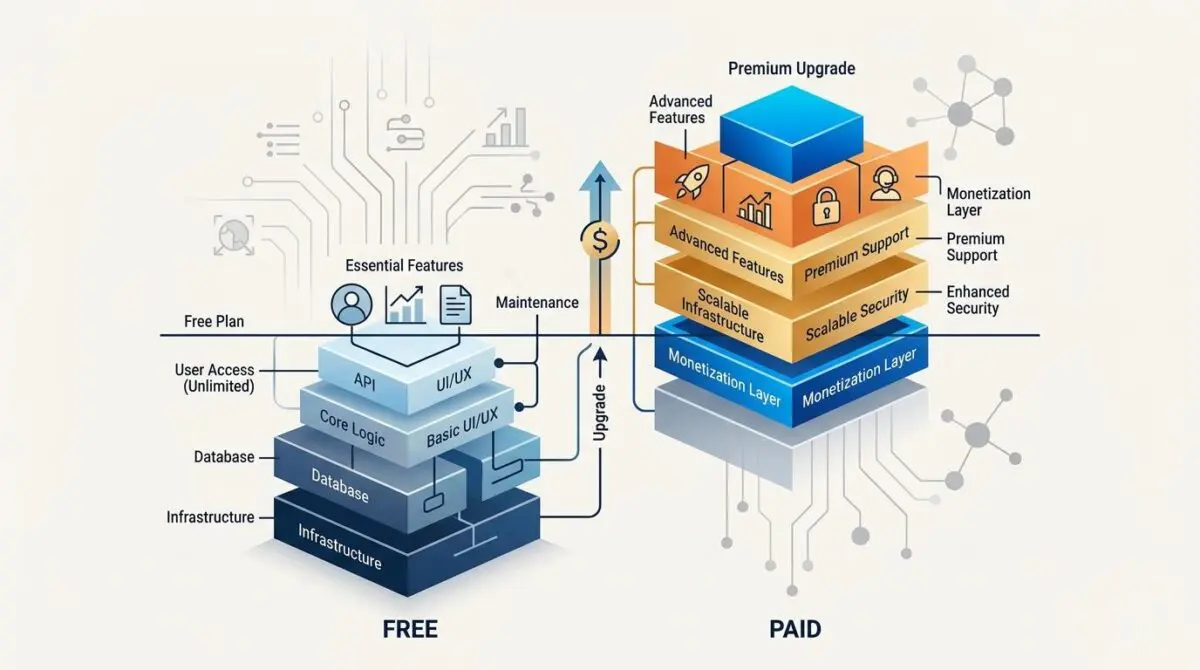
Vendors are actively attempting to bake mandatory AI surcharges into standard renewals. This predatory pricing strategy is resulting in an average cost increase of 8.9% across the board for legacy enterprise suites. To combat this margin erosion, smart operators are turning to Product-Led Freemium Architecture as the ultimate barrier-to-scale solution. This operational framework completely redefines how a company acquires, deploys, and pays for its digital infrastructure.
Product-Led Freemium Architecture allows for zero-marginal-cost expansion across the entire organizational chart. Businesses only incur financial costs when a specific AI agent generates a measurable, undeniable return on investment. This effectively eliminates vendor lock-in and provides a powerful hedge against the bloated contracts of the past. The era of paying for empty seats and unused software features is officially dead.
Market Intelligence & Smart Capital
Market Intelligence & Data
B2B PLG Dominance
Data from SaaS Mag indicates that 58% of B2B software companies now utilize a product-led growth motion as their primary customer acquisition strategy in 2026.
AI Process Savings
According to McKinsey’s 2026 Global AI Survey, the average enterprise is saving $4.6 million annually by replacing manual processes with AI-driven, freemium-first automations.
Enterprise API Deployment
Index.dev reports that over 80% of enterprises are expected to have fully deployed generative AI APIs or models by the end of 2026, up from less than 5% in 2023.
Valuation Premium
Gilion’s 2026 Market Analysis shows that AI-native SaaS companies using freemium models are raising capital at 40% higher valuations than traditional subscription software firms.
The data reveals a stark reality for legacy monolithic suites that refuse to adapt. Smart money is rapidly abandoning traditional enterprise sales cycles in favor of decentralized, agile frameworks. Institutional capital is shifting aggressively from legacy SaaS to Agentic-PLG disruptors that promise immediate value creation. Heavyweights like Menlo Ventures and Sequoia are actively funding this revolution.
These venture capital titans are betting heavily on startups that utilize outcome-based billing layered seamlessly over free infrastructure. They understand that the future of enterprise software is not about locking clients into rigid contracts, but about proving continuous utility. Meanwhile, strategic corporate arms like Salesforce Ventures and HubSpot Ventures are executing a brilliant pivot. They are pouring capital into connectivity layers to protect their market share.
These connectivity layers act as the central nervous system of the modern enterprise. They are specialized tools designed to stitch together disparate free-tier APIs into a unified enterprise operating system. By owning the integration layer, these legacy giants ensure their platforms remain the central hub in a highly fragmented, low-cost software environment. This is a masterclass in defensive market positioning.
The Strategic Deep Dive
Modular Composable Architecture
By 2026, the freemium stack has fundamentally evolved into what industry insiders call Modular Composable Architecture. Businesses no longer buy bloated, monolithic suites that take months to deploy and require expensive implementation consultants. Instead, they assemble Lego-style operations using API-first, free-tier agents that can be swapped out at a moment’s notice. This hyper-agile approach allows departments to plug and play specific functionalities exactly when the business logic demands it.
The killer strategy driving this adoption is known as activation-first onboarding. In this new paradigm, AI agents perform roughly 80% of the initial setup entirely for free. The singular goal of this motion is to push the user to the critical Aha Moment in under 60 seconds. By removing all friction from the initial user experience, companies can demonstrate undeniable value before a credit card is ever requested.
This architectural shift is forcing a massive rewiring of enterprise procurement psychology. When a tool proves its worth in under a minute without requiring a budget sign-off, it inherently bypasses the traditional IT gatekeepers. The software essentially sells itself through utility rather than glossy pitch decks. This modularity is the ultimate defense against bloated operational expenditures.
Agentic-PLG & The New Penetration Rate
The true power of Product-Led Freemium Architecture lies in its viral distribution mechanics. We are witnessing the rapid rise of Agentic-PLG, where AI agents deploy themselves within an organization’s existing workflows to solve micro-frictions. These agents act as silent salespeople, optimizing processes in the background and only surfacing to request payment when scaling limits are reached.
A 2026 report from Menlo Ventures reveals that 27% of all AI application spend is now flowing through Product-Led Growth (PLG) channels, representing a 4x higher penetration rate than traditional enterprise sales cycles. This mid-content insight underscores a monumental shift in how software budgets are allocated and consumed. The days of top-down software mandates from the C-suite are rapidly coming to an end.
Instead, adoption is happening from the bottom up, driven entirely by end-user preference and immediate task resolution. When an AI agent seamlessly integrates into a worker’s daily routine, it becomes indispensable. This organic penetration rate is exactly why venture capital is placing such a massive valuation premium on freemium-first platforms.
The Mechanics of Shadow-Stacking
To fully grasp the impact of this movement, executives must understand the phenomenon of shadow-stacking. This occurs when rogue departments deploy free, highly specialized AI agents to solve immediate problems without waiting for official IT approval. Employees are actively bypassing traditional procurement pipelines because the legacy tools provided by their companies are simply too slow or restrictive.
Shadow-stacking allows teams to prove the financial value of a tool in real-time before ever seeking budget approval from the CFO. By the time leadership becomes aware of the software, it has already generated a positive return on investment. This flips the traditional risk model of software purchasing entirely on its head. The enterprise assumes zero risk during the testing phase.
While traditional IT managers view shadow-stacking as a security nightmare, visionary leaders see it as a decentralized R&D laboratory. It allows the company to crowdsource the best possible software solutions directly from the employees who use them daily. The goal is no longer to prevent shadow IT, but to harness it and integrate the winning tools into the official corporate stack.
The Executive Action Plan
The next logical evolution for the modern enterprise is the realization of the Autonomous Zero-Opex Stack. Founders are actively preparing for a landscape where AI-native software agents handle their own resource management and cost optimization. These intelligent agents automatically rotate data and workloads across various freemium tiers to maintain near-zero software spend indefinitely. This is the holy grail of operational efficiency.
Strategic Trajectory
- Architect an ‘Autonomous Zero-Opex Stack’ to capitalize on AI-driven cost efficiencies.
- Deploy AI-native software agents to automate workload rotation across multiple freemium service tiers.
- Maintain near-zero software expenditure indefinitely through strategic resource distribution.
- Pivot toward ‘Self-Sovereign Data Layers’ where internal data remains the core value driver.
- Treat third-party software tools as ephemeral utilities while prioritizing proprietary AI-trained models as long-term assets.
To execute this trajectory, CEOs must radically rethink their digital assets and vendor relationships. The transition toward Self-Sovereign Data Layers is no longer optional; it is a critical survival mechanism in a modular world. In this framework, the software tools themselves are viewed as ephemeral and entirely disposable. They can be swapped, upgraded, or discarded the moment a cheaper or faster alternative enters the market.
However, the company’s proprietary data and AI-trained models remain securely locked within the internal ecosystem. These proprietary datasets are the only assets that carry long-term financial value and create a defensible competitive moat. By separating the data layer from the application layer, businesses ensure they are never held hostage by a software vendor again. This architectural decoupling is the defining characteristic of a resilient modern enterprise.
Conclusion
The era of the bloated, multi-year software contract is officially over, replaced by a hyper-efficient, modular reality. Product-Led Freemium Architecture has democratized access to enterprise-grade AI, shifting the power dynamic from the vendor back to the business owner. By embracing shadow-stacking and outcome-based billing, companies can scale their operations with unprecedented financial agility.
Those who cling to legacy monolithic suites will find themselves crushed under the weight of subscription fatigue and mandatory AI surcharges. The future belongs to the agile, the modular, and the autonomous. Building a self-sovereign data ecosystem is the ultimate insurance policy against market volatility and vendor extortion.
Navigating the intersection of technology, capital, and market psychology requires a sharp strategy. To future-proof your business architecture and scale with precision, connect with Andres at Andres SEO Expert.