



Key Points
- Agentic Orchestration: Autonomous AI agents interact with ERP systems and APIs to resolve logistical conflicts dynamically.
- Knowledge Graphs: Graph neural networks map dynamic supplier relationships to uncover hidden vulnerabilities and dependencies.
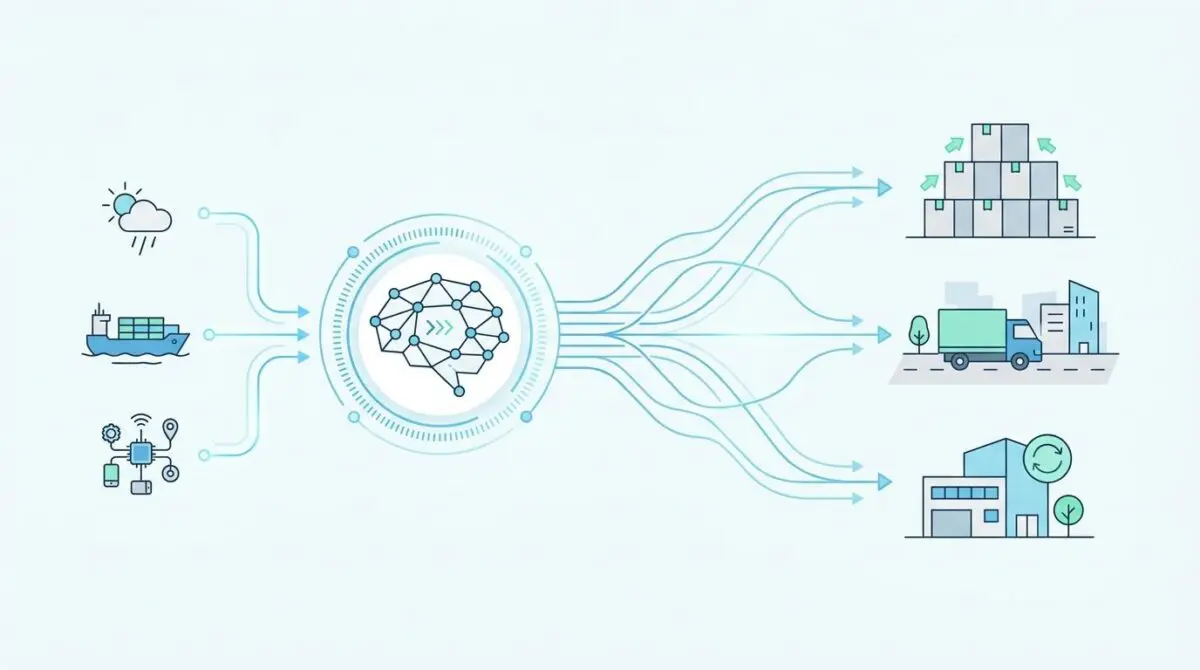
- Multi-Modal Synthesis: AI synthesizes satellite imagery and telemetry data to predict disruptions before they appear in text reports.
Table of Contents
The AI Landscape: Transitioning to Predictive Logistics
As of May 2026, most major companies have shifted to predictive AI to handle global shipping issues. This technology marks a huge leap from simply reacting to problems to actively preventing them. Businesses now use advanced machine learning to spot bottlenecks before they even happen.
This tech has quickly grown into smart, independent systems that can analyze massive amounts of data. They look at everything from satellite photos of crowded ports to global news trends. These systems can test different risk scenarios and suggest the best solutions instantly.
This change completely transforms how large companies stay resilient. The industry is moving away from just keeping extra stock on hand to being fast and data-driven. Supply chain managers no longer have to rely on past data to guess what will happen next.
Core Concepts & Capabilities of PSCI
Core Architecture & Pillars
Agentic Orchestration Frameworks
Modern predictive AI relies on autonomous agent architectures where specialized LLM-based agents manage specific domains like maritime freight or inventory replenishment. These agents use tool-calling capabilities to interact with ERP systems and external APIs, resolving conflicts through multi-agent negotiation logic rather than simple linear forecasting.
Temporal Knowledge Graph Integration
Supply chains are mapped into dynamic knowledge graphs that capture the relationships between suppliers, routes, and external variables. Predictive AI applies graph neural networks to these structures to identify ‘hidden’ dependencies that traditional relational databases miss, such as a Tier-2 supplier’s reliance on a specific high-risk energy grid.
Multi-Modal Risk Synthesis
The architecture integrates non-textual data—such as infrared satellite imagery of factory output and AIS transponder signals from ships—into the LLM’s latent space. By converting visual and telemetry data into tokens, the AI performs ‘cross-modal reasoning’ to predict delays that haven’t been reported in text-based news yet.
Probabilistic Scenario Simulation
Instead of a single forecast, predictive AI generates thousands of synthetic ‘future states’ using Monte Carlo simulations paired with Generative Adversarial Networks (GANs). The LLM then analyzes these simulations to determine the ‘path of least regret’ for inventory positioning and transport routing.
The main structure of predictive supply chain intelligence depends on smart, independent AI agents. In large companies, this looks like a complex network of agents working together seamlessly. For instance, a risk-focused agent might spot a labor strike and immediately alert a sourcing agent.
The sourcing agent then automatically searches for new suppliers using built-in connections. Forward-thinking companies are already using an agentic AI framework that autonomously monitors and responds to disruptions to keep things running smoothly. This kind of automation cuts down response times during a crisis dramatically.
Mapping out supply chains over time is another key feature driving this change. Supply chains are turned into flexible maps that show the complex links between suppliers, routes, and outside factors. Companies are now focused on enhancing supply chain visibility with graph neural networks to find hidden risks.
In modern cloud systems used by vendors, this tech allows the AI to easily flag connected issues. A tech failure in one area can be instantly linked to a larger shipping delay on the global map. This smart risk analysis turns visual and sensor data into clear, actionable steps.
In early 2026, a major retailer used an AI network to reroute 400 shipments just days before a cyberattack hit a major European port. This quick move saved them an estimated $112 million in lost sales. This event clearly showed the massive value of testing different future scenarios.
Strategic Implementation of Agentic Networks
Implementation Roadmap
Establish a Unified Data Fabric
Break down data silos by migrating legacy ERP, CRM, and IoT data into a centralized vector database. Ensure all metadata is tagged for semantic search capability to support the eventual RAG implementation.
Deploy Domain-Specific AI Agents
Configure autonomous agents using frameworks like LangGraph or AutoGPT. Assign each agent a specific mission, such as ‘Monitor Weather Anomalies’ or ‘Audit Supplier Financial Health,’ and give them ‘Read’ access to relevant external data feeds.
Implement Agentic RAG for Decision Support
Build a Retrieval-Augmented Generation pipeline that prioritizes real-time telemetry over historical documents. Use ‘Hybrid Search’—combining keyword and vector search—to ensure the AI can find specific SKU data during a crisis.
Iterative Human-in-the-Loop Refinement
Create a feedback interface where supply chain experts can ‘upvote’ or ‘downvote’ AI-suggested disruption responses. Use this reinforcement learning data to fine-tune the model’s policy for future autonomous actions.
Setting up predictive supply chain intelligence requires a big change in how company data is organized. The first major step is creating a single, unified data system to break down old barriers. Moving all business and sensor data into one central database gets everything ready for smart, advanced searches.
Once the data is secure, companies need to launch specialized AI agents using modern frameworks. Each agent gets a very specific job and access to the right outside data feeds. This building-block approach keeps the AI system flexible and highly focused.
Adding smart decision support turns the AI from a simple search tool into an active helper. This setup values real-time sensor data over old documents, helping find specific product details during an emergency. The system needs to take in data very quickly to give the best advice.
It is also vital to create a way for human experts to check the AI’s suggested fixes. This constant feedback helps train the model to make better choices on its own in the future. Over time, the network of AI agents becomes much more independent and trustworthy.
Real-World Impact & Advanced Use Cases
The effect of predictive supply chain intelligence on modern AI systems is truly massive. Generative AI no longer just reads old reports; it acts like a smart control tower for the whole business. It combines live sensor data with global market trends to help leaders make better choices.
This shift requires AI that actively checks live shipping data and sensor networks. Companies do this by sending live data from smart warehouses straight into their AI systems. This lets the AI update its view of the entire supply chain every few seconds.
Industry leaders are closely studying the effectiveness of autonomous AI agents in multi-echelon supply chains to improve buying processes. By making sure managers always see fresh data, companies keep a strong competitive edge. The AI can even predict delays before they are officially reported anywhere.
Instead of just one simple guess, predictive AI creates thousands of possible future scenarios. The AI then looks at all these options to find the absolute best place to store inventory. Managers can easily compare the costs and risks of each scenario right on their screens.
Best Practices & Future Outlook
Strategic Best Practices
- Always maintain a ‘Human-in-the-Loop’ protocol for any AI-suggested financial commitments exceeding a specific threshold to mitigate hallucinations.
- Prioritize data diversity by including non-traditional sources like social media sentiment to catch early signs of labor unrest.
- Ensure that all predictive models are ‘Explainable AI’ (XAI) compliant, meaning the system must be able to state exactly which data points led to a specific disruption forecast to build trust with stakeholders.
Setting up predictive supply chain intelligence means following strict AI safety rules. Companies must always keep a human involved when the AI suggests spending money. This safety net stops the AI from making costly mistakes if it gets confused.
Using a wide variety of data is just as important when training these smart models. Looking at unusual sources, like social media trends, can help spot early signs of worker strikes or political trouble. This mix of data keeps the AI’s future predictions highly accurate and strong.
Also, making sure all AI models can explain their choices is a must for big companies. The system needs to clearly show exactly which data points led to a specific warning. This honesty is crucial for building trust with managers and company leaders.
Navigating the rapid evolution of Large Language Models and AI infrastructure requires a precise strategy. To stay ahead of the AI revolution and optimize your digital presence, connect with Andres at Andres SEO Expert.
Frequently Asked Questions
What is Agentic Predictive AI in supply chain management?
Agentic Predictive AI is an advanced orchestration framework that uses autonomous LLM-based agents to transition from reactive logistics to proactive disruption management. By 2026, it is projected that 84% of Fortune 500 companies will use this technology to analyze multi-modal datasets and anticipate global logistics bottlenecks before they manifest.
How do Temporal Knowledge Graphs enhance supply chain visibility?
Temporal Knowledge Graphs map complex relationships between suppliers, routes, and external variables using graph neural networks. This allows predictive AI to identify ‘hidden’ dependencies, such as a Tier-2 supplier’s reliance on a high-risk energy grid, which traditional relational databases often overlook.
What is the role of multi-modal risk synthesis in logistics?
Multi-modal risk synthesis integrates non-textual data—such as satellite imagery of port congestion and AIS transponder signals—into an AI’s latent space. By performing cross-modal reasoning, the AI can predict logistics delays based on visual and telemetry tokens before they are reported in text-based news feeds.
How does Probabilistic Scenario Simulation differ from traditional forecasting?
Unlike a single linear forecast, Probabilistic Scenario Simulation uses Monte Carlo simulations and Generative Adversarial Networks (GANs) to create thousands of synthetic future states. The AI then analyzes these scenarios to determine the ‘path of least regret’ for inventory positioning and transport routing.
What is Agentic RAG and how is it used in supply chains?
Agentic RAG (Retrieval-Augmented Generation) is a pipeline that allows AI to actively query live logistics APIs and IoT sensor networks rather than relying on static historical documents. It uses hybrid search—combining keyword and vector search—to provide real-time decision support for specific SKU data during emerging crises.
Why is Explainable AI (XAI) necessary for predictive logistics?
Explainable AI is critical for enterprise adoption because it requires the system to state exactly which data points led to a specific disruption forecast. This transparency builds trust with stakeholders and ensures that ‘Human-in-the-Loop’ protocols can accurately validate AI-suggested financial commitments.