Key Points
- AI-Orchestrated Migration: The shift to proprietary LLMs automating legacy code translation has reduced project timelines by an unprecedented 65%.
- Shadow-Migration Strategy: Enterprises are mirroring production environments in real-time to eliminate cutover downtime and executive anxiety.
- Self-Healing Infrastructure: The ultimate strategic goal is deploying dynamic environments that autonomously upgrade, permanently ending the 5-year re-platforming cycle.
Table of Contents
The Innovation Tax and the End of Monoliths
According to the Gartner 2026 Infrastructure Report, 82% of Global 2000 enterprises have shifted to AI-automated re-platforming tools. This massive pivot has reduced project timelines by an average of 65% compared to 2024 standards.
For decades, enterprise re-platforming was a terrifying, multi-year saga of manual operations. Boards viewed it as a necessary evil, fraught with downtime, budget overruns, and operational friction.
Today, the narrative has completely fractured. Enterprise re-platforming is no longer a defensive IT maneuver, but an offensive strategy for market dominance.
Organizations are waking up to the reality of the innovation tax dragging down their balance sheets. When legacy codebases bottleneck scalability, integrating emerging AI technologies becomes a mathematical impossibility.
Monolithic architectures were once the gold standard of enterprise stability. Today, they are concrete blocks tied to the ankles of agile competitors.
The smart money recognizes that survival requires a fundamental architectural reset. The focus has shifted from merely surviving a migration to architecting a system that never needs to be migrated again.
Market Intelligence: The Capital Shift to MaaS
Market Intelligence & Data
Global Modernization Spending
IDC 2026 forecasts indicate that global enterprise spending on re-platforming and cloud modernization services will hit $145B this year as the ‘2020-era’ tech stacks reach end-of-life.
Operational Cost Reduction
Data from a 2025 McKinsey Global Survey shows that organizations moving to composable, re-platformed architectures see a 42% reduction in long-term operational costs.
AI-Driven Data Mapping
Forrester Research 2026 highlights that 95% of data mapping and schema migration in enterprise projects is now performed by specialized LLM agents rather than human architects.
Faster Feature Deployment
The 2026 MACH Alliance Annual Review reports that companies using re-platformed, headless architectures achieve 3.8x faster feature deployment cycles than those on monolithic systems.
The numbers above illustrate a profound reallocation of institutional capital. Dominance is rapidly shifting toward the MACH Alliance ecosystem, with leaders like commercetools and Contentstack setting the new baseline.
Venture capital is currently flooding into Migration-as-a-Service startups that utilize proprietary LLMs. These advanced models can now automate up to 90% of legacy code conversion.
This automated modernization directly attacks the core friction holding enterprises back. In fact, it is widely documented that legacy systems consume up to 75% of IT budgets on maintenance.
Significant institutional money from firms like Sequoia and a16z is moving toward AI-native infrastructure tools. Smart money recognizes that the future belongs to architectures that enable seamless multi-cloud elasticity.
The capital markets are heavily indexing on these solutions because they transform capital expenditure into operational agility. When you eliminate the human bottleneck in code refactoring, return on investment timelines compress dramatically.
The Psychology of Shadow-Migration
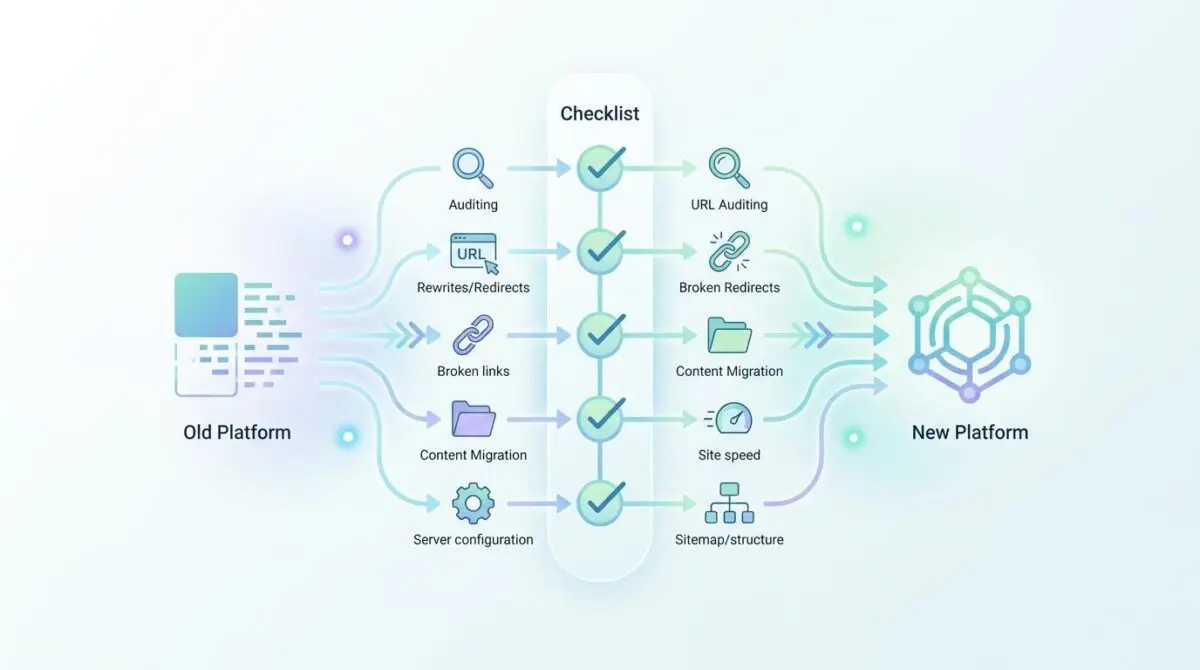
The traditional re-platforming checklist was essentially a countdown to a highly risky cutover weekend. Executives would hold their breath, praying the monolithic architecture would survive the transition.
The killer strategy in 2026 involves a brilliant concept known as Shadow-Migration. Rather than executing a hard switch, AI agents continuously mirror production environments in a modern stack.
This allows engineering teams to test performance, load, and data integrity in real-time before the final cutover. The psychological relief for the C-suite is immense, as this strategy virtually eliminates the threat of downtime.
Change management is often the silent killer of digital transformation. Shadow-Migration bypasses human anxiety by proving the new system works before the old one is turned off.
It acts as a psychological safety net woven entirely from real-time data. Founders can finally sleep at night knowing their revenue engine is protected during the transition.
Microservices and Platform Fluidity
Modern enterprise re-platforming provides the crucial elasticity required to handle high-velocity AI workloads. Businesses can now scale infrastructure instantly, bypassing the technical debt that crippled previous generations.
This concept of platform fluidity means the architecture is no longer a rigid, fragile structure. It is a composable ecosystem where microservices and serverless functions interact seamlessly without friction.
When an enterprise achieves this level of agility, integrating new tech becomes plug-and-play. The focus shifts from merely keeping the lights on to rapidly deploying disruptive customer experiences.
Fluidity is the ultimate competitive moat in a hyper-accelerated market. If your platform cannot pivot in real-time, your market share will inevitably be absorbed by a competitor who can.
AI Agents and the Decommissioning of Mainframes
The sheer scale of this technological leap is best understood by looking at the titans of the industry. A 2026 internal strategy leak from Microsoft revealed a $9.2B investment in ‘Project Phoenix.’
This highly classified initiative centers on an AI agent specifically designed to decommission legacy mainframes. The agent operates by autonomously rewriting COBOL into cloud-native architectures.
According to the leak, this autonomous translation into TypeScript operates with an astonishing 99.8% accuracy. Human architects are no longer writing the translation logic; they are merely supervising the AI orchestrator.
This represents the final nail in the coffin for legacy mainframes. The barrier to exit has been destroyed by artificial intelligence.
The Executive Action Plan: Self-Healing Infrastructure
Strategic Trajectory
- Pivot platform vision from static destinations to dynamic, autonomous environments.
- Architect self-healing infrastructure that proactively upgrades its own components and libraries.
- Deploy security protocols designed to evolve and patch without human intervention.
- Strategic alignment toward ending the legacy five-year re-platforming cycle.
- Optimize for continuous evolution to replace periodic, high-risk infrastructure migrations.
The ultimate goal for any forward-thinking CEO is to completely eradicate the traditional re-platforming cycle. The next evolution of enterprise infrastructure is entirely self-healing.
Founders must prepare for a future where the platform is no longer a static destination. It is a living, dynamic environment that autonomously upgrades its own components and security protocols.
This requires a fundamental shift in how tech budgets are allocated and how engineering teams are structured. The focus must move from maintenance to orchestration, allowing AI to handle the heavy lifting of infrastructure evolution.
Self-healing infrastructure is not a theoretical whitepaper concept; it is currently being deployed by the top one percent of tech organizations. This paradigm shift means vulnerabilities are patched before zero-day exploits can even be conceptualized.
By adopting this checklist, executives position their companies to thrive in an era of continuous disruption. The platform becomes an asset that appreciates in capability, rather than depreciating into technical debt.
Conclusion: The Dynamic Platform Era
Enterprise re-platforming has officially transcended its IT origins to become a core pillar of high-level business strategy. The days of manual code translation and high-risk cutovers are firmly behind us.
By leveraging AI-orchestrated composable migration, organizations can finally break free from the innovation tax. The market disproportionately rewards those who build fluid, self-healing systems capable of matching the velocity of modern commerce.
The future belongs to the fluid, while static infrastructure remains a terminal liability. Survival dictates that leaders must embrace autonomous architecture today.
Navigating the intersection of technology, capital, and market psychology requires a sharp strategy. To future-proof your business architecture and scale with precision, connect with Andres at Andres SEO Expert.
Frequently Asked Questions
What is the “Innovation Tax” in enterprise technology?
The innovation tax refers to the heavy financial and operational burden caused by legacy monolithic systems. These outdated architectures consume up to 75% of IT budgets on maintenance, creating a bottleneck that makes integrating modern AI technologies mathematically impossible and scaling difficult.
How has AI automation impacted enterprise re-platforming timelines?
AI-automated re-platforming tools have reduced project timelines by an average of 65% compared to 2024 standards. Modern LLM agents now handle approximately 95% of data mapping and schema migration, transforming what was once a multi-year manual process into an efficient, automated operation.
What is Shadow-Migration and how does it reduce risk?
Shadow-Migration is a strategy where AI agents continuously mirror production environments in a modern stack before a final cutover. This allows engineering teams to test performance and data integrity in real-time, virtually eliminating downtime and reducing the psychological and operational risks associated with traditional migrations.
How does Migration-as-a-Service (MaaS) utilize Large Language Models?
MaaS providers use proprietary LLMs to automate up to 90% of legacy code conversion. These specialized AI models can translate outdated codebases, such as COBOL, into cloud-native architectures like TypeScript with accuracy rates as high as 99.8%, significantly reducing the need for manual human refactoring.
What are the advantages of moving from monolithic to composable architectures?
Organizations moving to composable architectures typically see a 42% reduction in long-term operational costs and 3.8x faster feature deployment cycles. This shift enables platform fluidity, allowing businesses to scale infrastructure instantly and integrate new microservices without the technical debt of monolithic systems.
What is self-healing infrastructure in the context of modern IT?
Self-healing infrastructure is a dynamic, autonomous environment that proactively upgrades its own components, libraries, and security protocols. This paradigm shift aims to end the traditional five-year re-platforming cycle by creating a platform that evolves continuously and patches vulnerabilities before they can be exploited.