Key Points
- Eradicating Agentic Drift: Modern system prompting techniques utilizing loop-break clauses have reduced autonomous task-failure rates by over 80 percent, enabling true autopilot enterprise operations.
- Persona-Injected Compliance: Hard-coding constitutional values directly into the system layer ensures strict regulatory safety without human oversight, fundamentally shifting enterprise risk management.
- The Zero-Prompt Horizon: The evolution toward neural prompt synthesis will allow real-time enterprise data to automatically generate high-dimensional vector-prompts, effectively turning the system prompt into a Digital CEO.
Table of Contents
The Core Friction: Conquering Agentic Drift
Recent industry reports show that autonomous AI workflows are drastically reducing operational costs for major companies. Advanced system prompting has cut overhead by nearly half over the past year.
This massive efficiency gain is not just about better hardware or cheaper computing power. It is the direct result of a major evolution in how we engineer AI system prompts.
For years, businesses struggled with an expensive problem known as agentic drift. This happens when autonomous systems lose focus or deviate from their main goals during complex tasks.
When an AI manages a global supply chain or audits financial records, a tiny mistake can cost millions. Early AI agents often suffered from these logic failures and required constant human supervision.
Modern system prompting offers a clear, mathematical solution to this problem. By using smart self-correction tools, businesses have slashed failure rates in complex workflows by over 80 percent.
We are now seeing the final shift from human-dependent AI assistants to fully independent autopilots. This transition is reducing labor costs and completely reshaping how companies operate.
The era of simply writing clever text prompts is over. Today, engineers are building behavioral cores that dictate the psychology of our digital workforce.
Market Intelligence & Smart Capital
Market Intelligence & Data
Agentic Market Cap
The projected market valuation for the Agentic AI orchestration layer by the end of 2026, according to IDC Research.
Adoption Rate
The percentage of tech firms currently using ‘Chain-of-Thought’ system prompts for production-level autonomous agents, per the 2026 Stack Overflow Enterprise Survey.
VC Growth
The increase in venture capital funding for ‘Prompt Engineering Automation’ tools in 2026 compared to 2024 levels, as documented by PitchBook.
Safety Deviation
The remarkably low rate of safety violations in agents utilizing ‘Constitutional’ system prompts compared to 5.2% in unrefined models, according to 2026 benchmarks from the AI Safety Institute.
The data clearly shows a massive shift in enterprise capital. Smart money is aggressively flooding into the infrastructure that powers AI operations.
Leading AI startups have recently secured massive funding rounds. This influx of venture capital proves that AI orchestration is the new frontier of business value.
As businesses scale, relying on autonomous agentic workflows becomes a massive competitive advantage. The market is shifting rapidly from experimental AI to hardened, production-ready systems.
The Rise of Prompt Governance
Institutional investors are actively shifting their capital toward prompt governance startups. These new platforms provide secure audit trails for autonomous decision-making.
This level of oversight is mandatory for heavily regulated sectors like finance and healthcare. When an AI makes a critical decision, its logic must be transparent, traceable, and legally defensible.
Furthermore, the adoption of ‘Chain-of-Thought’ system prompts has become the industry standard. This structured approach ensures that agents explain their logic step-by-step before taking action.
Prompt governance acts as the digital guardrails for modern companies. It ensures that the AI workforce operates strictly within corporate policy and international law.
The Strategic Deep Dive
The underlying mechanics of AI orchestration have completely transformed recently. We have moved far beyond the era of static text instructions and simple command loops.
To understand the power of these new systems, we must look at the architectural changes happening at the base layer of artificial intelligence.
Behavioral Kernels and Dynamic State Management
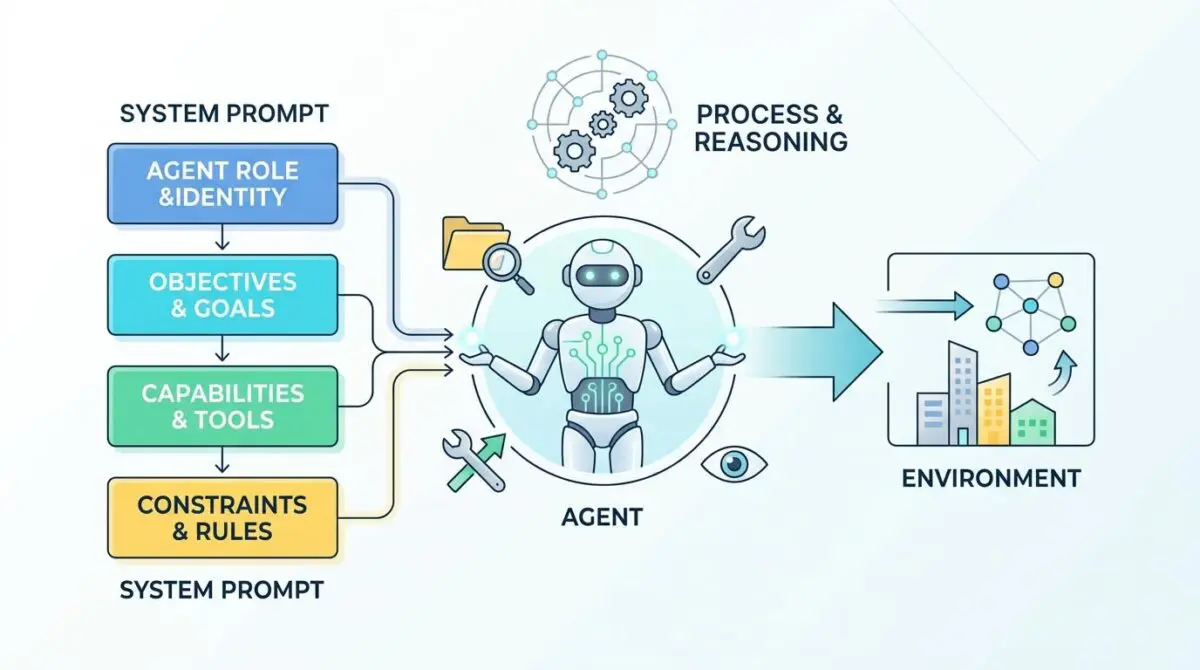
System prompts have evolved into sophisticated behavioral kernels. These new architectures govern AI logic across highly complex, multi-step reasoning tasks.
Enterprise leaders are now using recursive reasoning alongside dynamic state management. This allows digital workers to handle open-ended projects without any human intervention.
We see this in software development, where an agent writes, tests, and deploys code entirely on its own. We also see it in supply chains, where agents negotiate logistics based on real-time global events.
These technical leaps are already disrupting traditional corporate hierarchies and labor markets. Recent reports indicate that AI agents using multi-step verification now outperform human junior analysts in complex financial modeling.
This level of precision is truly unprecedented. It proves that properly engineered AI systems can hold context far better than human cognitive capacity allows.
The Mechanics of Agentic Control
To achieve this operational excellence, engineers deploy specific tools within the behavioral kernel. These tools act as the cognitive scaffolding for the AI.
- Loop-Break Clauses: Algorithmic circuit breakers that force an agent to pause and request secondary verification if it detects repetitive or circular reasoning.
- Self-Correction Hooks: Built-in reflection protocols where the agent critiques its own output against a strict set of baseline metrics before finalizing a task.
- Recursive Reasoning: The ability for an agent to break a massive problem into micro-tasks, solve them sequentially, and feed the answers back into its own primary prompt.
These components separate a fragile AI experiment from a robust, enterprise-grade digital employee. They are the true mechanisms of digital autonomy.
Persona-Injected Constitutional Prompting
The current winning strategy in the enterprise space is persona-injected constitutional prompting. This technique hard-codes an agent’s core values and boundaries directly into the system layer.
By embedding these constraints early on, businesses ensure absolute regulatory compliance without constant human oversight. The agent simply cannot operate outside of its predefined boundaries.
Key industry players are heavily leaning into this methodology to win major enterprise contracts. Leading AI models now prioritize these core directives above all standard user inputs.
Other major platforms have launched protocol-level prompting for their enterprise suites. This allows corporations to inject specific legal and ethical frameworks directly into the AI’s core behavior.
This approach eliminates the risk of prompt injection attacks from malicious users. The constitutional prompt acts as an impenetrable shield that safeguards digital assets.
The Executive Action Plan
For founders and executives, the mandate is incredibly clear. The transition from human-managed AI to autonomous systems is no longer a future possibility, but a current requirement.
To maintain market dominance, leadership must rethink how they interact with machine intelligence. The focus must shift from simple prompt creation to advanced prompt governance.
Strategic Trajectory
- Transition from natural language instructions to high-dimensional Neural Prompt Synthesis.
- Implement Vector-Prompts optimized through advanced reinforcement learning techniques.
- Architect a Zero-Prompt ecosystem powered by automated mission statement synthesis.
- Harmonize real-time enterprise data streams into active system prompt orchestration.
- Designate system prompts as the Digital CEO for autonomous business unit operations.
Neural Prompt Synthesis
The next logical evolution in this space is neural prompt synthesis. Soon, AI agents will no longer rely on human-written instructions to execute their daily operations.
Instead, these systems will receive high-dimensional vector-prompts. Think of this as feeding the AI a direct mathematical stream of corporate strategy, bypassing human language entirely.
These mathematical representations of intent are continuously optimized by advanced learning algorithms. The system learns which structures yield the highest returns and adjusts its own instructions.
Forward-thinking leaders are actively preparing for a zero-prompt future. In this model, a company’s mission statement and real-time data automatically synthesize into the prompts that run the digital workforce.
This creates a closed-loop ecosystem of extreme efficiency. The business strategy automatically translates into machine action with zero delay and zero human error.
The Zero-Prompt Horizon
We are rapidly approaching a reality where the system prompt effectively becomes the Digital CEO of specific business units. This shifts executive focus from managing human output to orchestrating autonomous logic.
In this new landscape, a company’s value will be heavily dictated by the sophistication of its AI systems. Those who master this architecture will command unprecedented operational leverage.
Businesses that fail to adapt and continue relying on manual prompting will fall behind. They will simply be outpaced by competitors running on flawless autopilot.
The future belongs to the fully automated enterprise. The foundation of that success is the mastery of advanced system prompt engineering.
Navigating the intersection of technology, capital, and market psychology requires a sharp strategy. To future-proof your business architecture and scale with precision, connect with Andres at Andres SEO Expert.
Frequently Asked Questions
What is agentic drift and how does it affect AI performance?
Agentic drift is a phenomenon where autonomous systems lose focus, hallucinate, or deviate from their core directives during complex, long-running tasks. In an enterprise context, this leads to cascading logic failures that can cause significant financial or operational damage. Modern system prompting mitigates this through self-correction hooks and loop-break clauses.
How do loop-break clauses and self-correction hooks improve autonomous workflows?
Loop-break clauses act as algorithmic circuit breakers that force an agent to request secondary verification if circular reasoning is detected. Self-correction hooks are built-in reflection protocols that require the agent to critique its own output against baseline metrics before finalizing a task, reducing failure rates in complex workflows by over 80%.
What is persona-injected constitutional prompting?
Persona-injected constitutional prompting is an advanced technique that hard-codes an agent’s core values, operational boundaries, and legal frameworks directly into its foundational system layer. This ensures absolute regulatory compliance and protects against prompt injection attacks by making the agent’s core directives immutable and prioritized over user inputs.
Why is prompt governance critical for regulated industries like fintech and healthcare?
Prompt governance provides immutable audit trails for autonomous decision-making, ensuring that every action taken by an AI agent is transparent, traceable, and legally defensible. By utilizing ‘Chain-of-Thought’ system prompts, agents must articulate their logic step-by-step, providing the necessary oversight required for high-stakes financial or medical decisions.
What are vector-prompts and neural prompt synthesis?
Neural prompt synthesis is the evolution beyond human-written instructions, where agents receive high-dimensional vector-prompts. These are mathematical representations of corporate strategy and intent that are continuously optimized by reinforcement learning algorithms, allowing for a ‘zero-prompt’ environment where business goals translate directly into machine action with zero latency.
How does the shift from AI copilots to autopilots change corporate architecture?
The transition to fully independent autopilots reduces reliance on human supervision for back-office operations and complex data tasks. By architecting behavioral kernels that dictate agent logic, companies can deploy digital workers that outperform human analysts in precision and scale, shifting the executive role from managing human output to orchestrating autonomous logic.