Key Points
- The transition from stationary elite schooling to UHNW Experiential Education & Travel-Integrated Tutoring resolves the continuity gap for hyper-mobile families.
- Smart capital is aggressively flowing into EdTech nomadic infrastructure and Credentialing 3.0 platforms to verify global experiential learning.
- By 2028, Decentralized Learning Estates and Micro-Campus Networks in major tech corridors will entirely redefine peer-to-peer elite education.
Table of Contents
The Continuity Gap: Friction in Hyper-Mobile Elite Schooling
The global private tutoring market for wealthy families has surged to $128.5 billion. This massive growth is driven by a 40% increase in demand for custom, travel-integrated learning models.
This massive influx of capital highlights a major shift in how people view education. The traditional model of staying in one elite school is quickly becoming outdated for families who travel constantly.
For decades, top schools required students to be physically present. This created a huge logistical headache for global entrepreneurs, forcing them to choose between traveling for work and keeping their kids in good schools.
This is where travel-integrated tutoring comes in. This new model completely eliminates the need to choose between traveling the world and getting a top-tier education.
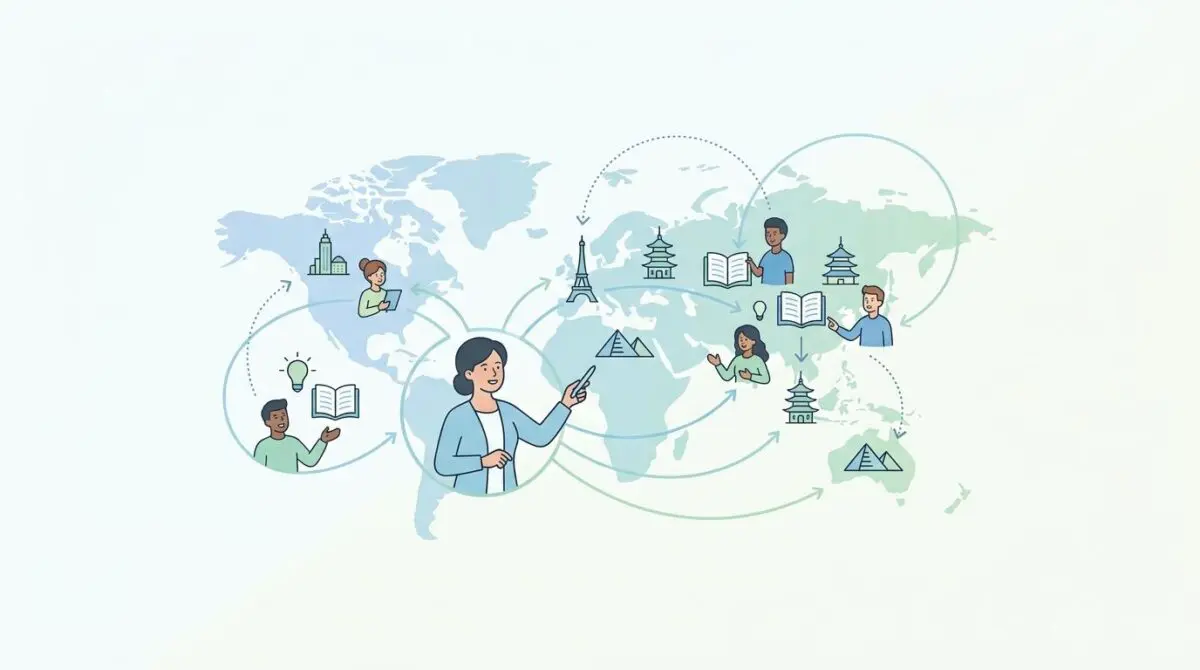
By turning the world into a personalized classroom, families are bypassing the limits of traditional campuses. Education is no longer stuck in one place; it moves with the student.
Market Intelligence: Where Smart Capital is Flowing
Market Intelligence & Data
Educational Travel Spend
The total market spend on high-end educational travel for minors reached $12.4 billion in 2026, according to the Travel + Leisure Business Report.
Hybrid Role Growth
The Knight Frank 2026 Wealth Report notes a 22% increase in the recruitment of ‘governess-tutor’ hybrids by families with a net worth exceeding $30 million.
AI-Mentor Integration
A 2026 Gartner study reveals that 68% of UHNW families now utilize AI-powered adaptive tutors to supplement human mentors during international travel.
Top-Tier Tutor Salary
The average annual package for elite traveling educators with specialized PhDs has risen to $450,000, as reported by The Economist in late 2025.
The data clearly shows that smart money is pouring into flexible education systems. We are seeing the rapid growth of major tutoring companies that cater to this exact need.
These firms have grown beyond simple tutoring placements to become full-service education managers. They now act like dedicated family offices focused entirely on a student’s learning journey.
This shift is fueled by changing lifestyle demands among the global elite. For instance, the Knight Frank 2026 Wealth Report notes a 22% increase in hiring ‘governess-tutor’ hybrids by ultra-wealthy families.
This hybrid role perfectly bridges the gap between daily childcare and high-level academics. It allows families to travel efficiently while ensuring their children receive a rigorous education.
The Rise of EdTech Nomadic Infrastructure
At the same time, specialized luxury travel firms are redefining global expeditions. They are now actively including PhD-level educators directly into their custom travel itineraries.
The massive demand for elite traveling educators has pushed their average salaries into the high six figures. This is not just a simple tutoring expense; it is a strategic investment in top-tier teaching talent.
Venture capital is also heavily backing new educational technology startups. These platforms provide the digital tools needed to keep up with rigorous academics across multiple time zones.
The Psychology of the Educational Concierge
At the center of this change is the rise of the Educational Concierge. Leading families are no longer relying on standard admissions counselors or traditional school principals.
Instead, they hire highly specialized strategists who design global learning plans from scratch. These concierges operate with the precision of a corporate logistics team.
They map out learning goals alongside global travel plans, ensuring every destination offers maximum educational value. The concierge coordinates everything between AI platforms, traveling tutors, and local guides.
This role requires a deep understanding of both advanced teaching methods and global cultures. It is a highly specialized job that connects academic theory with real-world experiences.
Strategic Deep Dive: Synchronous Worldschooling
The core innovation driving this trend is known as Synchronous Worldschooling. This method uses augmented reality field trips and AI-driven learning platforms to create a seamless educational experience.
It ensures that a student’s education continues smoothly while they travel between different countries. This approach directly solves the problem of outdated curriculums found in many prestigious boarding schools.
Memorization is replaced with high-impact, real-world problem-solving. Imagine a student studying marine biology on a boat in the Maldives, followed by an economics lesson in Singapore.
An outdated curriculum is a massive disadvantage in today’s fast-paced world. Traditional schools are often held back by state testing and slow bureaucratic approvals.
In contrast, travel-integrated tutoring allows for real-time updates to what a student learns. If a breakthrough in renewable energy happens, a student can immediately travel to Iceland to study it in person.
Several tech billionaires have even started investing in global learning networks. These networks allow students to rotate through different tech hubs every few months, replacing traditional campus life with real-world immersion.
This shows a profound shift in how wealthy families view education and social development. They are treating learning as a global, scalable experience rather than something tied to a single local community.
Credentialing 3.0 and the End of the GPA
As learning becomes more hands-on, the old ways of getting into college must change. Investors are now funding new credentialing platforms to solve this exact problem.
These innovative startups are building systems that verify real-world learning for top-tier university admissions. They are moving the evaluation process far beyond standard GPAs and traditional testing.
By using advanced portfolios and verification tools, these platforms turn real-world experiences into official academic credit. This ensures that traveling students keep a competitive edge when applying to elite universities.
Mentorship as an Asset Class
The ultimate strategy in this new educational model is high-level mentorship. Forward-thinking families are starting to bypass traditional teachers entirely.
Instead, they hire former CEOs, successful founders, or specialized experts as primary tutors. This gives students real-world business skills alongside their traditional academic studies.
It is essentially a modern apprenticeship model. Students learn negotiation, investing, and critical thinking directly from professionals who have already succeeded in those fields.
The integration of artificial intelligence is making this flexible model even faster. AI platforms can track a student’s progress seamlessly across multiple time zones.
They ensure that basic skills like math and reading are always improving, no matter where the student is located. This allows the human tutor to focus entirely on high-level thinking and mentorship.
The AI handles the repetitive practice, while the human mentor guides deep, critical thinking. It is a perfect blend of machine efficiency and human insight.
The Executive Action Plan: Future-Proofing Education
Strategic Trajectory
- Pivot toward a ‘Decentralized Learning Estate’ where education functions as a global service layer rather than a fixed physical location.
- Investment in Micro-Campus Networks located in high-value tech corridors such as Dubai, Zug, and Miami.
- Implementation of 4-6 week peer-group rotation pods to foster social development within elite international learning hubs.
- Adoption of hybrid staffing models that integrate permanent local facility staff with the family’s dedicated traveling tutors.
- Redefinition of educational continuity through travel-integrated tutoring that maintains academic standards across multiple global jurisdictions.
The next big step is the complete realization of global learning networks. Business leaders are actively preparing for a future where education functions as a seamless, worldwide service.
By 2028, we expect to see a massive rise in micro-campus networks. These are exclusive, temporary learning hubs located in major global tech cities.
Cities like Dubai and Miami are already building the foundation for these elite educational pods. Wealthy families will easily rotate their children into these environments for focused social and academic learning.
These short, 4-to-6-week group programs help build essential networks among the next generation of leaders. The model is supported by a mix of permanent local staff and the family’s own traveling tutors.
Conclusion
The shift from stationary schools to highly mobile, personalized education is accelerating rapidly. Families who embrace travel-integrated tutoring are securing a massive competitive advantage for their children.
They are completely bypassing the limits of traditional curriculums and geographic borders. By using new educational technology and high-level mentorship, they are building the ultimate global learning experience.
Navigating the future of education and technology requires a sharp strategy. To future-proof your learning models and scale with precision, connect with Andres at Andres SEO Expert.
Frequently Asked Questions
What is the Continuity Gap in hyper-mobile elite schooling?
The Continuity Gap is a logistical bottleneck where C-suite executives and global entrepreneurs must choose between family mobility and educational consistency. This friction is increasingly resolved through travel-integrated bespoke learning models that eliminate the trade-off between geographic freedom and academic excellence.
What is the average salary for elite traveling educators in 2026?
According to data from The Economist and the current market trajectory, the average annual package for elite traveling educators with specialized PhDs has risen to $450,000. This reflects the strategic acquisition of top-tier intellectual assets by UHNW families.
How does Synchronous Worldschooling differ from traditional education?
Synchronous Worldschooling replaces rote, stagnant curricula with high-impact, situational problem-solving. It utilizes AR-enhanced field studies and AI-driven adaptive learning to maintain academic continuity as students transit between global residences, allowing for real-time curriculum pivots based on location and global events.
What are Decentralized Learning Estates and Micro-Campus Networks?
Decentralized Learning Estates represent a shift where education functions as a global service layer rather than a fixed location. These are supported by Micro-Campus Networks in tech corridors like Dubai, Zug, and Miami, where students engage in 4-6 week peer-group rotations for social and academic development.
How does AI integration impact the UHNW tutoring model?
Approximately 68% of UHNW families utilize AI-powered adaptive tutors to handle rote mechanics and foundational skills. This allows human traveling tutors to transition into high-level mentors, focusing entirely on cognitive development, systems thinking, and critical analysis.
What is Credentialing 3.0 in experiential learning?
Credentialing 3.0 refers to decentralized platforms that verify and quantify experiential learning for elite university admissions. These systems move beyond standard GPA metrics to translate real-world, nomadic experiences into academic currency for Ivy League and top-tier institution placement.