Key Points
- Agentic Digital Adoption Platforms (A-DAP) eliminate the $450 billion productivity drain caused by context switching by unifying the interface layer.
- Knowledge workers using production-ready AI agents recover a median of 6.4 hours per week, reclaiming a full workday previously lost to manual coordination.
- By 2028, 15% of daily business decisions will be executed autonomously, driving the shift toward a “Zero-Training” enterprise model.
Table of Contents
The Core Friction of Context Switching
According to Gartner’s 2026 AI Strategy Report, worldwide AI spending is projected to reach $2.52 trillion this year. This represents a staggering 44% year-over-year increase across the global market. Enterprises are aggressively pivoting from mere experimentation to the large-scale deployment of agentic workflow systems.
This massive capital injection points directly to a critical operational bottleneck in modern business. The average digital worker toggles between applications 1,200 times daily just to complete routine tasks. This creates a massive cognitive tax that severely impairs deep work and strategic thinking.
Psychologists refer to this phenomenon as “attention residue,” where the brain remains partially focused on a previous task while attempting to start a new one. When multiplied across an entire enterprise, this friction degrades overall operational velocity. The financial impact is devastating, draining billions from the global economy.
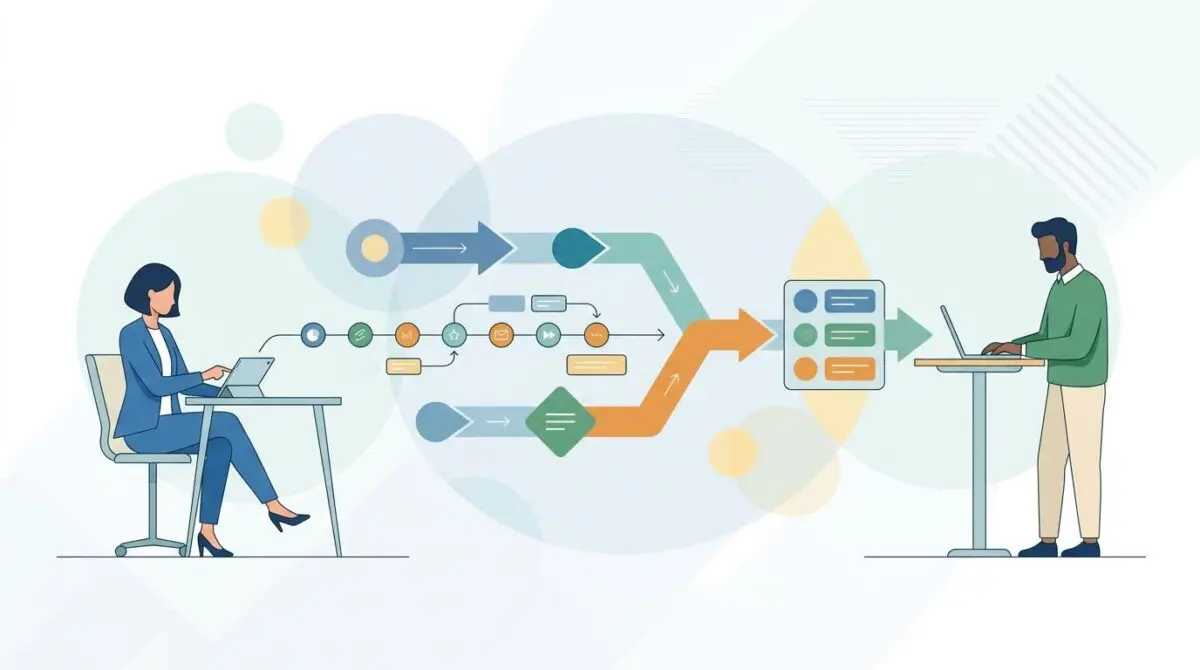
Agentic Digital Adoption Platforms (A-DAP) are emerging as the definitive solution to this friction. They eliminate the attention residue that plagues modern workforces by unifying the interface layer. By acting as digital co-pilots, these systems guide your employees through complex digital workflows seamlessly.
Market Intelligence and the Smart Money Migration
The integration of agentic AI into established platforms is fundamentally redefining market leadership. Smart capital is heavily concentrated in frontier labs and workflow-specific AI agents. Q1 2026 alone saw a record $300 billion in global venture funding poured into this specific sector.
Industry projections indicate worldwide AI spending will reach $2.52 trillion, but understanding where this liquidity flows is crucial. It is moving toward systems that observe employee behavior in real-time across fragmented SaaS stacks. Platforms like CRM, ERP, and HCM are being unified under a single intelligent layer.
Market Intelligence & Data
Enterprise Agent Embedding
According to SQ Magazine 2026 research, 80% of large-scale enterprises have moved beyond pilot programs into production-level AI agent deployments for workflow orchestration.
Context Switching Cost
Data from WaymakerOS and Microsoft workforce studies indicate that fragmented focus and app-toggling cost the U.S. economy approximately $450 billion annually in lost productivity.
DAP Market Valuation
The global Digital Adoption Platform market is projected to grow to $22.6 billion by 2034 as organizations prioritize frictionless employee onboarding, according to Dataintelo 2026 projections.
Administrative Load Reduction
Research from Second Talent 2026 suggests that middle management has shed 40% of its administrative burden due to the rise of ‘digital middle management’ agents coordinating internal workflows.
This data reveals a profound shift in enterprise architecture and resource allocation. The $450 billion annual productivity drain caused by fragmented digital focus is no longer an acceptable loss. Investors recognize that curing Context Switching Exhaustion is the most lucrative enterprise play of the decade.
Furthermore, the reduction in administrative load signals a transformation in middle management. Organizations are replacing human coordination with digital middle management agents. This allows human managers to focus entirely on high-leverage strategic initiatives rather than chasing task updates.
The Strategic Deep Dive into Agentic Workflows
In 2026, the innovation focus has completely shifted from static “click-here” overlays to autonomous “Sense-Decide-Act” loops. These advanced systems proactively execute multi-step tasks without human prompting. They redirect focus contextually to predict the next required business action based on live telemetry.
Legacy software giants are rapidly acquiring this capability to maintain their market dominance. A prime example is SAP via its WalkMe acquisition, alongside Salesforce’s aggressive expansion of its Agentforce ecosystem. These acquisitions validate the thesis that static software is becoming obsolete.
The Rise of Headless Guidance
Key disruptors like Whatfix and Microsoft with Agent 365 are dominating the space by offering “headless” guidance. This architecture allows employees to complete complex workflows without ever entering the native UI of underlying applications. It effectively abstracts the complexity of the SaaS stack away from the human operator.
The psychological impact of this abstraction is immense for the modern workforce. Employees no longer feel like they are fighting their software tools just to do their jobs. Instead, the software adapts to the natural rhythm of the human workflow.
This headless approach also fundamentally changes how IT departments deploy new software. Rollouts no longer require weeks of intensive training sessions. The A-DAP layer simply translates the new software’s capabilities into the existing, familiar interface.
Solving the Cognitive Tax
The true ROI of Agentic Digital Adoption Platforms lies in massive time reclamation. The McKinsey Global AI Survey 2026 reveals that knowledge workers using production-ready AI agents now recover a median of 6.4 hours per week. This essentially reclaims nearly one full workday previously lost to manual digital coordination.
This recovered time translates directly into higher-level strategic output and revenue generation. When you remove the friction of navigating convoluted digital workflows, human capital can finally focus on innovation. The enterprise effectively transitions from a state of operational drag to operational velocity.
Moreover, this cognitive tax relief drastically reduces employee burnout and turnover rates. Top talent demands seamless, modern tooling to execute their best work. Providing an agentic co-pilot is rapidly becoming a baseline requirement for talent retention.
The Executive Action Plan for a Zero-Training Enterprise
The next evolution in enterprise software is the Autonomous Decision Layer. Founders and CEOs must prepare for a landscape where 15% of daily business decisions are executed autonomously by AI agents by 2028. We are rapidly moving toward a Zero-Training enterprise model.
In this new paradigm, software proficiency is no longer a human requirement. AI agents will handle the technical execution of workflows entirely behind the scenes. This shift requires a fundamental realignment of how we train and deploy human talent.
Strategic Trajectory
- Transition the organization toward the ‘Autonomous Decision Layer’ to handle complex operational scaling.
- Benchmark for a 2028 landscape where 15% of daily business decisions are executed autonomously by AI agents.
- Implement a ‘Zero-Training’ enterprise model where software proficiency is no longer a human technical requirement.
- Outsource the technical execution of workflows to AI agents to eliminate human mechanical error.
- Realign the workforce to focus exclusively on ‘Workflow Design’ and high-level strategic oversight roles.
Implementing this trajectory requires a ruthless audit of current operational bottlenecks. Executives must identify which workflows are purely mechanical and outsource them to agentic systems. The ultimate goal is to elevate humans into Workflow Design and high-level strategic oversight roles.
Leaders must also foster a culture that embraces human-AI collaboration. Resistance to autonomous agents often stems from a fear of obsolescence. Clear communication about upskilling and shifting focus to creative problem-solving will mitigate this internal friction.
Conclusion and Future Outlook
The transition to Agentic Digital Adoption Platforms is not just a standard IT upgrade. It is a fundamental restructuring of how a business operates, scales, and competes in a hyper-accelerated market. Those who cling to manual SaaS navigation will be outpaced by organizations running on autonomous decision layers.
The smart money has already placed its bets on frictionless, AI-driven workflow orchestration. The technology is mature, the capital is deployed, and the market leaders are already reaping the rewards. The only remaining question is how quickly your organization can adapt to this new reality.
Navigating the intersection of technology, capital, and market psychology requires a sharp strategy. To future-proof your business architecture and scale with precision, connect with Andres at Andres SEO Expert.
Frequently Asked Questions
What is an Agentic Digital Adoption Platform (A-DAP)?
An Agentic Digital Adoption Platform (A-DAP) is an AI-driven interface layer that unifies fragmented SaaS stacks. It uses autonomous “Sense-Decide-Act” loops to proactively execute multi-step workflows, acting as a digital co-pilot that eliminates the need for manual application toggling.
How much does context switching cost the U.S. economy?
According to research from WaymakerOS and Microsoft, fragmented digital focus and constant application switching cost the U.S. economy approximately $450 billion annually in lost productivity due to cognitive friction and attention residue.
What is the “Zero-Training” enterprise model?
The Zero-Training model is an enterprise paradigm where software proficiency is no longer a human technical requirement. AI agents handle the technical execution of workflows behind the scenes, allowing employees to focus exclusively on high-level strategic oversight and workflow design.
What are the benefits of “headless guidance” in AI workflows?
Headless guidance allows employees to complete complex tasks without ever entering the native UI of underlying applications. This architecture abstracts SaaS complexity, minimizes the cognitive tax of context switching, and significantly accelerates the deployment of new software tools.
How many hours can knowledge workers reclaim using AI agents?
Data from the 2026 McKinsey Global AI Survey shows that knowledge workers using production-ready AI agents reclaim a median of 6.4 hours per week, essentially recovering nearly one full workday previously lost to manual digital coordination and administrative tasks.
What percentage of business decisions will be handled by AI by 2028?
By 2028, it is projected that 15% of daily business decisions will be executed autonomously by AI agents. This shift toward an Autonomous Decision Layer marks a major transition from manual task management to high-leverage strategic oversight roles.