

Key Points
- Agentic Knowledge Workflows: The enterprise transition from basic RAG to specialized AI agents enables autonomous cross-departmental reasoning without exposing raw data to public models.
- Solving Data Gravity: Implementing In-Place AI architectures neutralizes the productivity losses of information silos while satisfying strict CISO zero-trust mandates.
- Edge Computing Dominance: Smart capital is heavily funding Small Language Models running on localized hardware to bypass the latency and exorbitant costs of centralized hyperscalers.
Table of Contents
The Data Gravity Paradox and Core Market Friction
According to recent enterprise AI pulse reports, a vast majority of global companies have successfully moved past pilot programs. They are now executing full-scale deployments of custom-tuned LLMs that interact exclusively with proprietary internal datasets.
This staggering adoption rate signals the definitive end of the experimental phase for artificial intelligence in the corporate sector. Building a custom ChatGPT for your business data is no longer viewed as a futuristic novelty or a mere efficiency tool.
It is now recognized as a fundamental operational requirement for survival in a hyper-competitive global market. However, the journey to seamless AI integration remains fraught with structural challenges and deep technical debt.
The primary market friction solved by modern enterprise-grade custom LLM orchestration is the notorious data gravity paradox. Executives and technical directors face a critical dilemma when scaling corporate intelligence.
They must constantly weigh the immense cybersecurity risk of moving massive, proprietary datasets to public cloud environments against the undeniable business need for high-compute AI reasoning.
Data possesses gravity, meaning that as datasets grow larger, they become increasingly difficult and expensive to move across networks. Cloud egress fees, latency bottlenecks, and compliance hurdles make centralized AI processing a logistical nightmare.
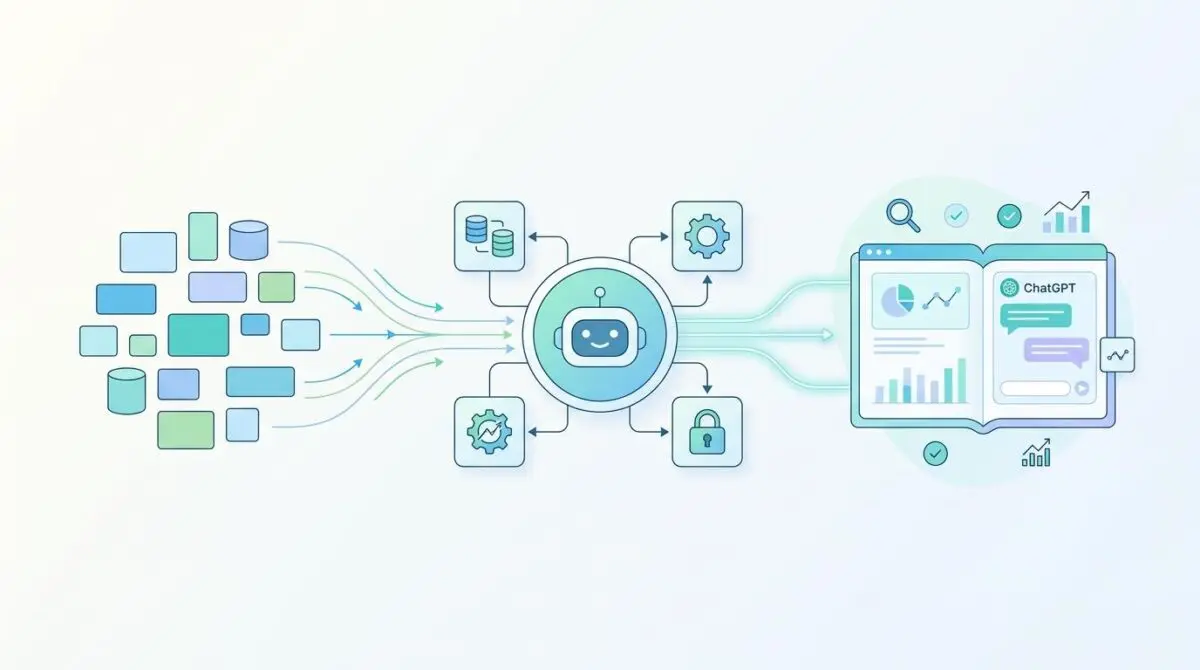
Modern custom solutions directly address this bottleneck by providing localized in-place AI architectures. This paradigm brings the computational model directly to the secure data repository, rather than forcing sensitive data to travel to external servers.
This strategic shift effectively eliminates the productivity loss typically attributed to fragmented internal information silos. Furthermore, it completely resolves pervasive fears of model poisoning and catastrophic data leakage into public training sets.
Market Intelligence and Smart Capital Flow
Market Intelligence & Data
Enterprise RAG Market Size
Bloomberg Intelligence reports that the global market for custom GenAI infrastructure and retrieval services reached $145B in the first half of 2026.
Efficiency Gain in Knowledge Retrieval
A 2026 Deloitte study found that enterprises utilizing custom data-connected AI reduced the time employees spend searching for internal information by 65%.
Average ROI on Custom AI
IDC data indicates that for every $1 invested in custom LLM orchestration and fine-tuning, enterprises are seeing an average 4.2x return within 18 months.
CISO Zero-Trust Adoption
According to a 2026 Cisco Security report, 94% of CISOs have mandated ‘Zero-Data Training’ architectures for all custom AI integrations to prevent data leaks.
The numbers presented above reveal a massive, structural shift in how smart money allocates capital toward enterprise infrastructure. A staggering market for custom retrieval architectures highlights a rapid transition from experimental generative AI to mission-critical operational layers.
Institutional investors are actively defunding superficial wrapper applications in favor of deep, defensible infrastructure plays. We are seeing an undeniable average return on custom AI as organizations bypass centralized technological bottlenecks.
Smart money is currently flooding into agile startups that allow companies to run highly capable models directly on-premise. This localized deployment strategy drastically reduces network latency and bypasses the exorbitant API costs associated with massive public models.
The reported efficiency gains translate directly into millions of dollars in recovered human capital. Instead of acting as data retrieval clerks, highly paid executives and engineers can now focus their cognitive bandwidth entirely on strategic execution.
Furthermore, the high adoption rate of zero-trust architectures underscores a fundamental psychological shift in boardroom risk management. Enterprise leaders are demanding total sovereignty over their intellectual property, refusing to compromise on security for computational convenience.
The Strategic Deep Dive into Neural Memory
Dominance in the enterprise intelligence space is currently split between two distinct, often conflicting technological philosophies. On one side, hyperscalers are providing massive private AI cloud environments to capture enterprise workloads.
On the other side, we are witnessing highly disruptive infrastructure plays from agile database companies that prioritize localized control. These platforms have evolved rapidly from basic vector search engines into sophisticated neural memory layers.
These neural memory layers act as the long-term cognitive storage for enterprise-grade custom LLM orchestration. They allow the AI to recall past interactions, contextualize historical company data, and apply nuanced reasoning to current business problems without hallucinating.
Traditional retrieval-augmented generation often fails because it lacks the ability to understand the temporal relevance of corporate documents. Neural memory layers solve this by assigning semantic weight to data, ensuring that outdated financial policies do not override newly minted compliance mandates.
Shifting from Cloud to Edge Computing
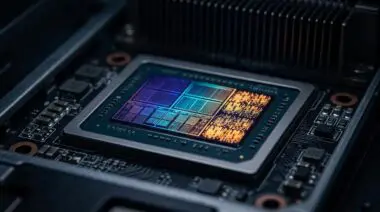
The hardware markets are reflecting this aggressive push toward localized data sovereignty and reduced latency. Recent industry updates confirm that enterprise hardware sales are increasingly driven by companies building Small Language Models specifically for internal-only edge computing.
This revelation is a watershed moment for enterprise architecture and capital expenditure. It proves that the future of corporate AI relies on specialized, highly efficient models running on secure, localized hardware.
By leveraging small language models, businesses can achieve near-instantaneous inference times while maintaining absolute control over their proprietary datasets. This edge computing approach completely neutralizes the threat of external data breaches.
The psychological impact of this architectural shift cannot be overstated in enterprise boardrooms. When executives know that their proprietary financial models and product roadmaps never leave the physical premises, the friction to adopt AI disappears entirely.
Edge computing also insulates the enterprise from the unpredictable pricing models and sudden API deprecations of major AI providers. It transforms artificial intelligence from a rented utility into an owned, depreciable corporate asset.
The Rise of Agentic Knowledge Workflows
The underlying strategy for enterprise data interaction has shifted aggressively from basic retrieval-augmented generation to agentic knowledge workflows. Businesses no longer just query static data repositories through a simple, passive chat interface.
Instead, they deploy specialized, autonomous AI agents that navigate cross-departmental silos seamlessly. These highly capable agents connect disparate platforms and internal ERP systems to perform highly complex, multi-step reasoning tasks.
The killer application driving this massive adoption involves memory-persistent agents. These advanced systems learn individual executive preferences, communication styles, and historical project nuances over time.
Crucially, they achieve this deep personalization without ever sending raw operational data back to public model providers. The intelligence remains entirely localized, creating a compounding competitive advantage that cannot be replicated by industry rivals.
Consider a scenario where a global supply chain experiences a sudden disruption. A memory-persistent agent does not wait to be prompted by an analyst.
It autonomously synthesizes current project statuses, cross-references financial constraints, and analyzes supplier contracts from the legal database. It then delivers a fully contextualized strategic recommendation directly into a secure executive channel, saving days of manual research.
The Executive Action Plan
Strategic Trajectory
- Evolution toward the ‘Autonomous Enterprise Brain’ for proactive decision-support.
- Transition from reactive chat interfaces to integrated, intelligence-led operational systems.
- Implementation of ‘Self-Updating Documentation’ to bridge gaps in policy and technical specs.
- Real-time identification of operational documentation needs based on behavioral data.
- Automated drafting of corporate updates derived from observed organizational patterns.
The roadmap outlined above represents the next inevitable evolution of corporate intelligence and operational efficiency. We are rapidly approaching the era of the autonomous enterprise brain, where custom LLMs move from reactive chat interfaces to proactive decision-support systems.
Forward-thinking executives are already restructuring their data pipelines to prepare for self-updating documentation systems. In this new operational paradigm, the AI continuously monitors corporate workflows and communication channels to identify hidden inefficiencies.
When the system identifies a gap in company policy or technical specifications, it acts in real-time without human prompting. It autonomously drafts the necessary updates or compliance manuals based entirely on observed operational patterns and historical data.
Founders must immediately audit their current data architecture to ensure it supports this level of autonomous orchestration. Relying on legacy data lakes and fragmented permissions will break the functionality of these advanced agentic workflows.
Delaying this integration will result in an insurmountable intelligence deficit in the near future. Early adopters will operate at a velocity and scale that traditional human-led teams simply cannot match, effectively pricing slower competitors out of the market.
Conclusion
Building a custom ChatGPT for your business data is no longer a localized IT project relegated to the engineering department. It is a foundational restructuring of how a modern company processes, retains, and acts upon its internal knowledge capital.
The organizations that master enterprise-grade custom LLM orchestration will operate with unprecedented agility and absolute zero-trust security. Those who continue to rely on generalized public models will inevitably face insurmountable data gravity bottlenecks and severe compliance risks.
The smart money has already placed its bets on localized, agentic workflows powered by neural memory layers and small language models. The only remaining question is whether your enterprise infrastructure is prepared to capitalize on this disruptive technological shift.
Navigating the intersection of technology, capital, and market psychology requires a sharp strategy. To future-proof your business architecture and scale with precision, connect with Andres at Andres SEO Expert.
Frequently Asked Questions
What is the Data Gravity Paradox in enterprise AI?
The Data Gravity Paradox refers to the structural challenge where large datasets become difficult and expensive to move across networks. Modern custom LLM orchestration solves this via localized In-Place AI architectures, which bring the model to the secure data repository rather than moving sensitive data to external servers, reducing latency and egress costs.
How do custom LLMs impact business ROI and efficiency?
Enterprises are seeing an average 4.2x ROI within 18 months of deploying custom LLM orchestration. Additionally, these systems can reduce the time employees spend on internal information retrieval by up to 65%, effectively recovering significant human capital for strategic innovation.
What are the security benefits of localized Small Language Models (SLMs)?
By running SLMs on-premise or at the edge, organizations maintain absolute data sovereignty. This Zero-Trust architecture, adopted by 94% of CISOs, prevents proprietary intellectual property from leaking into public training sets and eliminates risks associated with model poisoning.
How do neural memory layers prevent AI hallucinations?
Neural memory layers act as long-term cognitive storage by assigning semantic weight to data. This allows the AI to understand the temporal relevance of corporate documents, ensuring that historical context is correctly applied and preventing outdated policies from triggering incorrect reasoning.
What is the difference between RAG and Agentic Knowledge Workflows?
While standard Retrieval-Augmented Generation (RAG) relies on passive chat interfaces, Agentic Knowledge Workflows utilize autonomous agents. These agents navigate cross-departmental silos and connect platforms like Jira and ERP systems to perform complex, multi-step tasks without manual human prompting.
Why are enterprises moving AI workloads from the cloud to edge computing?
The shift toward edge computing is driven by the need for near-instantaneous inference and protection from unpredictable API costs. Moving AI to the edge transforms artificial intelligence into an owned, depreciable corporate asset that remains insulated from the security vulnerabilities of the public cloud.