Key Points
- XDR platforms have evolved into autonomous security ecosystems, utilizing AI SOC Agents to resolve 90% of routine alerts without human intervention.
- The convergence of XDR with ITDR and CNAPP forms a self-healing security fabric, dramatically reducing the Mean Time to Respond (MTTR) and mitigating severe alert fatigue.
- Institutional capital is aggressively backing platformization, shifting investments away from legacy SIEM tools toward comprehensive platforms capable of predictive threat modeling.
Table of Contents
The Core Friction of Modern Cybersecurity
According to the latest IDC Worldwide Security Spending Guide, global investment in cybersecurity is projected to reach $308 billion in 2026. This growth surge is primarily fueled by the transition to unified, AI-driven platforms like Extended Detection and Response (XDR). For years, organizations have patched together fragmented security tools, creating a disjointed perimeter that sophisticated adversaries easily exploit.
This legacy approach has transformed enterprise security into a reactive cost center rather than a strategic advantage. Today, the conversation has fundamentally shifted. XDR is no longer just a technical upgrade; it is a critical business utility designed to stop revenue-destroying breaches in their tracks.
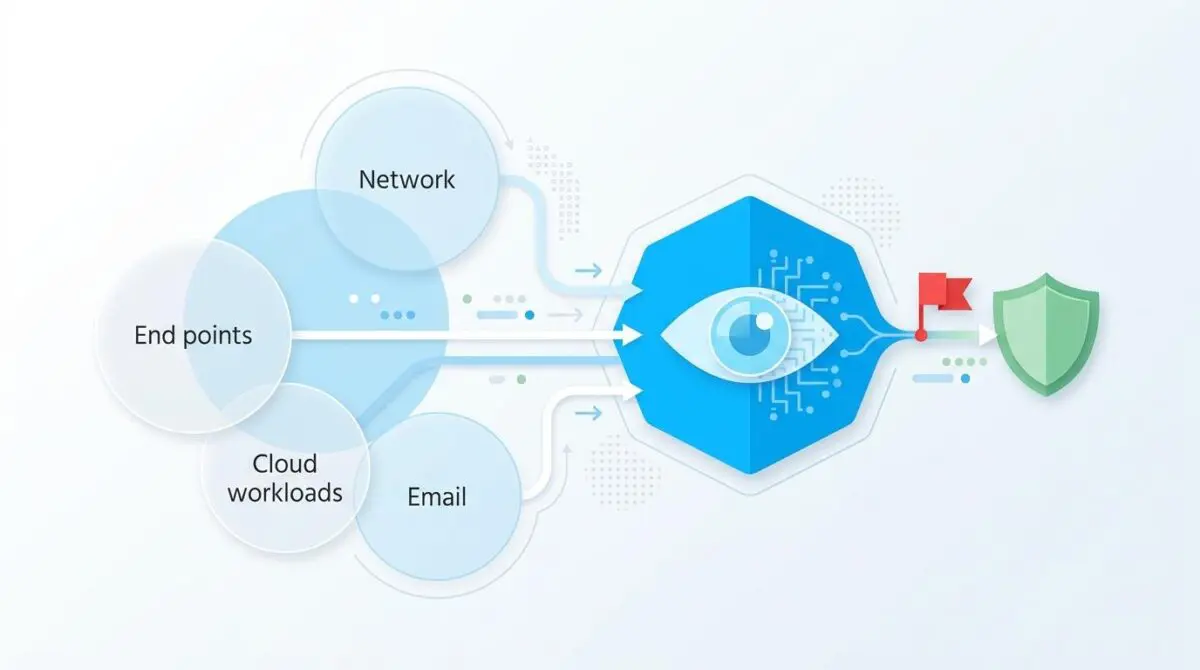
By unifying endpoint, network, and cloud telemetry, XDR eliminates the blind spots that plague traditional security operations. Leaders are now recognizing that comprehensive threat detection is the baseline for operational survival in a hostile digital economy.
Market Intelligence and Smart Capital
Market Intelligence & Data
XDR Market Valuation
The global XDR market is projected to skyrocket to over $30 billion by 2030, rising from $7.92 billion in 2025, according to MarketsandMarkets.
AI Savings Per Breach
Organizations utilizing AI and security automation identify and contain breaches 98 days faster than manual counterparts, saving an average of $2.22 million per incident, per Fortinet’s 2026 Global Threat Report.
SIEM Replacement Rate
Data from SecureWorld 2025 reveals that 73% of security leaders are actively seeking alternative SIEM solutions in favor of unified XDR platforms to mitigate tool sprawl.
Daily Alert Saturation
The 2026 Vectra AI State of Threat Detection report indicates that SOC teams receive an average of 2,992 alerts daily, a volume that leaves 63% of potential threats unaddressed in non-automated environments.
The financial metrics surrounding the cybersecurity sector reveal a massive shift in institutional capital. As the data above illustrates, the global XDR market is projected to skyrocket to over $30 billion by 2030. Smart money is aggressively abandoning siloed legacy systems in favor of comprehensive, self-healing security fabrics.
This rapid capital deployment is driven by pure operational economics. Organizations are realizing that the cost of manual threat hunting far exceeds the investment in autonomous platforms. The mass exodus from traditional SIEM solutions highlights a market completely intolerant of tool sprawl and administrative friction.
The Strategic Deep Dive into Autonomous Defense
Overcoming the Alert Fatigue Crisis
The modern Security Operations Center (SOC) is suffocating under the weight of its own data. As of 2026, the average SOC team faces nearly 3,000 alerts per day, creating an unsustainable environment of constant triage. Historically, this meant over 60% of these alerts went entirely unaddressed, leaving critical vulnerabilities exposed to threat actors.
XDR directly solves this critical visibility gap and the resulting alert fatigue. By intelligently correlating disparate signals into high-confidence incidents, these platforms reduce the Mean Time to Respond (MTTR) from agonizing hours to mere minutes. Furthermore, this automation bridges the global cybersecurity skills shortage by transforming junior analysts into supervisors of AI-driven workflows.
The Rise of AI SOC Agents
We are witnessing a fundamental evolution in how security software operates. XDR has officially transitioned from a passive data aggregation tool into the realm of autonomous security operations. The market has decisively moved beyond static playbooks toward Agentic AI.
Gartner officially established AI SOC Agents as a formal technology category in June 2025. They project that by late 2026, autonomous orchestration will resolve upwards of 90% of routine Tier 1 security alerts without human intervention. These AI SOC Agents now autonomously plan, triage, and execute complex remediation protocols across all enterprise environments.
The killer strategy for 2026 relies on converging XDR with Identity Threat Detection and Response (ITDR) and Cloud-Native Application Protection Platforms. This convergence creates a singular security fabric that limits human intervention to only high-stakes strategic oversight.
Platformization and the Big Three
Market dominance in the XDR space is currently held by a formidable trio known as the Big Three. CrowdStrike commands attention with its Falcon platform, Palo Alto Networks drives innovation through Cortex XSIAM, and Microsoft secures the enterprise via Defender XDR. Meanwhile, SentinelOne is aggressively capturing the mid-market through its Purple AI autonomous response capabilities.
However, venture capital is not resting on the incumbents. Institutional capital is flowing heavily into AI-native startups like Adaptive Security, which recently secured $81 million in Series B funding from Andreessen Horowitz and NVIDIA. The overarching investment thesis is clear: the future belongs to unified security ecosystems capable of processing petabytes of telemetry daily.
The Executive Action Plan for Cyber Resilience
For founders and C-suite executives, surviving the next wave of state-sponsored cyber threats requires an immediate strategic pivot. The era of reactive defense is officially over.
Strategic Trajectory
- Pivot the organizational focus from standard Extended Detection toward Continuous Threat Exposure Management (CTEM) and Cyber Resilience.
- Integrate predictive Digital Twin simulations to autonomously attack and patch internal networks before external exploitation.
- Reframe security infrastructure as an autonomous, embedded business utility rather than a reactive cost center.
- Solidify operational continuity protocols to withstand state-sponsored, AI-driven cyber attacks.
Implementing this trajectory demands a shift in corporate psychology. Security must be viewed as an embedded business utility that guarantees operational continuity, rather than a frustrating IT expense. Executives must prioritize platforms that offer true autonomous orchestration.
By 2027, the integration of predictive digital twin simulations will become standard practice. Platforms will continuously attack their own networks, identifying and patching vulnerabilities long before human adversaries can exploit them. Preparing for this reality is the ultimate executive mandate.
Conclusion
The transition to Extended Detection and Response is the defining cybersecurity mandate of this decade. Companies that fail to adopt autonomous, AI-driven defense mechanisms will find themselves outpaced by both their competitors and their adversaries. Embracing XDR is not merely an IT upgrade; it is a foundational investment in enterprise survival.
Navigating the intersection of technology, capital, and market psychology requires a sharp strategy. To future-proof your business architecture and scale with precision, connect with Andres at Andres SEO Expert.
Frequently Asked Questions
What is XDR and why is it replacing traditional SIEM solutions?
Extended Detection and Response (XDR) is a security platform that unifies endpoint, network, and cloud telemetry to eliminate visibility blind spots. It is replacing traditional SIEM (Security Information and Event Management) because it reduces tool sprawl and automates threat detection, addressing the needs of the 73% of security leaders who are currently seeking unified alternatives to legacy systems.
How does AI automation impact the cost and speed of breach containment?
According to 2026 industry data, organizations using AI and security automation identify and contain breaches 98 days faster than those relying on manual methods. This efficiency results in an average cost saving of $2.22 million per incident by reducing the Mean Time to Respond (MTTR) from hours to mere minutes.
What are AI SOC Agents and what is their role in autonomous defense?
AI SOC Agents are a technology category involving Agentic AI that autonomously plans, triages, and executes remediation protocols. By late 2026, these agents are projected to resolve over 90% of routine Tier 1 security alerts without human intervention, transforming junior analysts into supervisors of automated workflows.
How significant is the alert fatigue crisis in modern security operations?
The average Security Operations Center (SOC) team faces approximately 2,992 alerts daily. In environments without automation, roughly 63% of these potential threats go unaddressed, creating significant vulnerabilities that XDR platforms aim to solve through intelligent signal correlation.
What is Continuous Threat Exposure Management (CTEM) and its future role?
CTEM is a proactive security strategy that shifts focus from simple detection to ongoing resilience. By 2027, this will include the use of predictive digital twin simulations that autonomously attack internal networks to identify and patch vulnerabilities before they can be exploited by external adversaries.