Key Takeaways
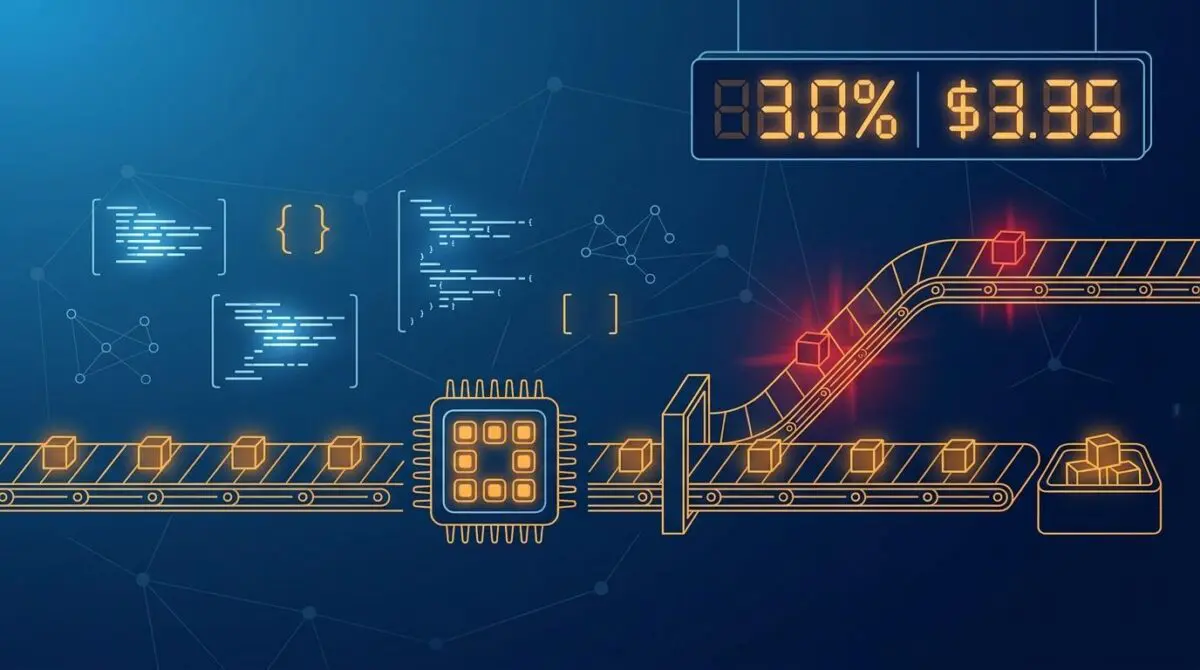
- A DeepSeek V4 Pro 0813 + GPT-5.6 Sol cascade clears 83% of DeepSWE tasks at $3.35, beating Sol alone by 10+ points at half the cost.
- DeepSeek solves 261 tasks per $100 vs Sol’s 9, but Sol leads first-shot accuracy (72.7% to 62.8%) and speed (17 min vs 35 min).
- Routing a budget model to failures escalates smarter than any single model: the cascade even outperforms a perfect one-shot oracle (80.8%).
Table of Contents
A 35x Price Gap Reorders the Coding Benchmark Race
Together AI’s August 18 benchmark report delivers a counterintuitive result: the strongest DeepSWE performance belongs to neither model alone.
Pro first, Sol on failure, 83.0% at $3.35 a task.
The study tracked 904 rollouts across all 113 DeepSWE tasks and found that a cascade strategy clears 83.0% of cases at $3.35 per task.
That is more than ten points above GPT-5.6 Sol’s solo 72.7% and costs less than half of Sol’s $8.37 task price.
Where Each Model Wins, Fails, and Flips the Script
Single-Shot Quality Versus Retry Ceiling
In Together AI’s benchmark, GPT-5.6 Sol takes the opening pass with 72.7% pass@1, a nine-point edge over DeepSeek V4 Pro 0813’s 62.8%.
At pass@2, Sol still leads 81.0% to 78.5%.
The pyramid inverts on the fourth attempt. DeepSeek posts 88.5% pass@4, passing Sol’s 85.8%.
DeepSeek also reaches 88.5% coverage against Sol’s 85.8%, but its reliability sits at 71.0% compared with Sol’s 84.5%.
Cost, Latency, and Dollar Efficiency
DeepSeek V4 Pro 0813 costs $0.24 per rollout, while GPT-5.6 Sol runs $8.37, a 35x gap.
Measured per $100 of compute, DeepSeek solves 261 tasks and Sol solves 9.
The discount does not buy speed. DeepSeek needs a median 146 steps and 35 minutes, emitting 101k output tokens.
Sol finishes in 53 steps and 17 minutes, with 59k output tokens.
Failure Modes and Regression Risk
Sol’s failure profile is messier. Roughly 20% of its failed runs break tests that had previously passed.
DeepSeek’s regression rate is 11%, and its misses usually leave the existing test suite untouched.
The operational rule is to require a full regression review before accepting Sol’s changes. DeepSeek can operate with fewer guardrails.
Language and Domain Splits
Sol posts the stronger language numbers in Python, Go, TypeScript, and JavaScript, with wide margins in Python and Go.
DeepSeek takes Rust 65 to 60, the only language where it leads outright.
Across task domains, Sol wins six of eight. The widest gap appears in data modeling and serialization, where Sol reaches 92%.
DeepSeek edges stateful reactivity 66 to 64, while both models tie at 75 on language and runtime internals.
Their union resolves 107 of the 113 tasks. Both clear 90 tasks; DeepSeek alone claims 10, Sol alone claims 7, and six defeat both.
Routing and the Portfolio Logic
The cascade leads with DeepSeek V4 Pro 0813 and escalates to GPT-5.6 Sol only when the test suite rejects the output.
That sequence clears 83.0% at $3.35 per task, beating Sol alone by more than ten points for less than half the price.
It also surpasses a perfect one-shot oracle router at 80.8%, because two independent attempts outperform one ideal pick.
Leading with the lower-cost model produces the same accuracy at $3.35 instead of $8.44.
The Market Signal Behind the DeepSWE Numbers
The competitive frame around these numbers has already moved. xAI’s Grok 4.6 announcement, published August 12, lists GPT-5.6 Sol Max at 73% on DeepSWE v1.1, a rounding-level difference from the 72.7% captured in the August 18 benchmark run.
xAI’s Grok 4.6 High records 65.9%, trailing both models in this comparison while targeting long-running agents and visual work.
DeepSeek V4 Pro 0813 does not appear in xAI’s DeepSWE table, leaving the low-cost challenger outside that particular frame.
Public leaderboard snapshots from mid-August place Claude Opus 5 at 73.6%, GPT-5.6 Sol at 72.7%, Claude Fable 5 at 69.7%, and DeepSeek V4 Pro 0813 tenth at 62.8%.
These rankings are configuration-specific, because DeepSWE entries pair a model with a harness and reasoning-effort setting rather than representing a pure model score.
The deeper market signal is bifurcation. Premium models are racing on first-shot accuracy and latency, while value models are winning on solved-work-per-dollar.
The cascade result demonstrates that the strongest economic position may be architectural: a low-cost model absorbing volume, with a premium escalation path reserved for hard failures.
xAI lists Grok 4.6 pricing at $2 per million input tokens and $6 per million output tokens, adding another reference point to the cost-per-solved-task conversation.
The New Playbook for AI Engineering Budgets
The routing architecture, not any single model, is the clearest competitive lever in AI-assisted coding. For teams building that routing intelligence into automated workflows, Andres SEO Expert’s programmatic SEO AI automation service is the direct path — contact the team.
Frequently Asked Questions
Is DeepSeek V4 Pro 0813 better than GPT-5.6 Sol on DeepSWE?
It depends on the metric. GPT-5.6 Sol wins the first attempt with 72.7% pass@1 vs DeepSeek’s 62.8%, and it still leads at pass@2 with 81.0% to 78.5%. DeepSeek overtakes at pass@4 with 88.5% vs Sol’s 85.8%, and it is far cheaper at $0.24 per rollout vs $8.37. The best result comes from routing: use DeepSeek first and escalate to Sol on failure, which clears 83.0% of tasks at $3.35 per task.
What is the cascade routing strategy tested in the Together AI DeepSWE benchmark?
The cascade leads with DeepSeek V4 Pro 0813 and escalates to GPT-5.6 Sol only when the test suite rejects DeepSeek’s output. Together AI found this sequence clears 83.0% of DeepSWE tasks at $3.35 per task, beating Sol alone by more than ten points for less than half the cost and beating a perfect one-shot oracle router at 80.8% because two independent attempts outperform one ideal pick.
Why does DeepSeek beat GPT-5.6 Sol on pass@4 when Sol wins pass@1?
DeepSeek improves more with retries. Its pass@4 reaches 88.5% vs Sol’s 85.8%, even though Sol starts with a nine-point pass@1 advantage. DeepSeek’s lower per-rollout cost also makes those additional attempts economically viable, while Sol’s retry ceiling remains lower at the same coverage level.
How large is the cost gap between DeepSeek V4 Pro and GPT-5.6 Sol?
DeepSeek V4 Pro 0813 costs $0.24 per rollout, while GPT-5.6 Sol costs $8.37 per rollout, a 35x price gap. Expressed in solved tasks per $100 of compute, DeepSeek solves 261 tasks and Sol solves 9. The discount does not buy speed, however: DeepSeek needs a median 146 steps and 35 minutes, while Sol finishes in 53 steps and 17 minutes.
What failure-mode differences should teams know before routing between these models?
GPT-5.6 Sol has a messier failure profile: roughly 20% of its failed runs break tests that had previously passed. DeepSeek’s regression rate is 11%, and its misses usually leave the existing test suite untouched. The operational rule is to require a full regression review before accepting Sol’s changes, while DeepSeek can operate with fewer guardrails.
Are DeepSWE leaderboard results pure model scores?
No. Each DeepSWE entry pairs a model with a specific harness and reasoning-effort setting, so rankings are configuration-specific. Grok 4.6 High’s 65.9%, Claude Opus 5 at 73.6%, and GPT-5.6 Sol at 72.7% are comparisons of those pairs, not standalone evaluations of the underlying models.
What does the DeepSWE benchmark mean for AI engineering budgets?
The strongest economic position is architectural: a low-cost model like DeepSeek V4 Pro absorbs the high-volume work, while a premium model like GPT-5.6 Sol is reserved for hard failures. The benchmark shows a cascade strategy outperforms both solo strategies at a lower cost per solved task, so teams should build routing intelligence into automated workflows rather than committing fully to one model.