Key Takeaways
- COMPASS trains a residual RL specialist on NVIDIA’s X-Mobility, avoiding full retraining for new robots.
- Agent-managed skills handle scene prep, smoke tests, training, and evaluation, with human approval at three gates.
- Scene paths from warehouse to SAGE-10K and NuRec make simulation-to-real training reproducible and deployable.
Table of Contents
- NVIDIA’s COMPASS Framework Replaces Robot Navigation Retraining With Agent-Managed Residual Learning
- Inside the COMPASS Pipeline: Scene Gates, Residual Training, and Runtime Handoff
- Why Agent-Gated Cross-Embodiment Training Matters for the Physical AI Market
- From Specialist Checkpoints to Scalable Robot Fleets
NVIDIA’s COMPASS Framework Replaces Robot Navigation Retraining With Agent-Managed Residual Learning
NVIDIA has published a technical walkthrough on its developer blog outlining an agent-driven framework called COMPASS.
The system trains a residual reinforcement learning specialist on top of a pretrained navigation policy, letting robot teams adapt new embodiments and environments without starting from scratch.
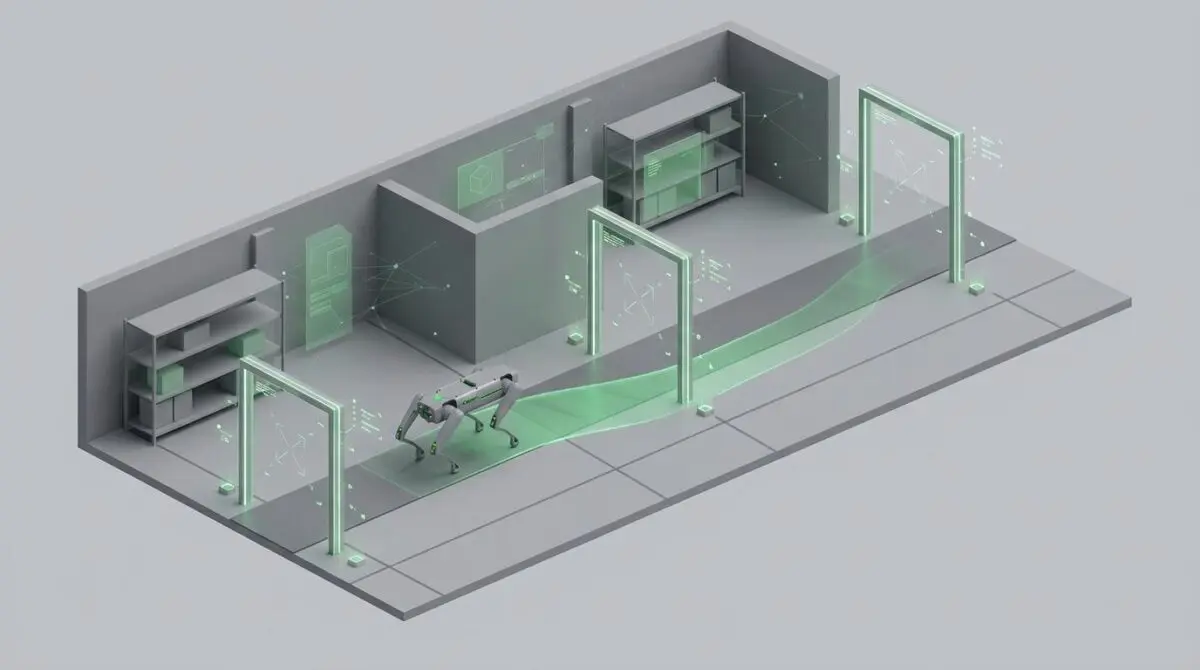
Boston Dynamics Spot serves as the reference robot for the workflow, which spans scene preparation, smoke testing, training, evaluation, and runtime deployment.
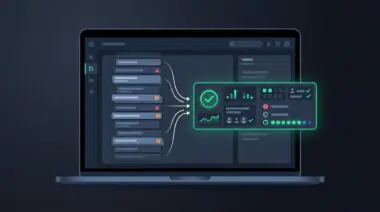
Human approval gates remain at three critical moments: scene acceptance, the one-environment smoke test, and checkpoint promotion.
Inside the COMPASS Pipeline: Scene Gates, Residual Training, and Runtime Handoff
According to NVIDIA’s developer blog, COMPASS stands for Cross-Embodiment Mobility Policy via Residual RL and Skill Synthesis.
It does not retrain navigation from the ground up for each new robot or scene.
Instead, it reuses navigation behavior from a pretrained model called NVIDIA X-Mobility and trains a residual RL policy that corrects the base action.
That residual specialist is much cheaper to produce than a full navigation stack, and data from multiple specialists can later be distilled into a shared cross-embodiment policy.
Agent-Gated Development and Repository Skills
The developer defines the robot, scene source, and navigation goal.
A coding agent then handles dependency validation, asset preparation, smoke tests, training launches, failure diagnosis, and checkpoint comparisons.
Agent skills such as COMPASS, COMPASS-Doctor, and COMPASS-New-Embodiment enforce the workflow contract.
The coding agent coordinates development and validation, but it does not control the robot at runtime.
Three Scene Paths for Real and Synthetic Environments
- Built-in warehouse: The registered combined_multi_rack warehouse provides the fastest reproducible baseline.
- SAGE-10K generated scenes: A dataset of 10,000 generated indoor scenes across 50 room types lets teams shortlist living room or warehouse candidates.
- NVIDIA Omniverse NuRec reconstruction: Captured environments become Isaac Sim-ready reconstructions for fine-tuning in a digital twin of the deployment site.
Each path requires registration, occupancy map verification, and visual inspection before training can start.
The generated and captured paths include two human approval gates: one after scene conversion and map generation, and another after the one-environment preview.
Residual Training and Checkpoint Evaluation
The training command launches a standard residual RL workflow using pinned configuration files, embodiment keys, and environment keys.
Engineers can adjust the number of parallel environments based on GPU memory, with one environment used only for smoke testing.
Monitoring tracks reward components, goal progress, falls, contacts, terminations, throughput, and GPU memory.
Checkpoints are saved periodically and evaluated under matched conditions rather than assuming the last iteration is best.
Standard COMPASS evaluation reports goal-reached rate, fall-down rate, and travel time.
Additional evidence must be labeled as derived analysis, and a human must approve promotion before packaging.
Why Agent-Gated Cross-Embodiment Training Matters for the Physical AI Market
The most important shift here is not the residual RL architecture alone.
It is the inversion of development burden: the expensive, repetitive work moves from human engineers to a coding agent with explicit gates.
That changes the unit economics of adapting navigation across heterogeneous robot fleets.
For enterprises running Spot today, a facility change or a new robot model has traditionally meant a fresh integration effort.
COMPASS reframes that effort as a specialist tuning problem, with the base policy staying intact and the residual layer absorbing the delta.
The SAGE-10K integration also points to a broader trend.
Synthetic scene generation is no longer a research toy; it is becoming a routine input to production robot training.
A dataset of 10,000 indoor scenes across 50 room types gives teams a scalable way to stress-test navigation policies before a robot enters a physical space.
NVIDIA Omniverse NuRec adds the other half of the equation: real-world capture for deployment-specific fine-tuning.
Together, generated and reconstructed environments create a bridge from simulation to physical operations that is more reproducible than ad hoc field testing.
The runtime design is equally significant.
COMPASS inference consumes front-camera images, a navigation target, and odometry-derived speed, then publishes velocity commands on ROS 2.
That separation means the coding agent does not control the robot at runtime, and trained policies can be exported to ONNX, JIT, or TensorRT for deployment.
Optional cuVSLAM support addresses a frequent deployment blocker: GPS-denied or GPS-intermittent environments where the robot lacks validated odometry.
Its map is not an input to the policy, a critical architectural distinction that keeps state estimation and navigation policy separate.
From Specialist Checkpoints to Scalable Robot Fleets
COMPASS gives robot operators a repeatable path from scene selection to promoted checkpoint, with human judgment preserved at every gate.
The real payoff arrives when multiple specialists are distilled into a single cross-embodiment policy, but even the intermediate step reduces the cost of fleet adaptation today.
For teams building AI agentic workflows that need to scale, programmatic SEO AI automation is how Andres SEO Expert approaches it — contact Andres SEO Expert.
Frequently Asked Questions
What is the NVIDIA COMPASS framework?
COMPASS stands for Cross-Embodiment Mobility Policy via Residual RL and Skill Synthesis. It trains a residual reinforcement learning specialist on top of a pretrained navigation policy, allowing robot teams to adapt new embodiments and environments without retraining from scratch.
How does COMPASS replace traditional robot navigation retraining?
Instead of building a full navigation stack for each new robot or scene, COMPASS reuses navigation behavior from a pretrained model called NVIDIA X-Mobility and trains a residual policy that corrects the base action. This residual specialist is much cheaper to produce, and data from multiple specialists can later be distilled into a shared cross-embodiment policy.
What are the three scene paths in COMPASS?
The three scene paths are the built-in warehouse scene for a reproducible baseline, SAGE-10K generated scenes from 10,000 indoor environments across 50 room types, and NVIDIA Omniverse NuRec reconstructions of captured real-world environments. Each path requires registration, occupancy map verification, and visual inspection before training.
What role do AI agents play in the COMPASS pipeline?
A coding agent handles dependency validation, asset preparation, smoke tests, training launches, failure diagnosis, and checkpoint comparisons using agent skills such as COMPASS, COMPASS-Doctor, and COMPASS-New-Embodiment. The agent coordinates development and validation but does not control the robot at runtime.
What are the human approval gates in COMPASS?
Human approval is required at three critical moments: scene acceptance, the one-environment smoke test, and checkpoint promotion. This preserves human judgment while delegating repetitive engineering work to the AI agent.
How does COMPASS handle runtime deployment?
COMPASS inference uses front-camera images, a navigation target, and odometry-derived speed to publish velocity commands on ROS 2. Trained policies can be exported to ONNX, JIT, or TensorRT, and optional cuVSLAM support addresses GPS-denied environments. The agent does not control the robot at runtime.