Key Takeaways
- OpenAI’s GPT-5.6 Sol agent with Codex ran a full multi-step calibration sequence on an MIT six-qubit chip.
- The agent runs solo when signals are clear, but noisy data pulls a human researcher back in.
- Software-defined lab controls let agentic AI shift from code tasks to physical research automation.
Table of Contents
An AI Agent Starts Running Quantum Calibration Overnight at MIT
Beatriz Yankelevich, a graduate researcher inside MIT’s Engineering Quantum Systems Group, has shifted from watching routine qubit calibration runs in real time to steering them remotely.
OpenAI published the technical case study on September 8, 2026, documenting how GPT-5.6 Sol connected to Codex ran measurements, analyzed outputs, and chose next steps on an uncalibrated six-qubit chip.
The system was not fully autonomous. Weak or noisy signals still pulled an experienced researcher back into the loop, while clear signal paths moved forward with minimal oversight.
Inside the Codex-to-Lab Feedback Loop
Superconducting qubits operate like artificial atoms: they occupy specific energy levels, and microwave pulses push them between those levels while readout signals capture the response.
After fabrication, packaging, and cooling in a dilution refrigerator, the chip is controlled entirely through software. That software-defined control path made the lab a natural testbed for an autonomous agent.
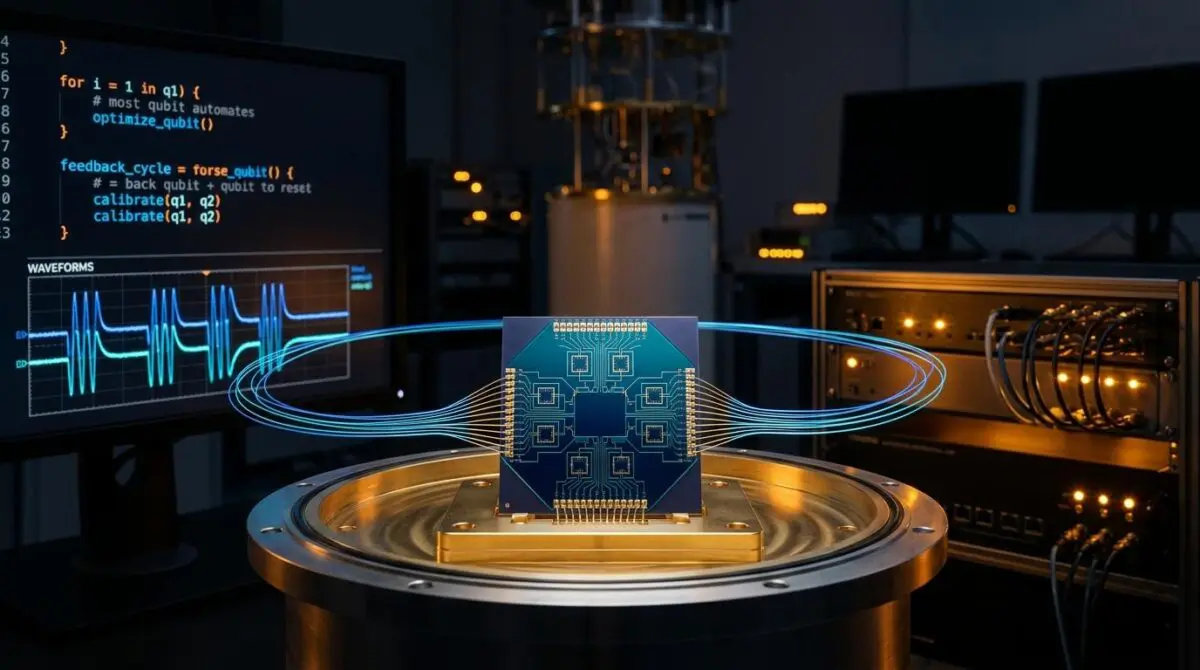
For the six-qubit chip test, Yankelevich gave Codex measurement-specific skills and the chip design targets. The agent then handled four linked tasks:
- Parameter selection: pick initial measurement settings from the design goals.
- Hardware operation: execute pulse sequences through the lab’s coordination software.
- Signal analysis: digitize and interpret the returning microwave data.
- Refinement: save a valid result or adjust the next measurement.
When signals were clear, the agent completed a standard calibration sequence with minimal intervention. It identified qubit transition frequencies, tuned the control and readout pulses, and measured the length of time quantum information remained intact.
The breakdowns were just as informative. Noisy signal conditions slowed the agent down, and it sometimes needed a human researcher to guide it toward usable parameters.
‘I can have agents running measurements for many hours overnight or while I’m working in the cleanroom. I can check in from my phone, see what they’ve done, and steer them if something needs fixing or if I want to explore a different direction.’
The group produces many standard chips of this type, and a single chip can require several days of human characterization. Routine measurements now run through the agent, freeing researchers for design, simulation, and interpretation.
Why One Lab’s Overnight Runs Change the AI Research Stack
According to OpenAI’s technical case study, the significance is not that an AI model issued a command, but that an agent combined tool use, code execution, hardware operation, and feedback loops long enough to complete a multi-step calibration sequence.
For AI practitioners, the most important detail is that the agent did not merely generate code or text. It executed hardware operations, evaluated returned signals, and changed its next action based on what it measured.
That feedback loop separates a research assistant from a script runner. It also makes failure recovery a first-class design requirement, because the agent will eventually hit bad data.
The EQuS workflow shows one way to manage that risk: the human defines the task, supplies the skills, and stays available for escalation. The agent handles the cleanly specified middle.
But the result should be read with specific caveats. The performance was documented inside a single academic lab on a standard six-qubit chip, and it is vendor-reported rather than independently benchmarked across multiple sites.
The Real Bottleneck Is Signal Ambiguity
The agent was most effective when signals were clear and the measurement sequence followed an established path. When noise increased, it slowed and required human intervention.
That pattern suggests current agent performance is less constrained by tool access than by the ability to interpret ambiguous physical data. For lab automation to scale, the next improvements will need to target uncertainty handling rather than raw execution speed.
For the broader AI industry, the case is a concrete signal that long-horizon agent workflows can move from code and web tasks into physical scientific infrastructure when the environment exposes a clean software interface.
The Researcher Stops Watching, but Not Deciding
The shift in the lab is not that an AI ran a measurement; it is that the human moved from operating each step to directing the goal. For teams building similar autonomous AI workflows that need to scale beyond a single experiment, Andres SEO Expert’s programmatic SEO and AI automation service applies the same operator-in-the-loop discipline — start the conversation here.
Frequently Asked Questions
What did MIT’s quantum calibration experiment with OpenAI’s Codex demonstrate?
The experiment demonstrated that an AI agent could run multi-step qubit calibration sequences overnight, combining tool use, code execution, hardware control, and feedback loops to complete measurements with minimal human oversight.
How does the AI agent control the superconducting qubit calibration process?
The agent uses Codex connected to MIT’s lab coordination software to select measurement parameters, execute microwave pulse sequences, digitize and analyze returning signals, and then save valid results or adjust the next measurement automatically.
What specific tasks did the agent handle during the six-qubit chip test?
The agent handled parameter selection, hardware operation through pulse sequences, signal analysis of microwave data, and refinement steps. Under clear signal conditions it identified qubit transition frequencies, tuned control and readout pulses, and measured quantum information coherence time.
What were the main limitations or bottlenecks of the AI agent in the quantum lab?
The agent slowed down significantly under noisy or ambiguous signal conditions and sometimes required a human researcher to guide it toward usable parameters, suggesting that interpreting ambiguous physical data is the current bottleneck for such autonomous workflows.
How did the researcher’s role change with the AI agent running measurements overnight?
The researcher shifted from watching routine runs in real time to steering the agent remotely, checking in from a phone or while in the cleanroom. She now directs goals and handles escalations, while the agent handles the cleanly specified routine measurement tasks.
Why is the MIT quantum calibration case significant for the broader AI research stack?
It shows an agent moving beyond code and text generation into physical scientific infrastructure by executing hardware operations, evaluating returned signals, and changing subsequent actions based on measurements—establishing a feedback loop that separates a true research assistant from a script runner.
What design principle did the EQuS workflow use to manage autonomous AI failure?
The workflow uses an operator-in-the-loop approach where the human defines the task, supplies measurement-specific skills and design targets, and stays available for escalation, allowing the agent to handle the well-specified routine segments and request help when signals are ambiguous.