Key Takeaways
- NVIDIA cBottle uses guided diffusion models to sample rare extreme weather events efficiently.
- An odds-ratio correction reweights guided samples, achieving 25% lower standard error than Monte Carlo.
- Methodology is open-source in Earth2Studio and applicable beyond climate to finance, engineering, and more.
NVIDIA’s Generative Model Breakthrough Turns Extreme Weather Forecasting Into a Probabilistic Science
A groundbreaking methodology from NVIDIA Research is redefining how scientists estimate the likelihood of rare, high-impact weather events. Led by Peter Manshausen and Mike Pritchard, the team has demonstrated that guided diffusion models—specifically the NVIDIA cBottle climate emulator—can perform importance sampling of tropical cyclones with a 25% reduction in standard error compared to brute-force Monte Carlo simulations. The key innovation is an ‘odds-ratio’ correction that quantifies the bias introduced by steering the model toward rare events, enabling accurate probability estimates under the original climate distribution. The findings, published in July 2026, offer a scalable path for risk analytics across climate science, finance, and engineering.
Table of Contents
The Mechanics of Guided Diffusion for Rare Events
Traditional Monte Carlo methods require thousands of model runs to capture events that occur with low probability, each run using expensive physics-based simulations. Guided diffusion models invert this paradigm: they actively steer the generative process toward desired rare states, producing samples that are more likely to contain extreme events.
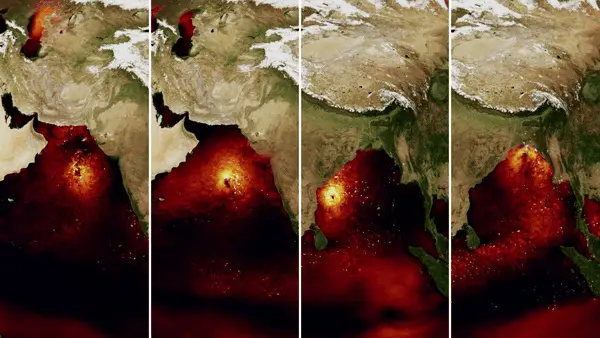
The NVIDIA cBottle model, a diffusion-based climate-conditional weather generator, accepts a ‘guidance tensor’ specifying geographic coordinates and temporal conditions—e.g., a tropical cyclone near Florida during hurricane season. The model then samples atmospheric states that satisfy these constraints.
The critical challenge: oversampling the tail of a distribution skews probability estimates. The NVIDIA team solved this with a log-odds ratio calculation that compares the probability of a sample under the guided versus unguided distribution. This ratio serves as an importance weight, allowing researchers to reweight guided samples to reflect true likelihood under the baseline climate.
As described in the Earth2Studio implementation, the odds-ratio requires second-order derivatives through the diffusion model, adding computational cost but enabling rigorous probability estimation. The result: ‘importance sampling’ that can generate rare events on demand while maintaining statistical consistency.
In the paper, the technique achieved a 25% reduction in standard error for tropical cyclone landfall probability estimates compared to simple Monte Carlo sampling, validating its practical utility.
Why This Matters: Market and Industry Implications
The implications extend far beyond climate modeling. According to recent analysis from Physics World (July 2026), ‘combining artificial intelligence with physical climate modelling enables more accurate characterization of rare weather events.’ This synergy is now moving from research to application, as detailed in the official NVIDIA DEVELOPER technical release.
The Monte Carlo method, long the gold standard for probabilistic simulation, samples from probability distributions to produce thousands of outcomes. However, as Wikipedia notes, it can require excessive iterations for rare events. NVIDIA’s approach directly addresses this inefficiency, cutting computational cost while improving accuracy.
In the broader AI ecosystem, diffusion models are increasingly used for simulation-based inference (a recent arXiv tutorial highlights their role in likelihood estimation). NVIDIA’s work extends this to ‘guided’ generation, opening doors for tail-risk estimation in finance, power grid resilience, aerospace testing, and even materials discovery.
For insurers, reinsurers, and infrastructure planners, the ability to rapidly generate and evaluate thousands of realistic extreme scenarios—with known probabilities—could transform risk models. Similarly, financial firms can apply the same methodology to portfolio tail risk, using generative models to simulate market crashes and compute their likelihood.
The market for AI-driven climate analytics is projected to grow substantially by 2030, and tools like cBottle with odds-ratio diagnostics are positioned as foundational infrastructure for next-generation risk platforms.
The Future of Probabilistic AI in Risk Management
The NVIDIA team acknowledges there is more work to do: faster samplers, better density estimation, and extending guidance to other event types like heat waves and atmospheric rivers. But the core innovation—an odds-ratio that corrects for guidance bias—is a universal tool for any domain where rare events dominate risk.
As Peter Manshausen noted, ‘Guidance alone is not enough. The odds ratio provides that correction, enabling importance sampling of rare events while still estimating their probability under the original distribution.’ This principle could become standard in generative model workflows.
The Earth2Studio implementation, available on GitHub, already provides a quick-start guide for tropical cyclone guidance. As computational efficiency improves, expect similar methods to be embedded in enterprise risk systems.
For AI professionals and quants, the message is clear: generative models are not just for content creation. They are becoming probabilistic engines capable of rigorous inference. The next wave of AI applications will be built on tools that can both generate and evaluate likelihoods.
Staying ahead in the rapidly shifting landscape of AI requires precision. To future-proof your digital strategy and scale effortlessly, you need a foundation built on precision. Optimize your site with advanced speed engineering, secure your infrastructure in high-performance hosting environments, and streamline your entire workflow through autonomous AI pipelines. If you are ready to elevate your systems, Connect with Andres at Andres SEO Expert to build your ultimate architecture.
Frequently Asked Questions
What is guided diffusion in climate modeling?
Guided diffusion uses a generative AI model that is steered toward specific rare weather events by providing a ‘guidance tensor’ (e.g., location and time conditions). Instead of randomly sampling thousands of simulations, it actively generates atmospheric states that match desired extreme conditions, making rare event generation efficient.
How does the odds-ratio correction ensure accurate probabilities?
The odds-ratio compares the probability of a sample under the guided distribution versus the unguided (true climate) distribution. This ratio serves as an importance weight to reweight biased samples, allowing researchers to estimate probabilities under the original climate despite oversampling rare events.
What advantages does NVIDIA’s method offer over traditional Monte Carlo simulations?
Traditional Monte Carlo requires many expensive runs to capture rare events. NVIDIA’s guided diffusion reduces computational cost and achieves a 25% reduction in standard error for tropical cyclone landfall probabilities by focusing generation on extreme scenarios while correcting for bias.
Can this technique be applied outside of climate science?
Yes. The methodology is universal for tail-risk estimation. Potential applications include finance (simulating market crashes), insurance (rare catastrophe modeling), power grid resilience, aerospace testing, and any domain where rare events dominate risk and generative models can be guided.
What is the Earth2Studio implementation?
Earth2Studio is an open-source framework from NVIDIA that includes the cBottle model. It provides a quick-start guide for generating tropical cyclone guidance using diffusion models, with the odds-ratio correction built in for probabilistic estimation.
What computational costs are involved in guided diffusion with odds-ratio?
The odds-ratio requires second-order derivatives through the diffusion model, adding computational overhead. However, this cost is offset by the efficiency gain from focused sampling, making it practical for generating rare events with rigorous probability estimates.
What future developments are expected for this technology?
Future work includes faster samplers, better density estimation, extending guidance to other event types like heat waves and atmospheric rivers, and integrating the method into enterprise risk systems for insurance, finance, and infrastructure planning.