Key Takeaways
- Tesla launches a dual-AI voice assistant in China using ByteDance’s Doubao for vehicle controls and DeepSeek for conversational queries.
- The system supports hands-free activation and 18 Chinese dialects, replacing the previous button-press requirement.
- This move aligns with China’s strict data regulations and comes amid new rules targeting AI companion services from regulators.
Why Tesla Swapped Grok for a Pair of Chinese AI Models in Its Cars
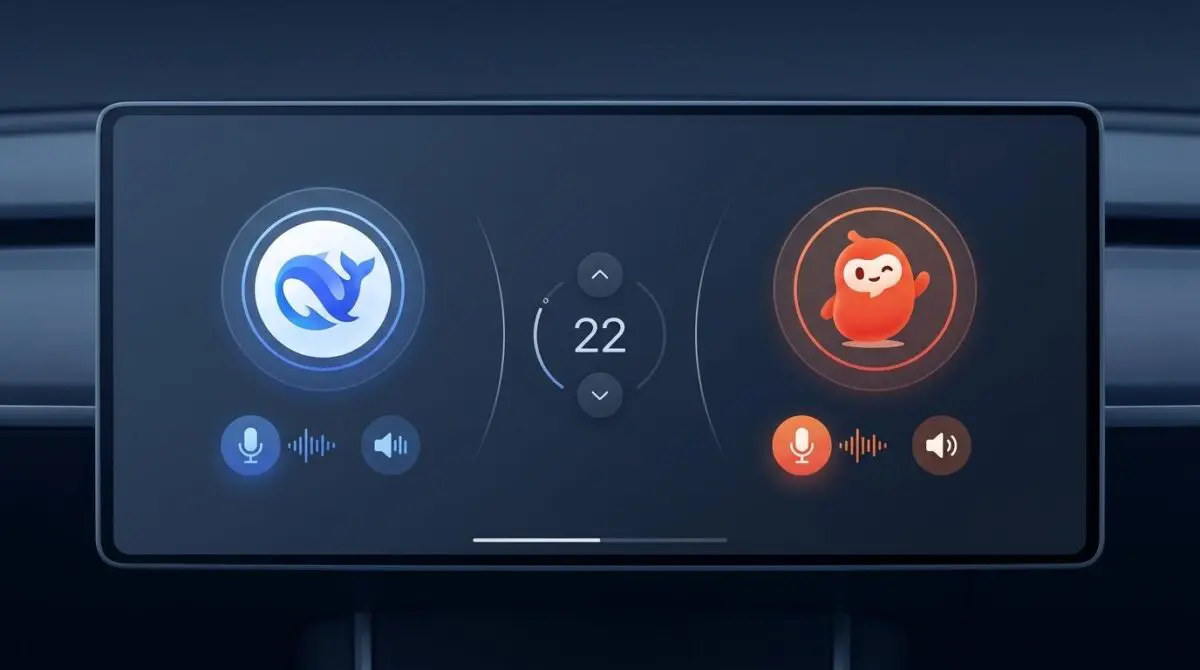
Tesla has begun rolling out a software update in China that replaces its usual Grok-powered voice assistant with two local AI models: ByteDance’s Doubao and the Chinese startup DeepSeek. The shift, first reported by TeslaNorth.com, marks a significant localization move for the automaker in the world’s largest EV market.
The new system splits responsibilities: Doubao handles direct vehicle commands like climate and navigation, while DeepSeek takes on conversational queries and live information retrieval. Chinese drivers can now activate the assistant hands-free with the wake word ‘Hey Tesla’ or a custom trigger, a departure from the previous button-press requirement.
Table of Contents
Doubao Drives, DeepSeek Chats: Inside Tesla’s Dual-AI System
Under the hood, the integration leverages ByteDance’s Volcano Engine cloud platform, giving Tesla access to Doubao’s optimized inference for rapid in-car controls. The model recognizes up to 18 regional Chinese dialects, an upgrade over Grok’s standard Mandarin support, and processes continuous commands—adjusting temperature, setting destinations, or opening apps—in a single interaction.
DeepSeek, meanwhile, handles open-ended queries and real-time data like weather and news. The separation allows each model to specialize: Doubao for low-latency deterministic actions, DeepSeek for broader language understanding. Tesla also removed the physical scroll-wheel activation, replacing it with persistent voice listening for hands-free use.
By adopting these Chinese AI platforms, Tesla sidesteps potential data sovereignty conflicts. The move ensures compliance with China’s strict data localization laws, which require vehicle data to remain within national borders—a challenge when using a US-based model like Grok.
Regulatory Winds and Market Forces Behind Tesla’s AI Pivot
The timing of Tesla’s switch coincides with a tightening regulatory environment for AI in China. On July 15, 2026, new rules took effect targeting ‘AI companion’ services that provide sustained emotional interaction. According to a China Daily Asia report, the regulations mandate dependency detection, crisis intervention, and usage limits—including a forced reminder after two hours of continuous engagement. In response, major platforms including ByteDance’s Doubao, Alibaba’s Qwen, and Yuanbao suspended their AI agent features.
Doubao’s role in Tesla’s system largely involves task-oriented vehicle controls, which the regulations explicitly exclude from the companion category. However, the broader crackdown reflects Beijing’s focus on managing AI’s social impact. A 2025 survey from the China Youth and Children Research Center found that over 60% of minors had used AI, and more than 20% said they ‘only wanted to chat with AI and did not want to talk with real people.’
Tesla’s choice to partner with DeepSeek also carries weight. DeepSeek recently closed its first external funding round, raising roughly $7.4 billion at a valuation exceeding $50 billion, according to a mid-2026 report from the Steinbeis School of Future Tech. The startup’s new capital position makes it a credible long-term supplier for enterprise AI integrations.
For the broader AI industry, Tesla’s move signals a trend: multinational firms operating in China are increasingly adopting local AI stacks not just for compliance, but for competitive differentiation. Doubao’s dialect support and DeepSeek’s conversational ability give Tesla a tailored edge over rivals relying on generic voice assistants.
Local AI Partnerships Signal Tesla’s Long Game in China
Tesla’s dual-AI voice assistant is more than a software update—it’s a strategic bet on localization as a growth driver in China. By integrating models that understand local language nuances and regulatory realities, the company positions its smart cabin to compete on consumer experience rather than just price or range.
Understanding how AI localization shapes product success in regulated markets is critical for technical leaders. If you’re building systems that must navigate similar operational constraints, explore programmatic SEO AI automation workflows to scale your AI deployments intelligently. Learn more about Andres SEO Expert‘s approach to scalable performance engineering, and connect with Andres to discuss your specific challenges.
Frequently Asked Questions
Why did Tesla replace Grok with Doubao and DeepSeek in China?
Tesla swapped Grok for local AI models to comply with China’s strict data localization laws, better serve local dialects, and navigate tightening AI regulations. Doubao handles vehicle commands, while DeepSeek manages conversational queries.
What are the roles of Doubao and DeepSeek in Tesla’s system?
Doubao manages low-latency vehicle controls like climate and navigation, while DeepSeek handles open-ended conversations and real-time information such as weather and news.
How does Tesla’s new voice assistant improve user experience?
It supports hands-free activation with ‘Hey Tesla,’ recognizes up to 18 regional Chinese dialects, and processes continuous commands in a single interaction.
What regulatory challenges does Tesla’s AI assistant face in China?
China’s new rules target AI companion services, requiring dependency detection and usage limits. However, task-oriented controls like Doubao’s are exempt. Tesla’s shift ensures compliance with data sovereignty laws.
Why is data localization important for Tesla in China?
Chinese law requires vehicle data to remain within national borders. Using US-based Grok would risk non-compliance, whereas local models like Doubao and DeepSeek keep data in China.
What does Tesla’s partnership with DeepSeek signify for the AI industry?
DeepSeek’s $7.4B funding round makes it a credible long-term partner. Tesla’s move signals that multinational firms will increasingly adopt local AI stacks for compliance and competitive differentiation.
How does Tesla’s dual-AI system affect other automakers in China?
It sets a precedent for localization, forcing rivals to adopt tailored voice assistants with dialect support and regulatory compliance to compete on consumer experience.