Key Takeaways
- 65% of leaders cite agentic system complexity as the top barrier to AI deployment, per KPMG’s Q4 2025 survey.
- The orchestration layer—middleware connecting AI models to enterprise systems—is the critical enabler to move from department pilots to systemic AI.
- The global AI orchestration market is projected to reach $60.34 billion by 2034, with North America holding 38% share.
The AI Maturity Gap Is Wider Than Most Think
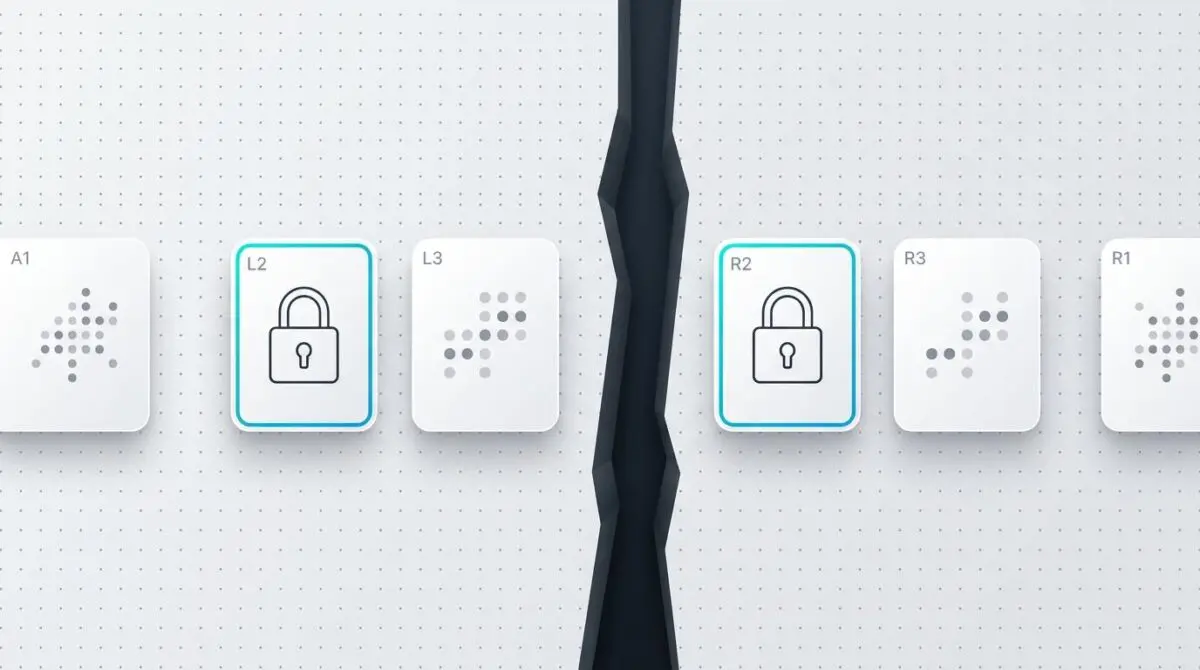
The path from AI experimentation to enterprise-wide production looks straightforward on paper. In reality, a majority of organizations hit a wall between Level 2 and Level 3 of AI maturity, a transition analysts now call the orchestration chasm. With 65% of leaders identifying agentic system complexity as the top barrier to deployment, according to KPMG’s Q4 2025 AI Pulse Survey, the gap is not just technical but structural.
Department-level pilots succeed all the time. Marketing automates content generation. Customer support deploys ticket triage. Finance flags anomalies in expense reports. Yet these wins rarely translate into enterprise-scale impact. The reason lies not in the models, but in the missing layer that connects them to the systems the business actually runs on.
Table of Contents
Why Enterprises Stall at Level 2 and How Orchestration Unlocks Level 3
At Level 2, an organization has real wins to point to. But each win is a standalone system built for a single use case. The marketing tool does not talk to the CRM. The support triage system does not connect to the billing platform. The HR workflow cannot reach the IT provisioning system. This is the pattern that KPMG’s survey captured: individual pilots often succeed, but deeper challenges emerge.
The Integration Barrier
Level 2 AI tools operate as islands. They receive input from a human, process it, and return output to that same human. To reach Level 3, AI systems must become part of the enterprise’s nervous system, reading from and writing to CRMs, ERPs, HR platforms, billing systems, and communication tools, many of which predate AI. Gartner predicts that over 40% of agentic AI projects will be canceled by the end of 2027, citing escalating costs and integration complexity with legacy systems.
The Governance Barrier
Department-level pilots can operate with lightweight governance. A marketing team using AI for copy generation needs only a usage policy and some prompt guidelines. But when AI systems start accessing customer data from the CRM, processing financial transactions, and making cross-departmental decisions, governance requirements expand dramatically. Deloitte’s 2026 State of AI in the Enterprise report found that only 21% of organizations have a mature model for governing autonomous agents, while 73% cite data privacy and security as their top concern.
The Coordination Barrier
At Level 2, each department owns its own AI initiatives. There is no central authority coordinating which systems AI can access, what standards agents must follow, or how cross-departmental workflows should be designed. The same Deloitte research found that 84% of companies have not redesigned jobs around AI capabilities, meaning the organizational structure itself is not yet ready for AI to operate at scale.
The Orchestration Layer Solution
The technical answer to bridging this chasm is what analysts increasingly call the orchestration layer. It is middleware that sits between AI models and enterprise systems, serving three critical functions: context, action, and control. Context allows agents to fetch real-time data from enterprise systems before making decisions. Action enables agents to perform write operations, not just read operations, transforming AI from an assistant that produces text into an actor that produces outcomes. Control keeps business logic within the enterprise’s own infrastructure rather than inside a specific AI vendor’s platform, allowing model swaps without rebuilding the system.
Forrrester has recognized this category with an Agent Control Plane research stream and a dedicated market evaluation. Gartner reported a 1,445% surge in client inquiries about multi-agent systems from early 2024 to mid-2025, underscoring the urgency.
The Orchestration Layer Market Is Exploding: Data and Trends
The orchestration chasm is not just a theoretical framework; it is a market reality that vendors and enterprises are racing to address. According to Fortune Business Insights, the global AI orchestration market was valued at USD 11.65 billion in 2025 and is projected to reach USD 60.34 billion by 2034, a compound annual growth rate of 20.05%. North America holds the largest share at 38%, followed by Europe at 27% and Asia-Pacific at 25%. Cloud deployment accounts for 59% of the market, and large enterprises represent 63% of demand.
IT and Telecom lead end-user segments at 24%, followed by BFSI at 18%, Healthcare at 16%, and Energy and Utilities at 13%. The key players—IBM with 27% market share and Oracle with 22%—are investing heavily in orchestration capabilities. The primary driver is rapid enterprise-scale AI adoption requiring centralized management, while integration complexity with legacy systems remains the top restraint.
The talent side reflects the same acceleration. Economic Times reports that hiring demand for AI agents, agentic AI, autonomous workflows, and AI orchestration grew 180–220% over the last 12 months, according to TeamLease Digital. AI orchestration roles now represent 5–8% of total tech hiring volumes and are among the fastest-growing categories. Agentic AI developer roles surged 260% year-over-year, and the talent pool for AI agents and autonomous systems expanded 31% to roughly 26,000 professionals—though annual churn exceeds 34%, indicating a tight labor market.
In the United States, Kings Research valued the agentic AI market at USD 6.20 billion in 2025, projected to reach USD 145.71 billion by 2033 (CAGR 49.16%). Agentic AI applications (SaaS) accounted for USD 2.36 billion in 2025, and the software development and testing segment is expected to grow at 54.86% CAGR. The U.S. government is also paying attention: NIST launched an AI Agent Standards Initiative in February 2026, and the Colorado AI Act and national AI legislation are shaping compliance requirements. The Cloud Security Alliance’s 2025 assessment found that only 26% of organizations had comprehensive AI security governance policies, meaning the orchestration layer is where the other three-quarters can close that gap.
From Model Selection to Integration: The Real Path Forward
A common mistake at the executive level is treating AI adoption as primarily a model-selection problem. Which AI should we buy? is the wrong first question. The right question is: How will AI connect to our existing systems, data, and workflows? The AI model is the reasoning engine, but it is interchangeable. What gives that reasoning engine the ability to do useful work inside your organization is the layer that connects it to your actual data and tools. Without it, even the most capable model is limited to answering questions based on whatever a human manually provides.
Organizations that have successfully bridged the chasm made the same architectural choice. Wells Fargo deployed an AI assistant to 35,000 bankers across roughly 4,000 branches, connecting the agent to internal procedures and reference material, cutting information retrieval from 10 minutes to 30 seconds. JPMorgan Chase built its LLM Suite, reaching 200,000 onboarded users in eight months, while its Contract Intelligence system performs the equivalent of 360,000 hours of legal and loan-officer work annually. In both cases, integration was what produced the breakthrough. The choice of model was secondary.
On the flip side, Sweep’s 2025 post-mortem of stalled enterprise AI initiatives found that organizations failed because their systems were illegible. Autonomous agents exposed years of hidden metadata debt in platforms like Salesforce. These companies had tried to modernize intelligence without modernizing how work gets done.
Is your organization treating AI adoption as a model-selection problem, or as an integration and governance problem? The answer usually predicts whether your pilots scale or stall. Crossing the orchestration chasm is not about a better model; it is about building the infrastructure that lets AI work with the systems you already own. The playbook for that transition starts with the orchestration layer, and the market data confirms that this is where the future of enterprise automation lies.
If you are ready to accelerate your automation journey and need expert guidance on connecting AI agents to your business systems, consider working with a partner who understands both the technical and strategic dimensions. Andres SEO Expert delivers tailored solutions for automating workflows, optimizing infrastructure, and scaling AI pipelines. Explore AI automation and programmatic workflow services to build orchestration-ready systems. For a comprehensive audit of your current automation maturity and a roadmap to close the gap, connect with Andres today. Learn more about the approach behind these strategies at Andres SEO Expert.
Frequently Asked Questions
What is the orchestration chasm in AI maturity?
The orchestration chasm refers to the gap between Level 2 and Level 3 of AI maturity, where organizations have successful standalone AI pilots but struggle to integrate them into enterprise-wide systems due to integration, governance, and coordination barriers.
Why do enterprises stall at Level 2 of AI maturity?
Enterprises stall because their AI tools operate as isolated islands—each department builds its own pilot without connecting to other systems like CRM, ERP, or billing platforms. Missing central governance and coordination also prevent scaling.
What is an orchestration layer and why is it important?
An orchestration layer is middleware between AI models and enterprise systems that provides context (real-time data), action (write operations), and control (business logic). It transforms AI from an assistant into an actor that can produce outcomes across the organization.
How does the orchestration layer solve the integration barrier?
By acting as a bridge, the orchestration layer allows AI agents to read from and write to legacy systems (CRMs, ERPs, etc.) in a governed manner, enabling cross-departmental workflows rather than human-mediated input-output loops.
What are the main barriers to reaching Level 3 AI maturity?
The three key barriers are integration with legacy systems, governance and data privacy concerns, and lack of coordination across departments. Only 21% of organizations have mature governance for autonomous agents, and 84% haven’t redesigned jobs around AI.
How big is the AI orchestration market?
The global AI orchestration market was valued at USD 11.65 billion in 2025 and is projected to reach USD 60.34 billion by 2034, growing at a CAGR of 20.05%. North America holds 38% of the market, with IT, BFSI, and healthcare as top segments.
What companies have successfully bridged the orchestration chasm?
Wells Fargo deployed an AI assistant to 35,000 bankers by connecting it to internal procedures, cutting information retrieval from 10 minutes to 30 seconds. JPMorgan Chase built its LLM Suite, reaching 200,000 users in eight months, and its Contract Intelligence system saves 360,000 hours of legal work annually.