![8 Best AI Agencies for RAG and Knowledge Agent Development [Guide 2026]](https://andresseo.expert/wp-content/smush-webp/2026/08/these-8-rag-agencies-turn-knowledge-bases-into-workflow-engines-1200x670.jpg.webp)
Key Takeaways
- Generic knowledge chatbots fail at scale; specialized RAG agencies build retrieval pipelines that cite and execute.
- Six pillars define RAG excellence: vector DB choice, chunking, citation, freshness, scale, and ecosystem integration.
- Integration depth (n8n, MCP) lets knowledge agents move from Q&A to automated workflow execution.
Table of Contents
Why Generic Knowledge Chatbots Collapse at Scale
By August 2026, the enterprise automation market has split into two camps: tools that retrieve text and tools that execute work. The failure mode of generic knowledge chatbots is now impossible to ignore for founders, CTOs, and knowledge-operations leads managing thousands of frequently updated documents.
Published analysis from n8n Lab identifies the precise threshold where these tools break: dumping a modest PDF into a context window can work, but live enterprise knowledge bases with thousands of changing documents demand a sharper architecture.
That architectural collapse creates an opening for specialized AI agencies that build agentic retrieval-augmented generation systems — pipelines that retrieve, cite, and act.
Architectural Depth That Separates RAG Agencies
Generic demo bots fail because they skip the engineering required for verifiable retrieval. Specialized RAG agencies distinguish themselves across six technical pillars: vector database selection, chunking strategy, source citation, data freshness pipelines, demonstrated scale, and native ecosystem integration.
Agencies that cannot immediately explain their indexing methodology or ranking algorithms are selling a thin wrapper. The strongest operators define specific vector stores — Supabase pgvector, Pinecone, Qdrant, Weaviate, Milvus, or AWS OpenSearch — and articulate why each fits a given data structure.
Equally important is what happens after retrieval. Leading systems append citation metadata to the final output, so every answer can be traced to a document, page, clause, or node-level execution step.
The agency landscape breaks into distinct specializations rather than a single winner:
- n8n Lab: multi-agent RAG orchestration tied to n8n workflows, using Supabase pgvector or Pinecone and cross-encoder reranking before final synthesis.
- LeewayHertz: enterprise-scale knowledge fabrics capable of ingesting millions of documents with strict access controls.
- Deeper Insights: healthcare and regulated-vertical RAG systems built around PII/PHI scrubbing, deterministic citation, and audit logging.
- Neoteric: custom LlamaIndex and LangChain architectures for product-native knowledge graphs and query transformations.
- SoluLab: legal clause-level chunking designed for court-ready citation accuracy and document management exports.
- Markovate: financial knowledge agents that combine semantic retrieval with structured SQL paths for tabular data analysis.
- 10Pearls: legacy system modernization, extracting knowledge from on-premise wikis and indexing it into modern vector environments.
- Vention: high-throughput, low-latency vector infrastructure built on AWS OpenSearch or distributed Pinecone clusters.
Each specialization maps to a distinct operational pain point, from action-oriented workflow automation to mission-critical compliance and massive-scale legacy migration.
The buyer checklist therefore shifts away from generic platform questions. It focuses on vector database rationale, re-indexing pipelines for changing documents, hardcoded source citations, largest proven document volume, and the ability to trigger actions in tools like Notion, Slack, Jira, and Salesforce.
Market Governance and the n8n Integration Shift
Real-time industry research reframes why integration depth now decides RAG outcomes. According to AIMultiple‘s 2026 agent tools analysis, most enterprise AI deployments sit at Level 2 or Level 3 on a four-level autonomy scale — meaning orchestration quality, guardrails, and tool execution matter more than raw model autonomy.
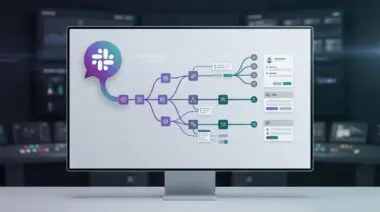
That is precisely where n8n-based RAG architectures gain advantage. The API-first orchestration layer lets a retrieval agent move from answer generation to downstream execution: a Slack query can trigger a vector search, rerank results, synthesize a cited response, and then create a Jira ticket or update a HubSpot record in the same workflow.
The same analysis reports a decisive shift in vendor-neutral integration standards. The Linux Foundation’s Agentic AI Foundation now governs MCP, with more than 10,000 published servers and 97 million monthly SDK downloads, anchoring agent interoperability across tools and data sources.
That standard matters for RAG buyers because knowledge agents rarely live in isolation. They must authenticate against cloud repositories, respect role-based access controls, and write durable audit logs — requirements that separate enterprise orchestration from consumer-style chatbot wrappers.
Cost context reinforces the operational risk of choosing poorly. Model API costs range between $0.003 and $0.10 per 1K tokens, with hidden overages from retries, debugging, governance infrastructure, and context-window accumulation.
Prompt caching can reduce repeated-context cost by up to 90 percent, but only if the architecture is designed to use it deliberately. For automation leaders, the takeaway is not simply to buy a RAG agent; it is to combine retrieval architecture with integration discipline so the knowledge agent becomes a node in a larger operational system rather than a standalone Q&A surface.
Regulated industries add another layer. Healthcare, finance, and legal deployments demand SOC 2, ISO 27001, GDPR, HIPAA, role-based access control, and human-in-the-loop approvals before consequential actions fire.
The competitive tension is equally clear: horizontal platforms can handle broad orchestration, but specialized RAG agencies win where domain depth, citation precision, and regulatory evidence are non-negotiable.
Selecting an Automation Partner That Holds Up
The 2026 RAG agency race will be won by providers that can prove retrieval accuracy under real document churn and connect cited answers to downstream actions. For teams building AI automation systems where retrieval must feed execution, Andres SEO Expert’s programmatic SEO AI automation service applies that same integration-first discipline to search-driven pipelines — contact us.
Frequently Asked Questions
Why do generic knowledge chatbots collapse at scale?
Generic knowledge chatbots collapse because they rely on dumping a modest PDF or document into a context window, which is insufficient for live enterprise knowledge bases with thousands of frequently updated documents. This architectural limitation creates the need for specialized AI agencies that build agentic retrieval-augmented generation systems with verifiable retrieval and execution capabilities.
What are the six technical pillars that separate specialized RAG agencies?
The six pillars are vector database selection, chunking strategy, source citation, data freshness pipelines, demonstrated scale, and native ecosystem integration. Agencies must explain their indexing methodology and ranking algorithms, define specific vector stores, and append citation metadata to ensure traceability.
Why does integration depth matter for RAG outcomes?
Integration depth matters because most enterprise AI deployments operate at Level 2 or Level 3 of autonomy, where orchestration quality, guardrails, and tool execution are critical. n8n-based RAG architectures enable retrieval agents to move from answer generation to downstream execution, such as creating Jira tickets or updating HubSpot records, making the knowledge agent a node in a larger operational system.
What is the role of the Linux Foundation’s Agentic AI Foundation and MCP in RAG systems?
The Linux Foundation’s Agentic AI Foundation now governs MCP, with over 10,000 published servers and 97 million monthly SDK downloads, anchoring agent interoperability. For RAG buyers, MCP standards ensure knowledge agents can authenticate against cloud repositories, respect role-based access controls, and write durable audit logs, which separates enterprise orchestration from consumer-style chatbot wrappers.
How do specialized RAG agencies handle data freshness and document churn?
Specialized RAG agencies build data freshness pipelines that re-index changing documents to keep retrieval accurate. They also demonstrate scale by proving retrieval accuracy under real document churn, using defined vector databases and chunking strategies to maintain verifiable citations and source traceability.
What should buyers look for when selecting a RAG automation partner?
Buyers should focus on vector database rationale, re-indexing pipelines for changing documents, hardcoded source citations, largest proven document volume, and the ability to trigger actions in tools like Notion, Slack, Jira, and Salesforce. The strongest operators articulate why specific vector stores fit the data structure and connect cited answers to downstream actions.