Key Takeaways
- One enhanced EventBridge bus now spans an entire AWS organization through Resource Access Manager, eliminating cross-account rules and bus-to-bus routing chains.
- EventGroupId ordering, content-based deduplication, JSONata transforms, and a unified Subscriber resource replace hand-built SQS and Lambda coordination patterns.
- Pricing moves to per-event ingest and delivery, removing compounding routing charges and sharpening the comparison with Azure Event Grid.
Table of Contents
A Single Bus Backbone Replaces Cross-Account Event Routing
Enterprise AWS teams no longer need to chain together multiple custom event buses to keep event-driven applications running across accounts.
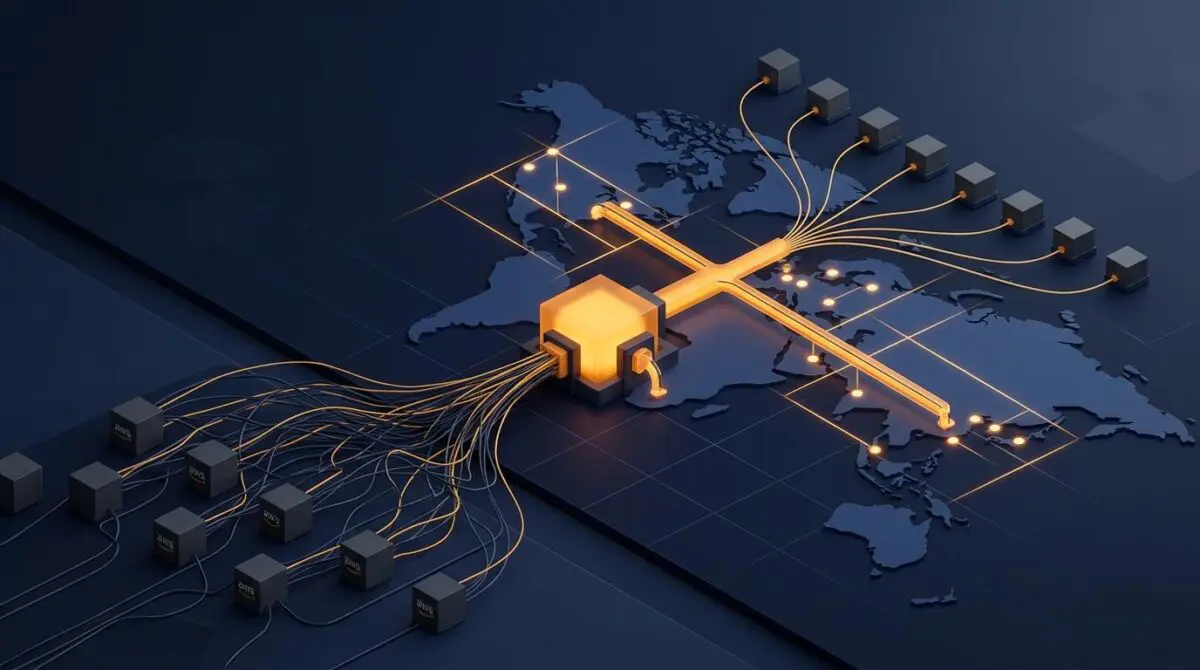
AWS News Blog reports that Amazon Web Services has released an enhanced custom event bus for Amazon EventBridge that consolidates cross-account routing, ordering, and subscriptions into a single organization-wide backbone.
The rollout spans 14 commercial AWS regions across the US East, US West, Europe, and Asia Pacific.
Platform teams can now share one bus across an entire AWS organization without configuring cross-account rules or bus-to-bus routing, as detailed in the AWS News Blog.
Ordering, Subscribers, and Deduplication: The Technical Reset
The enhanced bus removes hard-won workarounds that platform teams previously assembled from separate rules, queues, and retry configurations.
Organization-Wide Sharing
A single bus can serve every team through AWS Resource Access Manager without separate cross-account permissions or bus-to-bus routing.
The default quota sits at 10,000 subscribers per bus, with higher limits available on request.
Event Ordering Without the Queue Layer
Publishers can attach an EventGroupId to events that must arrive in sequence.
EventBridge delivers events sharing that ID in order only to subscribers that opt into ordered delivery, while other consumers remain fully asynchronous.
For targets like AWS Lambda, synchronous invocation confirms successful processing before acknowledging the event.
That removes the common need to place Amazon Simple Queue Service between EventBridge and Lambda for reliability.
A Single Subscriber Resource Consolidates Delivery
The Subscriber resource merges event filtering, target configuration, retry policies, and dead-letter destinations into one manageable unit.
It also supports variable start times, which simplifies onboarding new consumers, replaying events, and recovering from application errors.
Deduplication and Advanced Payload Handling
Publishers can enable content-based deduplication so EventBridge detects and drops retries of the same event directly from the payload.
Matches within five minutes collapse to exactly-once delivery semantics rather than EventBridge’s usual at-least-once model.
Subscribers can also reshape events with JSONata before delivery and consume Apache Avro or Protocol Buffers payloads as JSON for fine-grained filtering.
Pricing Shifts From Per-Event to Throughput
- Publishers pay for events ingested.
- Subscribers pay for events delivered.
- Cross-account and bus-to-bus routing charges no longer compound in multi-bus architectures.
Existing EventBridge custom buses remain available under the label ‘Custom event bus – classic’ and require no migration.
Why This Sharpens the Azure Event Grid Comparison
Microsoft Learn‘s official AWS-professional messaging mapping places Amazon EventBridge alongside Azure Event Grid as discrete event routing services.
The comparison directs buyers to evaluate supported sources, targets, filtering, transformation, retry, dead-lettering, and delivery models.
Those are precisely the dimensions the enhanced custom event bus changes in AWS’s favor.
The same mapping also splits Amazon SNS across Azure Service Bus topics, Event Grid, or communications providers depending on the use case.
Amazon Kinesis Data Streams maps to Azure Event Hubs for high-throughput stream ingestion.
That context matters because the enhanced bus collapses several previous SQS and Lambda coordination patterns into one resource.
For enterprise integration buyers, the shift reduces architectural surface area and makes cost allocation more transparent.
The published comparison does not yet include this specific enhanced bus, but its evaluation framework helps business leaders see what changed.
The competitive pressure is not simply feature parity; it is the removal of operational and economic penalties that previously made multi-account EventBridge designs difficult.
Platform teams gain a governance and cost model that aligns publisher and subscriber incentives more directly.
The Serverless Event Backbone Gains a Governance Layer
The enhanced custom event bus turns event routing from a per-team plumbing problem into a centrally governed platform primitive. For teams building event-driven content and data pipelines that need to scale without operational sprawl, Andres SEO Expert’s programmatic SEO automation applies the same consolidation logic to large-scale publishing workloads — talk to the team here.
Frequently Asked Questions
What is the enhanced custom event bus in Amazon EventBridge?
The enhanced custom event bus is an organization-wide EventBridge backbone that consolidates cross-account routing, event ordering, subscriber management, and deduplication into a single bus. It is available in 14 commercial AWS regions and removes the need for bus-to-bus routing and separate cross-account rules.
How does the enhanced custom event bus simplify cross-account event routing?
Platform teams can share one bus across an entire AWS organization using AWS Resource Access Manager, without configuring cross-account rules or bus-to-bus routing. This replaces the previous practice of chaining multiple custom event buses to support event-driven applications across accounts.
How does event ordering work on the enhanced EventBridge custom event bus?
Publishers attach an EventGroupId to events that must arrive in sequence. EventBridge delivers events sharing that ID in order only to subscribers that opt into ordered delivery, while other consumers remain asynchronous. For AWS Lambda targets, synchronous invocation confirms successful processing before the event is acknowledged, removing the need to place Amazon SQS between EventBridge and Lambda for reliability.
What is the EventBridge Subscriber resource and what does it replace?
The Subscriber resource merges event filtering, target configuration, retry policies, and dead-letter destinations into one manageable unit. It supports variable start times, which simplifies onboarding new consumers, replaying events, and recovering from application errors. This consolidates work that was previously spread across separate rules, queues, and retry configurations.
How does deduplication work on the enhanced custom event bus?
Publishers can enable content-based deduplication so EventBridge detects and drops retries of the same event directly from the payload. Matches within five minutes collapse to exactly-once delivery semantics rather than EventBridge usual at-least-once model. Subscribers can also reshape events with JSONata before delivery and consume Apache Avro or Protocol Buffers payloads as JSON for fine-grained filtering.
How does pricing change for the enhanced EventBridge custom event bus?
Pricing shifts from per-event to throughput. Publishers pay for events ingested, subscribers pay for events delivered, and cross-account and bus-to-bus routing charges no longer compound in multi-bus architectures. Existing EventBridge custom buses remain available as Custom event bus classic and require no migration.
Does the enhanced custom event bus replace Azure Event Grid or existing EventBridge custom buses?
No. Microsoft Learn official AWS-professional messaging mapping still places Amazon EventBridge alongside Azure Event Grid as discrete event routing services. The enhanced bus sharpens that comparison by reducing architectural surface area and making cost allocation more transparent. Existing EventBridge custom buses remain available under the label Custom event bus classic and require no migration.