Executive Summary
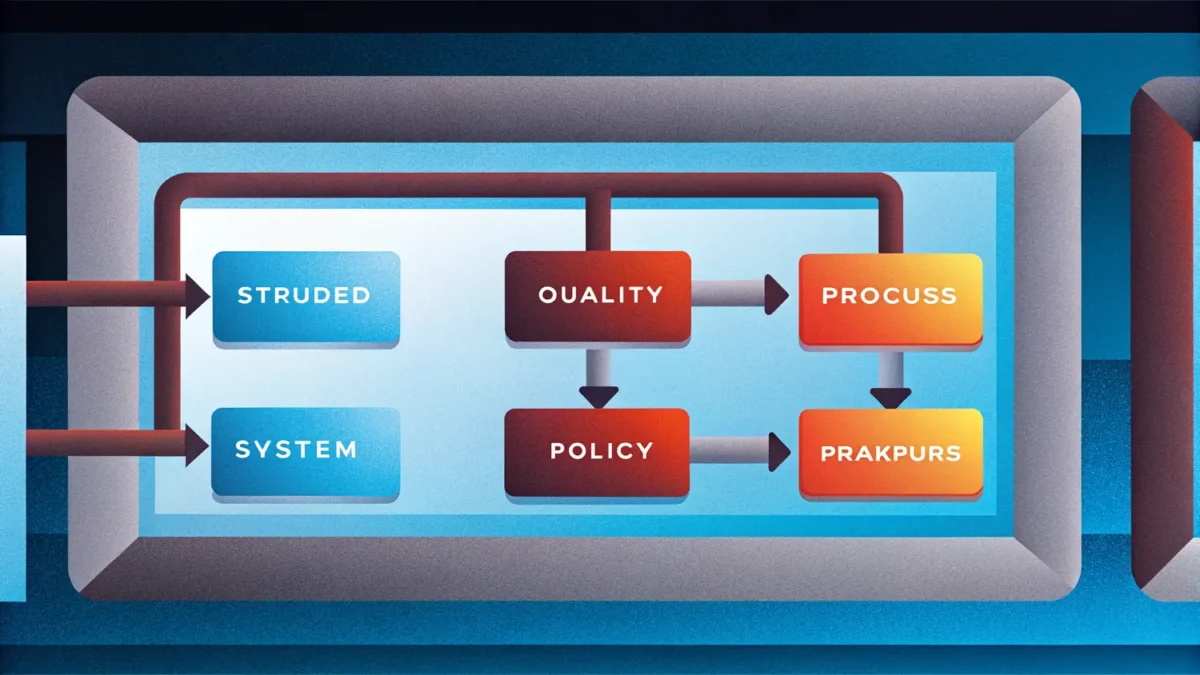
- Definition: A Quality Management System (QMS) is a formalized framework of policies, processes, and procedures for planning and executing the core business areas of an organization to ensure product/service quality and continuous improvement.
- Strategic Value: A robust QMS reduces operational variability, minimizes defects, and enhances customer satisfaction, directly impacting market competitiveness and regulatory compliance.
- Implementation: Effective QMS deployment requires top-down commitment, cross-functional integration, and adherence to standards like ISO 9001, leveraging data-driven metrics for ongoing optimization.
What is Quality Management System (QMS)?
A Quality Management System (QMS) is a structured system of documented policies, processes, and responsibilities for achieving quality objectives and policies. It aligns an organization’s operations with customer and regulatory requirements.
QMS frameworks, such as ISO 9001, provide a systematic approach to managing quality across all business functions. They emphasize continuous improvement, risk-based thinking, and process efficiency.
Modern QMS integrates with enterprise systems like ERP and PLM, enabling real-time quality data capture and analytics. This integration supports proactive quality management rather than reactive defect detection.
The Real-World Analogy
Think of a QMS as the central nervous system of a manufacturing plant. Just as the nervous system coordinates sensory input and motor output to maintain homeostasis, a QMS coordinates quality data, processes, and corrective actions to maintain product consistency.
Without a QMS, quality efforts are like a reflex arc—reactive and localized. With a QMS, the organization achieves a centralized, intelligent response to quality deviations, ensuring long-term stability and adaptability.
How Quality Management System (QMS) Drives Strategic Growth & Market Competitiveness?
A QMS directly reduces cost of quality by minimizing internal and external failures. Lower defect rates translate to reduced rework, warranty claims, and customer churn, improving profit margins.
Compliance with QMS standards like ISO 9001 opens doors to global markets and government contracts. It serves as a competitive differentiator, signaling reliability to customers and partners.
Data-driven QMS enables predictive quality analytics, identifying trends before they become systemic issues. This proactive stance accelerates time-to-market for new products while maintaining quality benchmarks.
Strategic Implementation & Best Practices
- Top-Down Commitment: Secure executive sponsorship to allocate resources and enforce quality policies across all departments. Leadership must model quality-first behavior.
- Process Mapping & Documentation: Document core processes using flowcharts and standard operating procedures (SOPs). Ensure version control and easy accessibility for all employees.
- Risk-Based Thinking: Integrate risk assessment (e.g., FMEA) into QMS processes to prioritize improvements. Use data to identify high-impact areas for corrective actions.
- Continuous Training: Implement regular training programs on QMS procedures and quality tools (e.g., Six Sigma, PDCA). Track competency through assessments.
- Internal Audits & Reviews: Conduct periodic internal audits to verify compliance and effectiveness. Use management reviews to drive strategic quality improvements.
Common Pitfalls & Strategic Mistakes
Treating QMS as a documentation exercise rather than a living system leads to bureaucratic overhead without quality gains. Avoid creating excessive paperwork that stifles agility.
Neglecting employee engagement results in poor adherence to procedures. Quality must be everyone’s responsibility, not just the quality department’s.
Failing to leverage data analytics from QMS outputs misses opportunities for predictive insights. Without data-driven decision-making, QMS becomes a historical record rather than a strategic tool.
Conclusion
A Quality Management System is a foundational element for any organization seeking operational excellence and market leadership. When implemented strategically, it transforms quality from a cost center into a competitive advantage.