



Key Takeaways
- Capcom’s reference path tracer validated against DCC tools enables game-optimized path tracing for direct and indirect lighting.
- Integration with NVIDIA DLSS Ray Reconstruction and RTX Kit delivers stable denoising, reducing overhead for real-time performance.
- The shift to path tracing transforms the content pipeline, requiring new asset production workflows that ultimately enhance realism and spatial coherence.
How Capcom Engineered a Path Tracing Revolution Without Compromising Performance
Capcom’s RE ENGINE team has successfully integrated full path tracing into two simultaneous titles, PRAGMATA and Resident Evil Requiem, delivering cinematic lighting quality in real-time gameplay. The breakthrough, achieved over two years, leverages NVIDIA RTX Kit and DLSS Ray Reconstruction to maintain high frame rates without sacrificing visual fidelity. This move not only eliminates the visual gap between cutscenes and gameplay but also sets a new benchmark for performance in immersive environments.
Table of Contents
Technical Breakdown of the Path Tracing Implementation
Capcom’s journey from ray tracing to full path tracing began with building a reference path tracer that was carefully validated against industry-standard DCC path tracers. This ensured that every bounce of light matched offline renderers, a feat that required two years of rigorous testing.
The game-oriented path tracer was then optimized for real-time performance using NVIDIA DLSS Ray Reconstruction, which provides faster and more stable denoising than traditional hand-written shaders. The team also implemented a custom ReSTIR GI algorithm based on published research rather than the out-of-the-box RTX Kit version, giving them finer control over noise reduction in complex indoor scenes.
Direct Lighting and Shadow Improvements
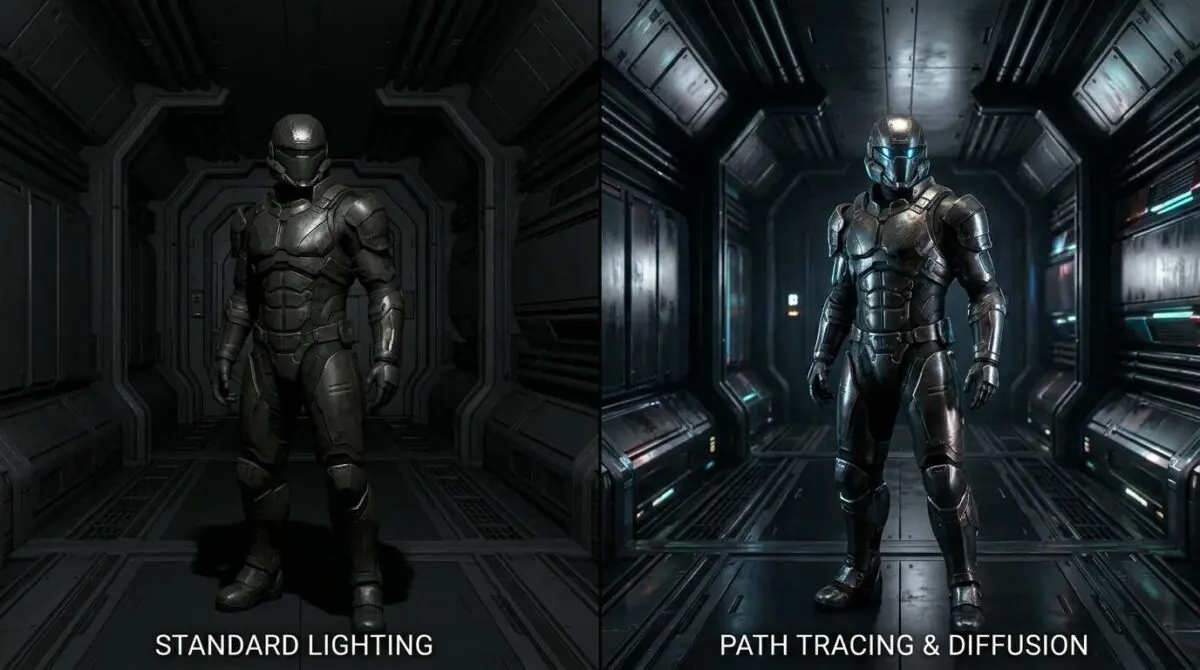
Unlike previous ray tracing implementations that only affected indirect lighting, path tracing now handles direct lighting as well. This eliminates the artifacts of shadow maps and creates more dimensional character lighting. As noted in NVIDIA’s developer blog, the RE ENGINE team reports that ‘the visual gap between gameplay and cutscenes has been greatly reduced’ because path tracing operates continuously.
Optimization for Alpha Geometry and Strand Hair
To avoid expensive texture lookups at every ray hit, the team developed ScreenSpaceAlphaTest, a lightweight method that compares ray-hit positions against screen-space depth. This allows path tracing to produce soft shadows on alpha geometry without the overhead of traditional alpha test shaders.
Strand hair rendering also benefited significantly. Real-time light transmission through hair strands in both titles contributes to a sense of volume and material quality, and the teams overcame performance hurdles related to hair count and joint control by sharing knowledge across the RE ENGINE and game teams.
Strategic Analysis: Performance Implications Across the Industry
Capcom’s achievement sets a new standard for real-time rendering performance, but its impact extends beyond visual fidelity. The ability to run full path tracing on current hardware, as demonstrated in PRAGMATA and Resident Evil Requiem, proves that the technology is ready for mainstream adoption when paired with efficient denoising and frame-generation techniques.
A recent analysis from Stepico, titled ‘What Game Has the Best Graphics?’ (published July 6, 2026), highlights path tracing as a key differentiator in top-tier graphics. Games built on RE ENGINE now occupy a leadership position in the market, putting pressure on other studios to adopt similar methods. This trend is likely to accelerate demand for high-performance GPUs, as path tracing requires substantial compute resources even with DLSS optimizations.
From a performance perspective, the integration of NVIDIA RTX Kit and DLSS 4 is critical. The use of multi-frame generation and ray reconstruction allows path tracing to run at playable frame rates on high-end hardware, but the technology also raises the baseline for what is considered acceptable performance. Developers must now balance the visual benefits of path tracing with the need to maintain broad hardware compatibility.
Capcom’s approach to content pipeline evolution is equally instructive. By reworking asset production and quality verification workflows, the studio ensures that path tracing does not become a performance bottleneck downstream. This holistic strategy—where rendering technology and production processes advance together—is a model for the industry.
Conclusion: The Future of Real-Time Rendering Performance
Capcom’s path tracing implementation marks a turning point in real-time rendering. It proves that cinematic lighting can be achieved without sacrificing gameplay performance, provided the right combination of hardware acceleration, denoising algorithms, and pipeline optimization is used. As more studios follow suit, the gap between offline and real-time rendering will continue to shrink.
Staying ahead in the rapidly shifting landscape of Performance requires precision. To future-proof your digital strategy and scale effortlessly, you need a foundation built on precision. Optimize your site with advanced speed engineering, secure your infrastructure in high-performance hosting environments, and streamline your entire workflow through autonomous AI pipelines. If you are ready to elevate your systems, Connect with Andres at Andres SEO Expert to build your ultimate architecture.
Frequently Asked Questions
What is path tracing and how does it differ from standard ray tracing?
Path tracing simulates the full light path from the camera, handling both direct and indirect lighting, while traditional ray tracing in games often only affects indirect lighting. This eliminates artifacts like shadow map aliasing and creates more dimensional character lighting, greatly reducing the visual gap between cutscenes and gameplay.
How did Capcom optimize path tracing for real-time performance?
Capcom used NVIDIA DLSS Ray Reconstruction for faster, more stable denoising, implemented a custom ReSTIR GI algorithm for better noise reduction in complex indoor scenes, and developed ScreenSpaceAlphaTest to handle alpha geometry and strand hair efficiently without expensive texture lookups.
What role does NVIDIA DLSS play in Capcom’s path tracing implementation?
DLSS Ray Reconstruction provides faster and more stable denoising compared to hand-written shaders. Additionally, DLSS 4’s multi-frame generation helps achieve playable frame rates on high-end hardware by generating intermediate frames, making full path tracing feasible in real-time gameplay.
How does Capcom’s path tracing affect hardware requirements?
Path tracing requires substantial compute resources, even with DLSS optimizations. It raises the baseline for acceptable performance, putting pressure on GPU demand. However, the combination of DLSS and frame generation allows it to run at playable frame rates on high-end GPUs, as demonstrated in PRAGMATA and Resident Evil Requiem.
What are the key technical innovations in Capcom’s path tracing approach?
Key innovations include a custom ReSTIR GI algorithm for finer noise control, ScreenSpaceAlphaTest for efficient alpha geometry and strand hair rendering, and a validated reference path tracer matching offline renderers. The team also reworked asset production and quality verification workflows to avoid performance bottlenecks.
What are the industry implications of Capcom’s path tracing achievement?
Capcom’s success proves that full path tracing is ready for mainstream adoption with efficient denoising and frame generation. It sets a new benchmark for real-time rendering, pressures other studios to adopt similar methods, and is likely to accelerate demand for high-performance GPUs.