Key Takeaways
- Google launches app integrations in AI Mode for Search, supporting Instacart, Canva, and YouTube Music.
- This positions Google as a serious contender in the AI assistant ecosystem, amid ChatGPT’s declining market share to 46.4%.
- For automation professionals, this represents a new channel for workflow integration and data connectivity, linking search triggers to external actions.
Google Search Now Connects to Your Go-To Apps in AI Mode
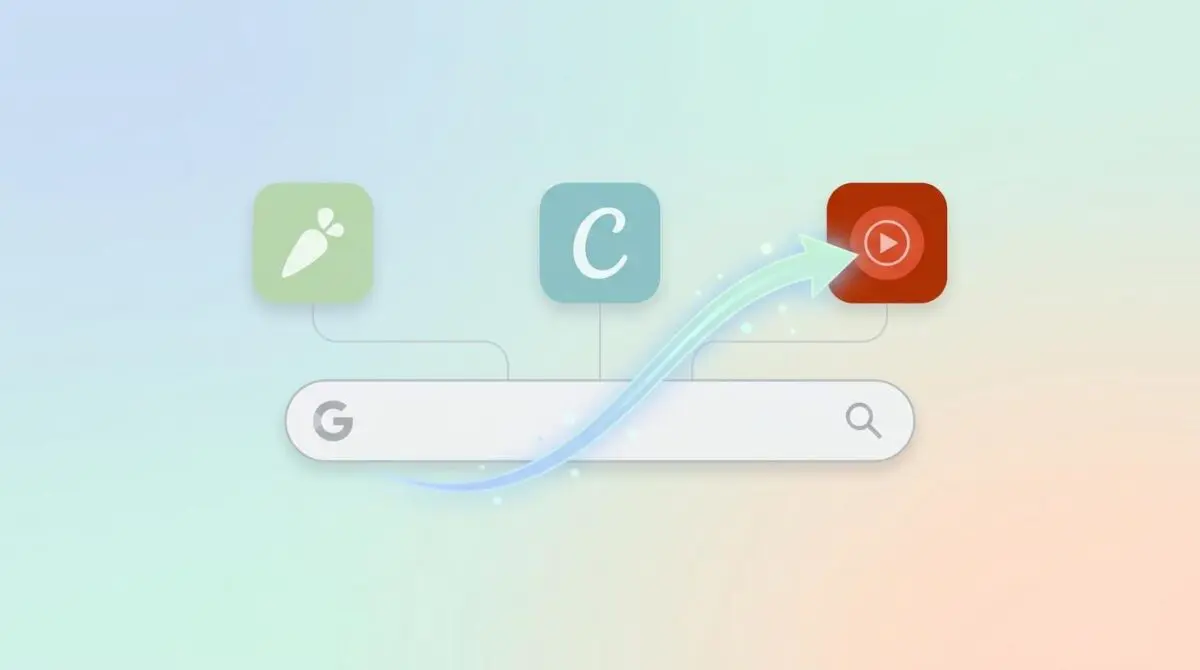
Google has flipped the switch on third-party app integrations inside AI Mode for Search. Starting July 16, 2026, U.S. users can link services like Instacart, Canva, and YouTube Music directly to their search results, enabling actions like adding groceries to a cart or saving a playlist without leaving the page. This marks a strategic expansion of Google’s AI footprint, turning Search from a discovery tool into a transactional hub.
Table of Contents
How the Integrations Work
According to the original announcement by Google Senior Product Manager Chips Mistry and Engineering Lead Biharck Araújo, the new feature allows users to securely link their accounts to AI Mode in Search. Once connected, users can perform tasks like adding ingredients to an Instacart cart, finding design templates in Canva, or curating playlists on YouTube Music, all within the search interface.
The integrations build on Google’s existing Personal Intelligence capabilities. By linking apps, Search can provide even more tailored responses based on the user’s connected data. For example, a user planning a barbecue could ask for a grocery list and automatically populate their Instacart cart.
Market Implications and Automation Opportunities
This move comes at a critical time in the AI assistant market. According to a Sensor Tower report covered by Tech Times, ChatGPT’s market share dipped below 50% for the first time in June 2026, settling at 46.4%. Meanwhile, Google’s Gemini and other assistants are gaining ground.
Google’s Search integration directly competes with OpenAI’s plugin ecosystem. As noted in a recent OpenAI blog post, ChatGPT now supports plugins connecting to Slack, Microsoft Teams, Google Drive, and more. Google’s strategy, however, leverages its massive search traffic to embed app actions at the point of intent, bypassing the need for a separate assistant interface.
For automation professionals, this development turns Search into a viable trigger for workflows. Imagine an automation that initiates a grocery reorder when a search for recipes triggers an Instacart integration, or a design workflow that starts when a user searches for flyer templates. The API-level connections behind these integrations are likely extensible for enterprise automation tools in the future.
Google’s announcement also underscores the importance of native integrations in AI ecosystems. As both Google and OpenAI race to connect with third-party services, the winner may be determined by the breadth and seamlessness of these links. For businesses relying on automation, evaluating which platforms offer the deepest connectivity is now paramount.
The Future of Search as an Automation Trigger
Google’s latest update blurs the line between search and action, making AI Mode a new node in the automation chain. With expansion planned, we can expect search queries to increasingly spawn external tasks, from ordering supplies to curating content. This is not just a convenience feature; it is a strategic pivot toward ambient automation.
The race between Google and OpenAI is heating up, and for automation specialists, the timing is perfect to experiment with these integrations as new building blocks. As the ecosystem matures, those who embed search-driven automation into their workflows will gain a competitive edge.
Staying ahead in the rapidly shifting landscape of Automations requires precision. To future-proof your digital strategy and scale effortlessly, you need a foundation built on precision. Optimize your site with advanced speed engineering, secure your infrastructure in high-performance hosting environments, and streamline your entire workflow through autonomous AI pipelines. If you are ready to elevate your systems, Connect with Andres at Andres SEO Expert to build your ultimate architecture.
Frequently Asked Questions
What is Google’s AI Mode in Search?
AI Mode is a new feature in Google Search that allows users to perform actions directly within search results by linking third-party apps like Instacart, Canva, and YouTube Music. It turns Search from a discovery tool into a transactional hub.
How do the third-party app integrations work?
Users securely link their accounts (e.g., Instacart, Canva, YouTube Music) to AI Mode. Once connected, they can perform tasks like adding groceries to a cart, finding design templates, or curating playlists without leaving the search page.
Which apps are initially supported?
The initial rollout supports three partners: Instacart, Canva, and YouTube Music. Google is working with additional partners and plans to launch with more apps soon.
How does this compare to OpenAI’s plugin ecosystem?
Google’s integration leverages its massive search traffic to embed app actions at the point of intent, bypassing the need for a separate assistant interface. OpenAI’s ChatGPT supports plugins for Slack, Microsoft Teams, Google Drive, etc. Both are competing to connect with third-party services.
What automation opportunities does this create?
Search can become a trigger for workflows, such as automatically reordering groceries when a recipe search initiates an Instacart integration, or starting a design workflow when searching for templates. The API-level connections may be extensible for enterprise automation tools.
Is AI Mode with app integrations available outside the US?
Currently, the feature is limited to U.S. users. Google plans to expand with more apps in the future, but no international rollout date has been announced.
How does this feature use Personal Intelligence?
The integrations build on Google’s Personal Intelligence capabilities, allowing Search to provide more tailored responses based on users’ connected app data. For example, a user planning a barbecue could ask for a grocery list and automatically populate their Instacart cart.